Explore the fundamental process of cellular respiration, where cells break down organic molecules like glucose to produce ATP, the energy currency of life. This explanation covers the key stages: glycolysis, pyruvate oxidation, the citric acid cycle, and oxidative phosphorylation, including the roles of redox reactions
Life is an energetic endeavor. From the microscopic movement of proteins to the macroscopic activities of a running athlete, every biological function requires a constant supply of energy. While we often think of energy in terms of food or sunlight, cells require a very specific, portable form of chemical energy to power their diverse metabolic pathways—the sum of all chemical reactions within an organism.
The Energy Currency: ATP
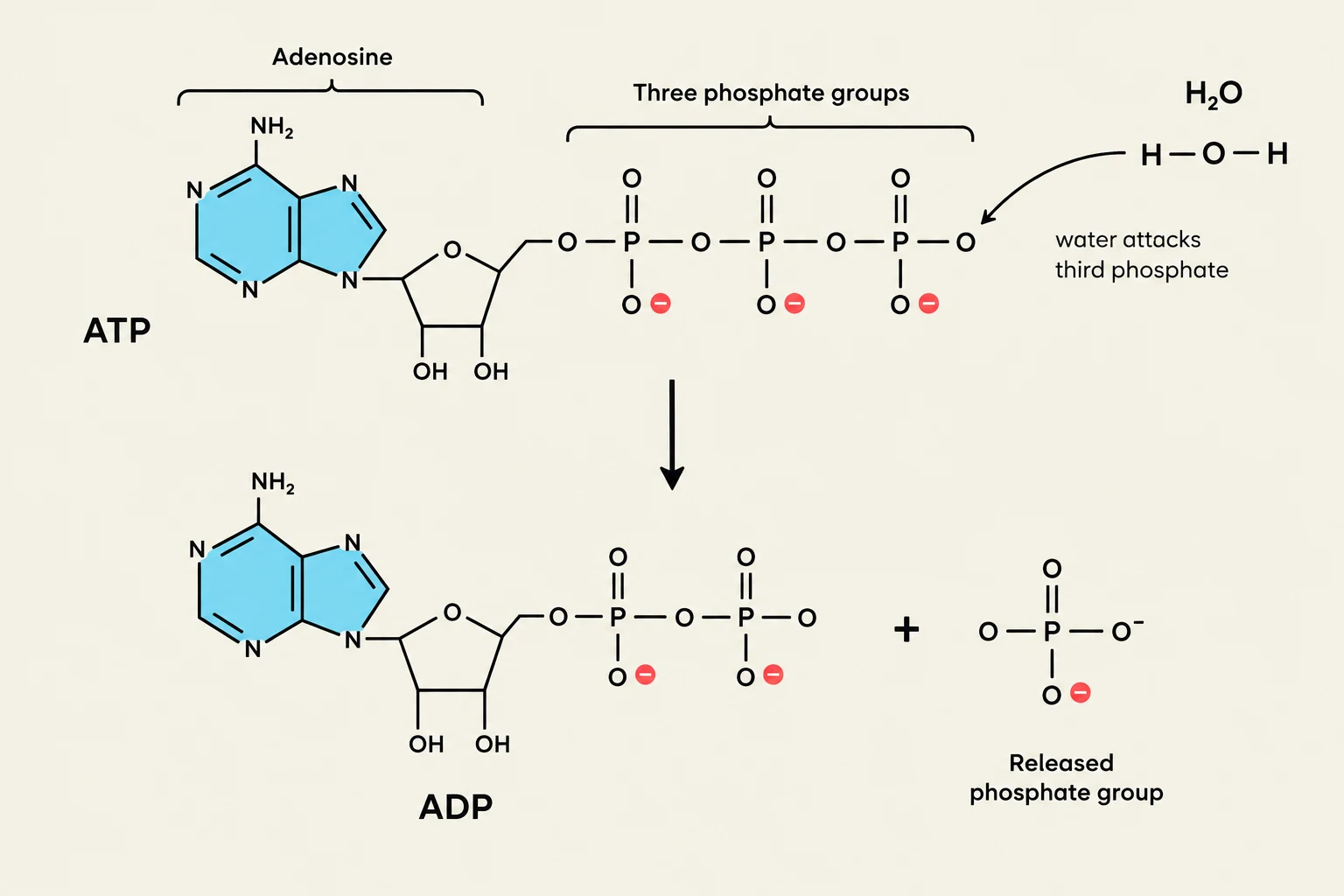
The diagram illustrates the hydrolysis of Adenosine Triphosphate (ATP) into Adenosine Diphosphate (ADP) and a released phosphate group, with water initiating the reaction.
To perform work, cells use a molecule called ATP (adenosine triphosphate). ATP is a type of nucleic acid that acts as the cell's "energy currency". Structurally, it consists of an adenosine molecule attached to three phosphate groups.
These phosphate groups are highly negatively charged. Because like charges repel each other, these three groups are "pushing" against one another, held together only by the chemical bonds between them. This creates a massive amount of potential energy. When the cell needs energy, it performs hydrolysis, adding a water molecule to break off the third phosphate group. This reaction converts ATP into ADP (adenosine diphosphate) and releases a burst of energy that the cell can use for tasks like active transport or mechanical movement.
The Big Picture: Cellular Respiration vs. Photosynthesis
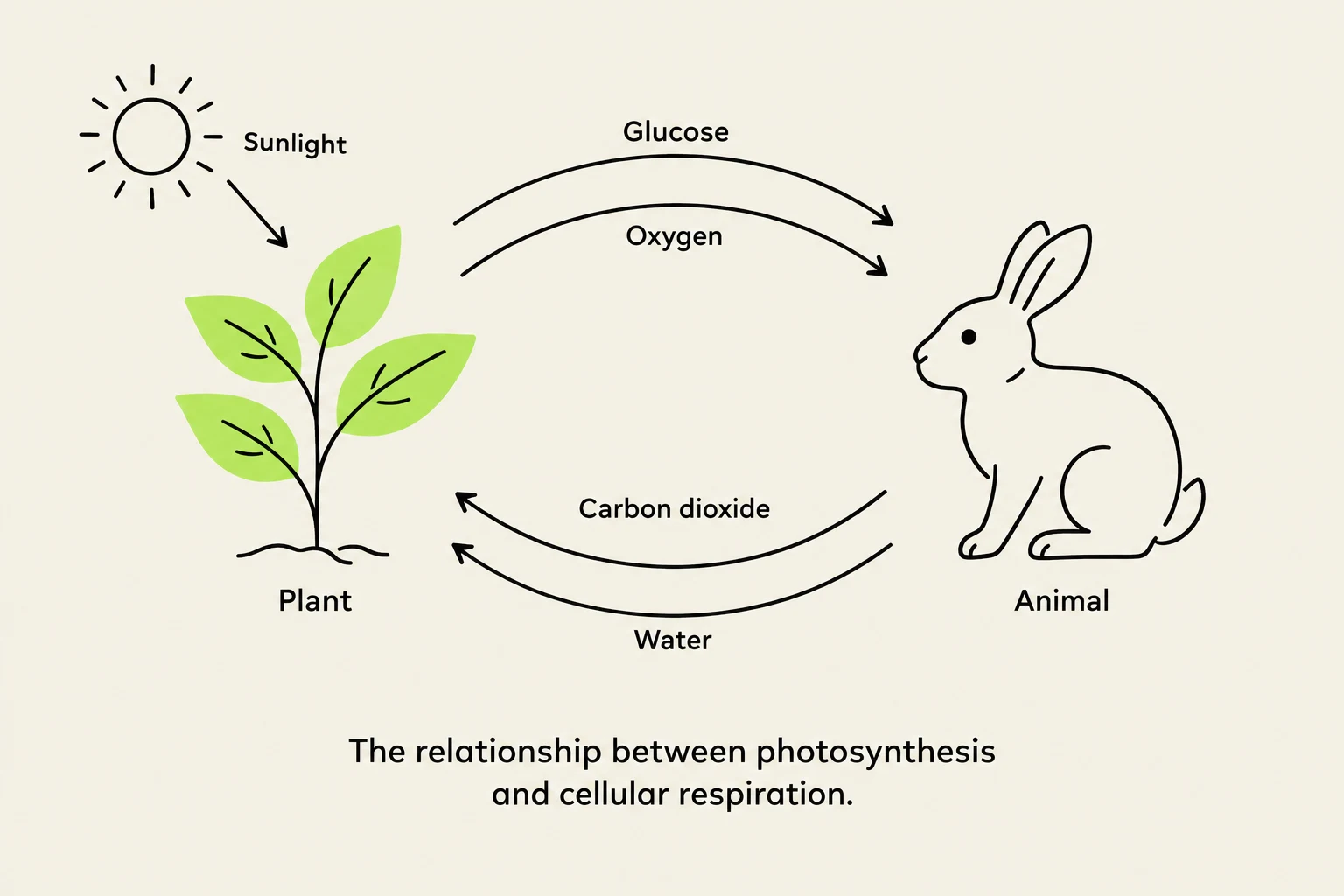
This diagram illustrates the relationship between photosynthesis in plants and cellular respiration in animals, showing the exchange of gases and energy.
The process of creating ATP from food is known as cellular respiration. In eukaryotic cells (such as those in animals, plants, fungi, and protists), aerobic cellular respiration is an exergonic process, meaning it releases energy by breaking down organic molecules.
The overall chemical equation for this process is:
C6H12O6+6O2⟶6CO2+6H2O+ATP+Heat
It is helpful to view cellular respiration in the context of the global energy cycle. While photosynthesis uses sunlight to build glucose and release oxygen, cellular respiration does the opposite: it consumes oxygen and glucose to produce ATP, releasing carbon dioxide and water as byproducts.
Exam Tip: A common misconception is that plants only perform photosynthesis while animals only perform respiration. In reality, plants perform both. They use photosynthesis to create glucose and cellular respiration to break that glucose down into usable ATP.
The Chemistry of Energy: Redox Reactions
How do cells actually "extract" the energy stored in a glucose molecule? The secret lies in redox reactions (reduction-oxidation reactions). Energy is harvested as electrons "fall" from organic fuels (like glucose) to oxygen.
This involves two simultaneous processes:
Oxidation: The loss of electrons or hydrogen atoms. During respiration, glucose is oxidized.
Reduction: The gain of electrons or hydrogen atoms.
To move these electrons from the fuel to the final destination, cells use electron carriers. These are coenzymes that act like shuttle buses for electrons. The two most important ones are NAD+ (which is reduced to NADH) and FAD (which is reduced to FADH2).
The Three Stages of Aerobic Respiration
In eukaryotic cells, the breakdown of glucose occurs in three distinct stages, moving from the fluid of the cell into the specialized compartments of the mitochondria.
1. Glycolysis
The first stage, glycolysis, occurs in the cytosol and is an anaerobic process, meaning it does not require oxygen. During this stage, one molecule of glucose is broken down into two molecules of a three-carbon compound called pyruvate. This process yields a net gain of 2 ATP and 2 NADH molecules.
2. Pyruvate Oxidation and the Citric Acid Cycle
If oxygen is present, the pyruvate molecules are transported via active transport into the mitochondrial matrix.
Pyruvate Oxidation: Each pyruvate is converted into acetyl CoA, a process that releases CO2 and produces NADH.
The Citric Acid Cycle (Krebs Cycle): The acetyl CoA enters this cycle, which completes the breakdown of the original glucose molecule into carbon dioxide. This stage produces a small amount of ATP (2 molecules) but, more importantly, generates a large number of electron carriers: 6 NADH and 2 FADH2.
3. Oxidative Phosphorylation
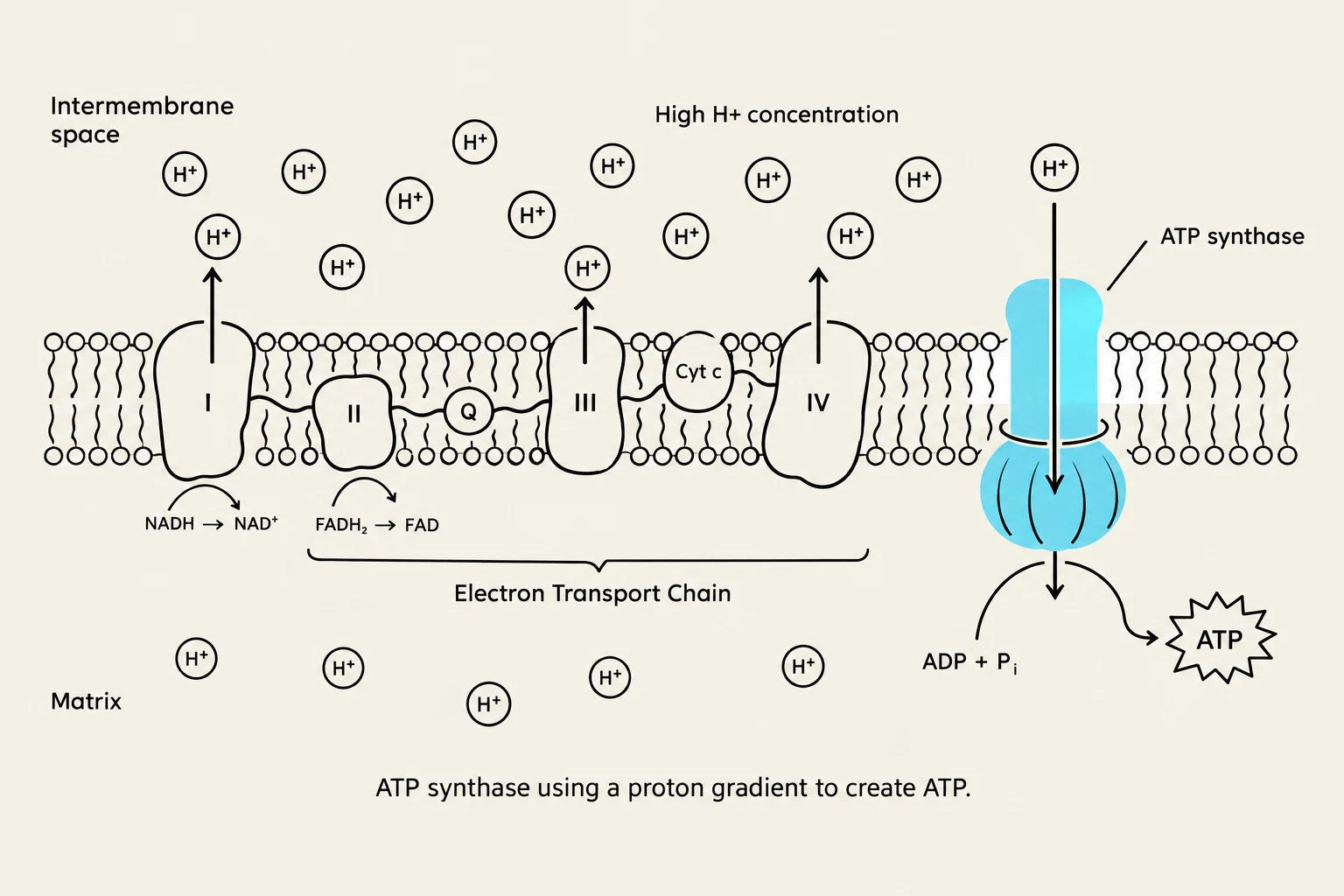
ATP synthase uses a proton gradient to create ATP.
This final stage occurs in the inner mitochondrial membrane and is where the "big payoff" happens. It consists of two tightly linked components:
The Electron Transport Chain (ETC): NADH and FADH2 deliver their high-energy electrons to a series of protein complexes embedded in the membrane. As these electrons move through the chain, they release energy used to pump protons ($H^+$) from the matrix into the intermembrane space. This creates a steep electrochemical gradient.
Chemiosmosis: The protons, wanting to move back to an area of lower concentration, flow back into the mitochondrial matrix through a special enzyme called ATP synthase. This flow of protons acts like water turning a turbine, providing the mechanical energy necessary for ATP synthase to phosphorylate ADP into ATP.
At the very end of the ETC, oxygen acts as the final electron acceptor. It picks up the "spent" electrons and combines with protons to form H2O (water).
Energy Yield and Anaerobic Alternatives
How much ATP do we actually get? While estimates vary depending on the efficiency of the proton gradient, the total net yield is typically between 30 and 38 ATP molecules per glucose molecule.
What happens if oxygen is unavailable? Under anaerobic conditions, cells cannot use the electron transport chain. To prevent the cell from running out of the NAD+ needed for glycolysis, cells perform fermentation.
Lactic Acid Fermentation: In human muscle cells, pyruvate is reduced to lactate (lactic acid) to recycle NAD+.
Alcohol Fermentation: In yeasts, pyruvate is converted into alcohol and CO2.
While fermentation is much less efficient than aerobic respiration, it allows cells to continue producing small amounts of ATP to survive when oxygen is scarce.
Critical Concept: The importance of this process cannot be overstated. Because the electron transport chain is so vital, certain toxins like cyanide can be lethal by blocking the ETC, effectively shutting down the cell's ability to produce ATP.
Keep reading for free.
Create an account to finish this reading and make it part of your study routine.