


All living organisms, from the tiny bacteria in our gut to the high-energy ruby-throated hummingbird, require a constant supply of energy to survive, grow, and reproduce. This energy is released through metabolic processes—chemical reactions that transform matter and energy within the cell. Specifically, cells utilize catabolic pathways to break down complex, energy-rich organic molecules like glucose into smaller pieces, releasing the stored chemical energy in the process. This released energy is captured and used to synthesize ATP (adenosine triphosphate), the primary energy currency of the cell.
Metabolic Regulation and ATP
The cell does not simply burn through all its fuel at once; it must maintain a steady state. This is achieved through feedback inhibition, a regulatory mechanism where the concentration of products dictates the speed of the reaction. For example, when levels of ATP, NADH, or citrate become high, they act as inhibitors for key enzymes such as phosphofructokinase. By slowing down these enzymes, the cell prevents the unnecessary breakdown of glucose when energy supplies are already sufficient.
Exam Tip: Remember that ATP is not just a product; it is a regulator. High ATP levels signal the cell to "slow down" catabolism, while low ATP levels signal the cell to "speed up" energy production.
Aerobic Respiration: The Efficient Pathway
When oxygen is available, cells undergo aerobic respiration, a highly efficient process that completely oxidizes glucose to produce a large yield of ATP. This process occurs in four distinct, interconnected stages:
1. Glycolysis
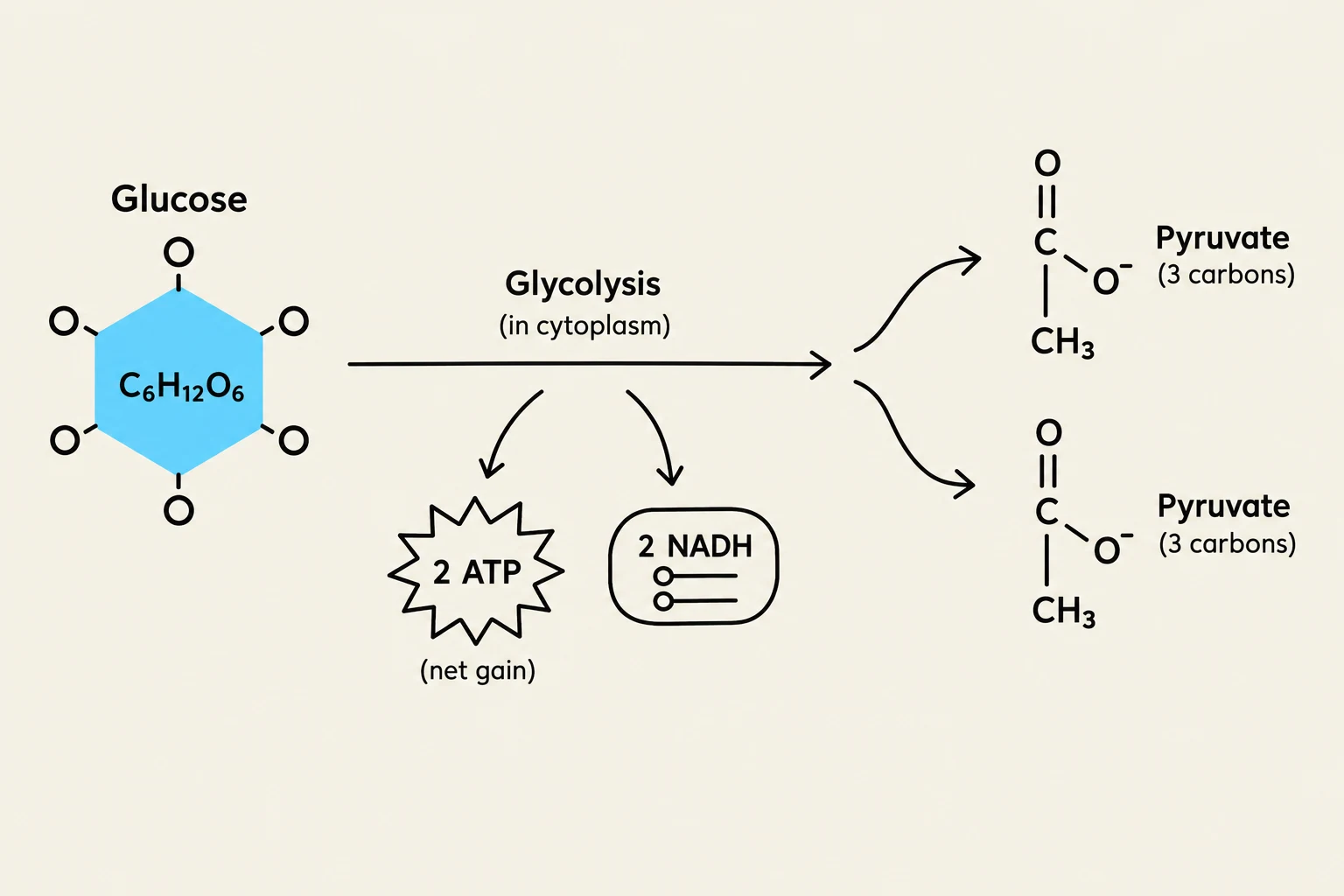
The first stage, glycolysis, occurs in the cytosol of the cell and does not require oxygen. During this process, one six-carbon glucose molecule is split into two three-carbon molecules called pyruvate. While glycolysis requires an initial investment of two ATP molecules, it produces four ATP molecules through substrate-level phosphorylation—a process where a phosphate group is transferred directly from a substrate to ADP. This results in a net gain of and the reduction of to .


Keep reading for free.
Create an account to finish this reading and make it part of your study routine.
Continue reading freeAlready have an account? Log in
Updated