Cellular Respiration and Fermentation: Harvesting Energy
Explores cellular respiration and fermentation as catabolic pathways that release energy from organic molecules to produce ATP. Covers redox reactions, aerobic and anaerobic respiration, glycolysis, the citric acid cycle, oxidative phosphorylation, and fermentation types.
Every living cell requires a constant supply of energy to perform work, from moving muscles to synthesizing new molecules. This energy is primarily stored in a molecule called ATP (adenosine triphosphate). To produce this ATP, cells must break down complex organic molecules—such as carbohydrates, fats, and proteins—through specialized metabolic pathways. These pathways are known as catabolic pathways, which release stored energy by breaking down large molecules into smaller, simpler ones.
The Role of Redox Reactions and Electron Transfer
At the heart of catabolism is the process of oxidation of organic fuels. When a cell breaks down a molecule like glucose, it isn't just breaking chemical bonds; it is performing a series of chemical reactions that involve the transfer of electrons. These are called oxidation-reduction reactions, or redox reactions.
In a redox reaction:
Oxidation occurs when a substance loses electrons.
Reduction occurs when a substance gains electrons.
During cellular respiration, the organic fuel (such as glucose) is oxidized, while oxygen (O2) is reduced to form water (H2O). The substance that donates electrons is the reducing agent, and the substance that accepts them is the oxidizing agent.
Exam Tip: Remember that "OIL RIG" is a common mnemonic: Oxidation Is Loss (of electrons), Reduction Is Gain (of electrons).
This diagram illustrates the redox reaction of methane combustion, showing methane (CH4) reacting with oxygen (O2) to produce carbon dioxide (CO2) and water (H2O). It explains that methane is oxidized (loses electrons) and acts as the reducing agent, while oxygen is reduced (gains electrons) and acts as the oxidizing agent.
Cellular Respiration: Aerobic and Anaerobic Pathways
Cellular respiration is a broad term used to describe the processes that harvest energy from organic molecules. It is generally divided into two main types based on the presence of oxygen:
Aerobic Respiration: This process consumes organic molecules and O2 to yield a high amount of ATP. It is the most efficient way for cells to produce energy.
Anaerobic Respiration: This is similar to aerobic respiration but uses compounds other than O2 as the final electron acceptor.
To understand how these work, we can look at the chemical equation for the aerobic respiration of glucose:
C6H12O6+6O2→6CO2+6H2O+Energy (ATP + heat)
The Three Stages of Aerobic Respiration
Aerobic respiration occurs in a series of steps to ensure energy is released in a controlled, manageable way rather than one explosive reaction.
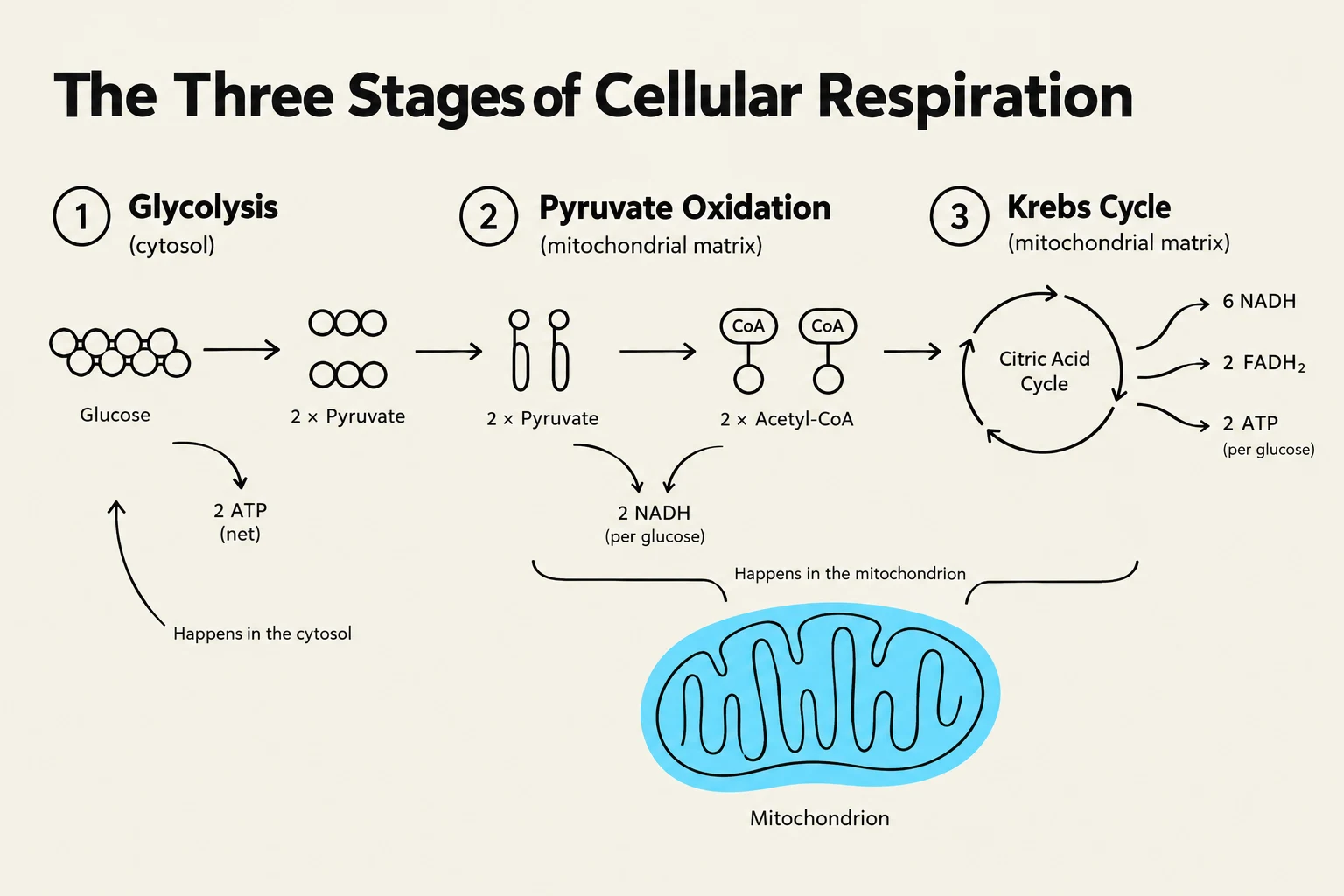
Stage 1: Glycolysis
Occurring in the cytosol, glycolysis ("sugar splitting") breaks down one glucose molecule into two molecules of pyruvate. This process consists of an energy investment phase and an energy payoff phase. Importantly, glycolysis does not require oxygen and can occur in both aerobic and anaerobic conditions.
Stage 2: The Citric Acid Cycle
If oxygen is present, pyruvate enters the mitochondrion and is converted into Acetyl CoA. This molecule then enters the citric acid cycle (also known as the Krebs cycle). The cycle completes the breakdown of the original glucose molecule, releasing CO2 and generating electron carriers like NADH and FADH2.
Stage 3: Oxidative Phosphorylation
This is the "payoff" stage, accounting for nearly 90% of the ATP generated. It involves two interconnected processes: the electron transport chain and chemiosmosis. Electrons from NADH and FADH2 are passed down a chain of proteins in the inner mitochondrial membrane. As electrons move down the chain, they release energy used to pump $H^+$ ions across the membrane, creating a proton gradient. This gradient then drives the synthesis of ATP through a protein called ATP synthase.
Diagram illustrating the three main stages of cellular respiration: Glycolysis, Pyruvate Oxidation, and the Krebs Cycle, showing the inputs, outputs, and locations of each process.
Fermentation: Energy Production Without Oxygen
When oxygen is unavailable, the electron transport chain cannot function. In these instances, cells must rely on fermentation to produce ATP.
Fermentation is not a complete breakdown of glucose; rather, it is a partial degradation. It consists of glycolysis followed by reactions that regenerate NAD+. Without this regeneration of NAD+, glycolysis would stop, and the cell would be unable to produce any ATP at all.
There are two common types of fermentation:
Alcohol Fermentation: Pyruvate is converted into ethanol and CO2. This is used by yeast in baking and brewing.
Lactic Acid Fermentation: Pyruvate is reduced to form lactate. This occurs in some bacteria (used for yogurt/cheese) and in human muscle cells when oxygen levels are low.
Comparison Table: Energy Yield
Process
Final Electron Acceptor
ATP Yield (per Glucose)
Aerobic Respiration
Oxygen (O2)
~30-32 ATP
Fermentation
Organic molecule (e.g., Pyruvate)
2 ATP
Metabolic Intersections and Regulation
Cellular respiration does not exist in a vacuum. Glycolysis and the citric acid cycle serve as major intersections for many other metabolic pathways. For example, proteins can be broken down into amino acids that enter the cycle, and fats can be converted into intermediates for energy production.
To prevent wasting resources, cells use feedback inhibition to regulate these pathways. A key regulatory enzyme is phosphofructokinase. If ATP levels are high, ATP acts as an inhibitor to slow down glycolysis; if ATP levels drop (and AMP levels rise), the process is stimulated to speed up production.
This diagram illustrates how proteins, carbohydrates, and fats are metabolized into Acetyl-CoA, which then enters the citric acid cycle and electron transport chain to produce ATP, the cellular energy currency.
Keep reading for free.
Create an account to finish this reading and make it part of your study routine.