The eukaryotic cell is a complex, highly organized unit of life, enclosed by a lipid bilayer membrane. Within this membrane, the cell is divided into specialized compartments known as organelles, which work together to maintain homeostasis, produce energy, and manage the life cycle of proteins. Understanding how these subcellular structures interact—specifically how proteins are synthesized, modified, and eventually destroyed—is fundamental to cell biology.
Subcellular Structures and the Nucleus
The cell is composed of the cytosol and various organelles. One of the most critical structures is the nucleus, which houses the cell's genetic material. The nucleus is enclosed by a double membrane called the nuclear envelope, which is interrupted by nuclear pores that mediate the translocation of molecules.
Inside the nucleus, DNA is organized into chromatin, a complex of DNA and proteins (histones and non-histone proteins). Chromatin exists in two primary forms:
Euchromatin: Loosely arranged and transcriptionally active.
Heterochromatin: Highly condensed and transcriptionally inactive.
The nucleolus is a prominent, non-membrane-bound inclusion within the nucleus that serves as the site for rRNA synthesis and the initial assembly of ribosomes.
The Secretory Pathway
Proteins are not all treated equally by the cell. Their destination is determined by specific signal sequences. The secretory pathway is the route taken by proteins destined for secretion from the cell, insertion into the plasma membrane, or delivery to specific organelles like lysosomes.
Synthesis in the Rough Endoplasmic Reticulum (rER)
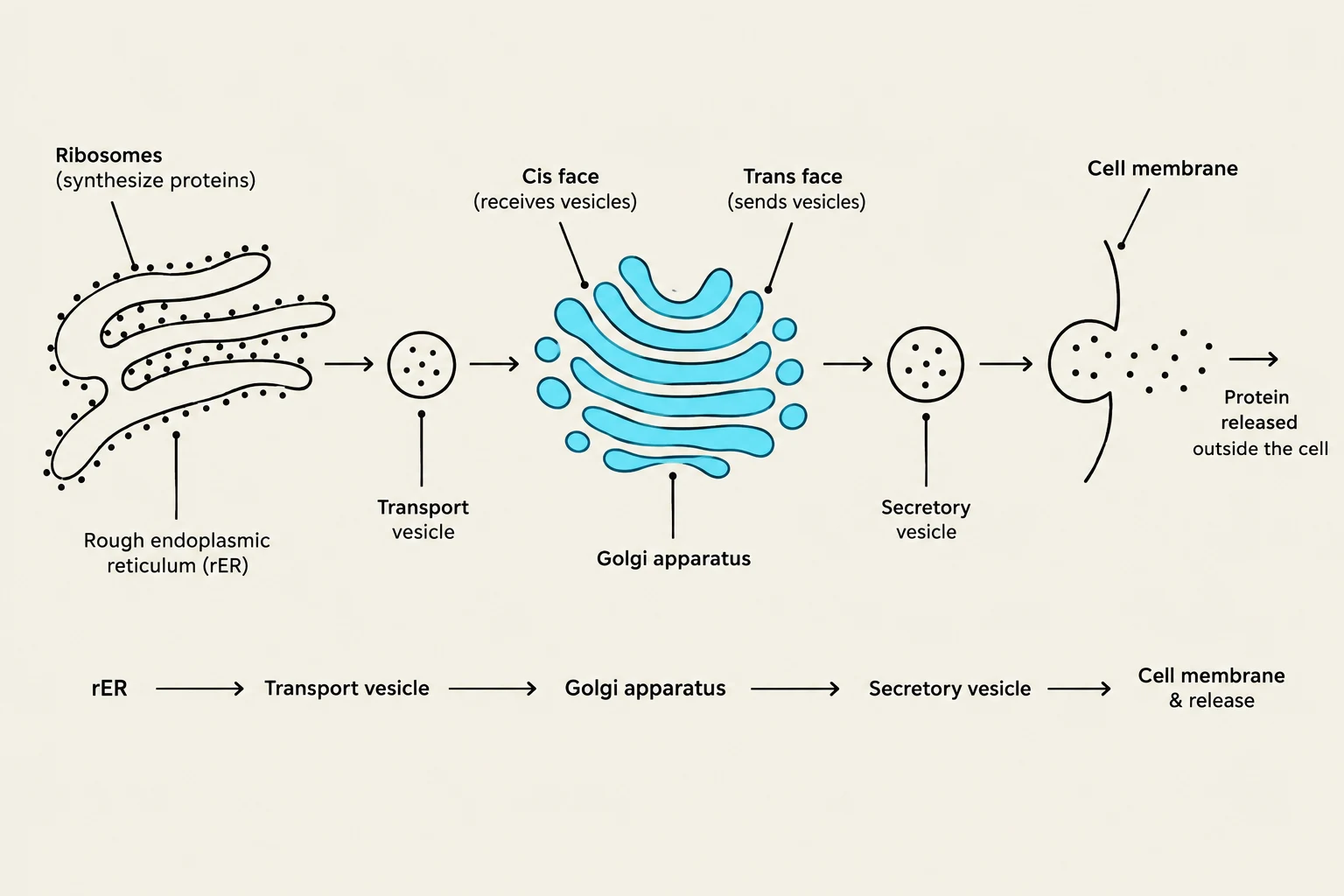
The process begins when translation starts on ribosomes in the cytosol. If the growing polypeptide contains an ER signal peptide, translation continues on the rough endoplasmic reticulum (rER). The rER is a system of interconnected sacs (cisternae) studded with ribosomes.
As proteins enter the rER, they undergo post-translational modifications, which are covalent additions of functional groups to a polypeptide. A critical modification is N-linked glycosylation, where an oligosaccharide is added to the side chain of an Asparagine (Asn) residue. This helps prevent protein aggregation and aids in proper folding.
Exam Tip: Chaperones (such as Heat-Shock Proteins/Hsp) are essential in the rER. They bind to nascent or incorrectly folded polypeptides to assist in proper folding and prevent aggregation.
Processing in the Golgi Apparatus
Once properly folded, proteins are transported via vesicles in an anterograde direction to the Golgi apparatus. The Golgi consists of stacked, flattened cisternae and acts as the cell's "sorting and packaging center".
In the Golgi, proteins undergo further modifications, including the completion of N-linked glycosylation and the initiation of O-linked glycosylation. O-linked glycosylation is vital for protein stability and recognition, such as in mucins or cell-to-cell adhesion. Finally, proteins bud from the trans-Golgi network in vesicles to be sent to their final destination, such as through exocytosis into the extracellular environment.
Diagram illustrating the process of protein synthesis and release from a cell, involving the rough endoplasmic reticulum, transport vesicles, Golgi apparatus, and cell membrane.
Non-Secretory Pathways
Not all proteins enter the rER. The non-secretory pathway involves proteins translated by free ribosomes in the cytosol. These proteins lack an ER signal sequence and are targeted to the nucleus, mitochondria, peroxisomes, or remain in the cytosol.
Mitochondria: Known as the "powerhouse" of the cell, mitochondria perform oxidative phosphorylation to produce energy. They contain their own circular DNA, RNA, and ribosomes within the matrix.
Peroxisomes: These organelles are prominent in liver cells and are responsible for many oxidation reactions, such as the catabolism of alcohol and very-long-chain fatty acids. They contain enzymes like catalase to detoxify hydrogen peroxide (H2O2).
Smooth Endoplasmic Reticulum (sER): Unlike the rER, the sER lacks ribosomes and is involved in lipid synthesis, cholesterol degradation, and detoxification of drugs via enzymes like Cytochrome P450.
Protein Degradation: The Ubiquitin-Proteasome System and Lysosomes
Cells must constantly remove misfolded and damaged proteins to prevent toxicity. There are two primary mechanisms for protein degradation:
1. The Ubiquitin-Proteasome System (UPS)
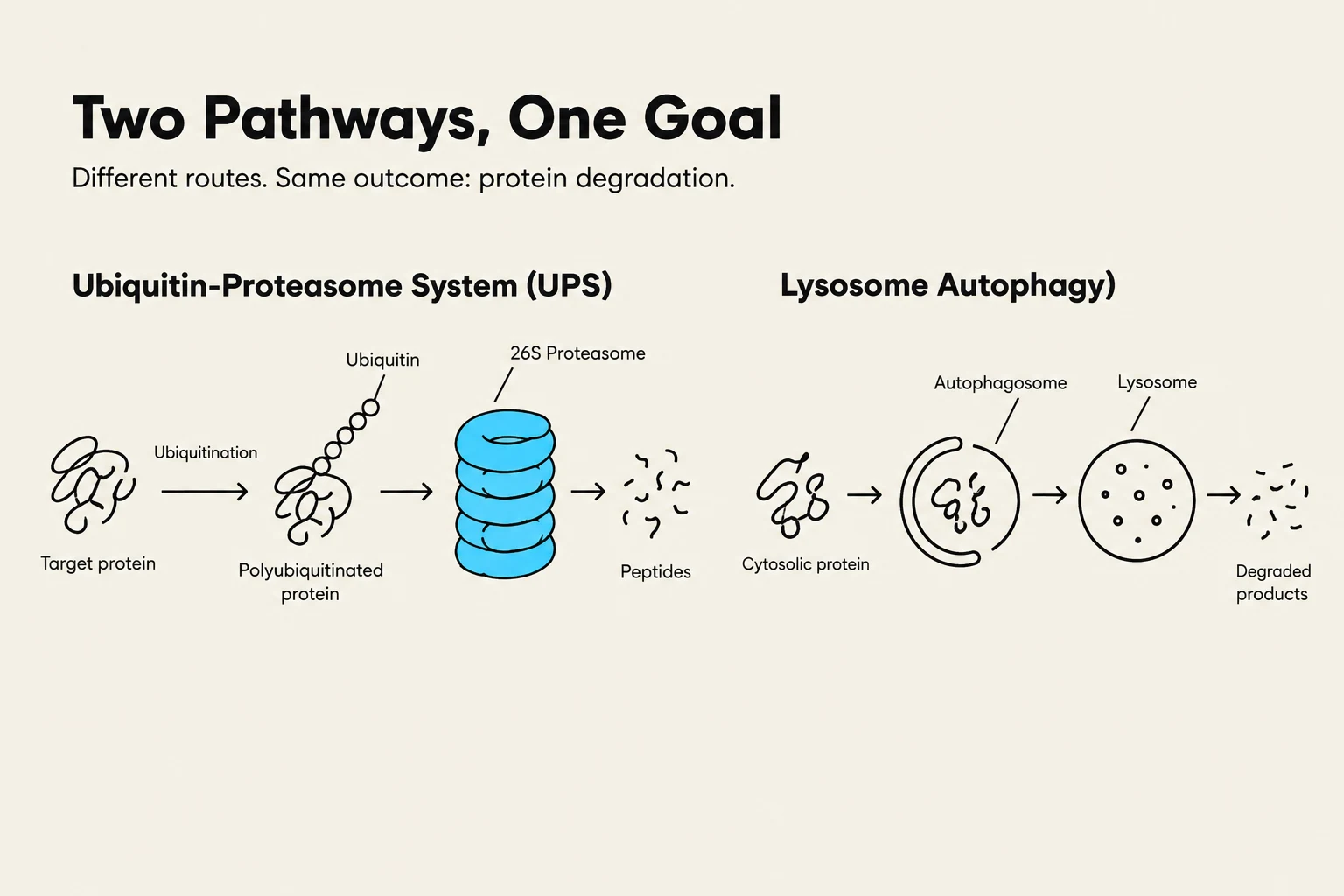
The proteasome is a non-membrane-bound protein complex located predominantly in the cytosol. To be degraded by the proteasome, a protein must first be "tagged." This is achieved through polyubiquitination, where multiple ubiquitin molecules are covalently attached to the target protein. This system is essential for removing proteins that are damaged by reactive oxygen species (ROS) or proteins that are no longer needed, such as mitotic cyclins.
2. Lysosomal Degradation
While the proteasome handles individual proteins, lysosomes are responsible for the enzymatic degradation of larger cellular structures (autophagy) and extracellular particles (phagocytosis). Lysosomes contain acid hydrolases that function in an acidic environment.
A key distinction in targeting is the use of the mannose 6-phosphate (M6P) tag. Lysosomal enzymes are synthesized in the rER and then modified in the Golgi with an M6P tag, which acts as a "destination tag" to direct them to the lysosome.
Clinical Correlation: I-cell Disease
In I-cell disease (Mucolipidosis type II), there is a genetic error in the post-translational modification required to add the M6P tag. Consequently, lysosomal enzymes are not directed to the lysosome, leading to the accumulation of undegraded material in cytoplasmic inclusion bodies.
This diagram illustrates two primary cellular pathways for protein degradation: the Ubiquitin-Proteasome System (UPS) and Lysosome Autophagy. Both pathways ultimately break down proteins into smaller components.
Summary Table of Organelle Functions
Organelle
Primary Function
Pathway Type
Nucleus
Genetic storage, rRNA synthesis
N/A
rER
Protein synthesis, N-linked glycosylation
Secretory
Golgi
Protein sorting, O-linked glycosylation
Secretory
Lysosome
Macromolecule degradation
Degradative
Proteasome
Targeted protein degradation
Degradative
Mitochondria
ATP production (Oxidative phosphorylation)
Non-secretory
Peroxisome
Oxidation reactions, H2O2 detoxification
Non-secretory
Diagram illustrating the synthesis, modification, and sorting of proteins within a cell, showing their transport from the Rough ER to the Golgi apparatus and subsequent delivery to secretory vesicles or lysosomes for secretion or degradation.
Keep reading for free.
Create an account to finish this reading and make it part of your study routine.