Cellular Manufacturing and Distribution: ER and Golgi Apparatus
Explore the intricate roles of the Endoplasmic Reticulum (ER) and Golgi apparatus in cellular protein and lipid synthesis, processing, and transport. Understand how these organelles function as a coordinated network for molecule production and distribution within the cell.
In the complex world of the cell, organelles do not work in isolation. Instead, they function like a highly coordinated industrial complex. To produce, refine, and ship the essential molecules that keep a cell alive—such as proteins and lipids—the cell relies on a specialized manufacturing and distribution network consisting primarily of the Endoplasmic Reticulum (ER) and the Golgi apparatus.
The Endoplasmic Reticulum: The Manufacturing Center
The endoplasmic reticulum is a continuous, three-dimensional arrangement of folded membrane compartments that encompasses the cell nucleus. Rather than being a simple flat surface, it is a complex network that provides a massive surface area for various biochemical reactions. The ER is divided into two distinct types based on its structure and the specific tasks it performs: the Rough Endoplasmic Reticulum (RER) and the Smooth Endoplasmic Reticulum (SER).
Rough Endoplasmic Reticulum (RER) and Protein Synthesis
The "rough" appearance of the RER is due to the presence of ribosomes studded on its outer surface. In microscopic views, these ribosomes often appear as small red dots.
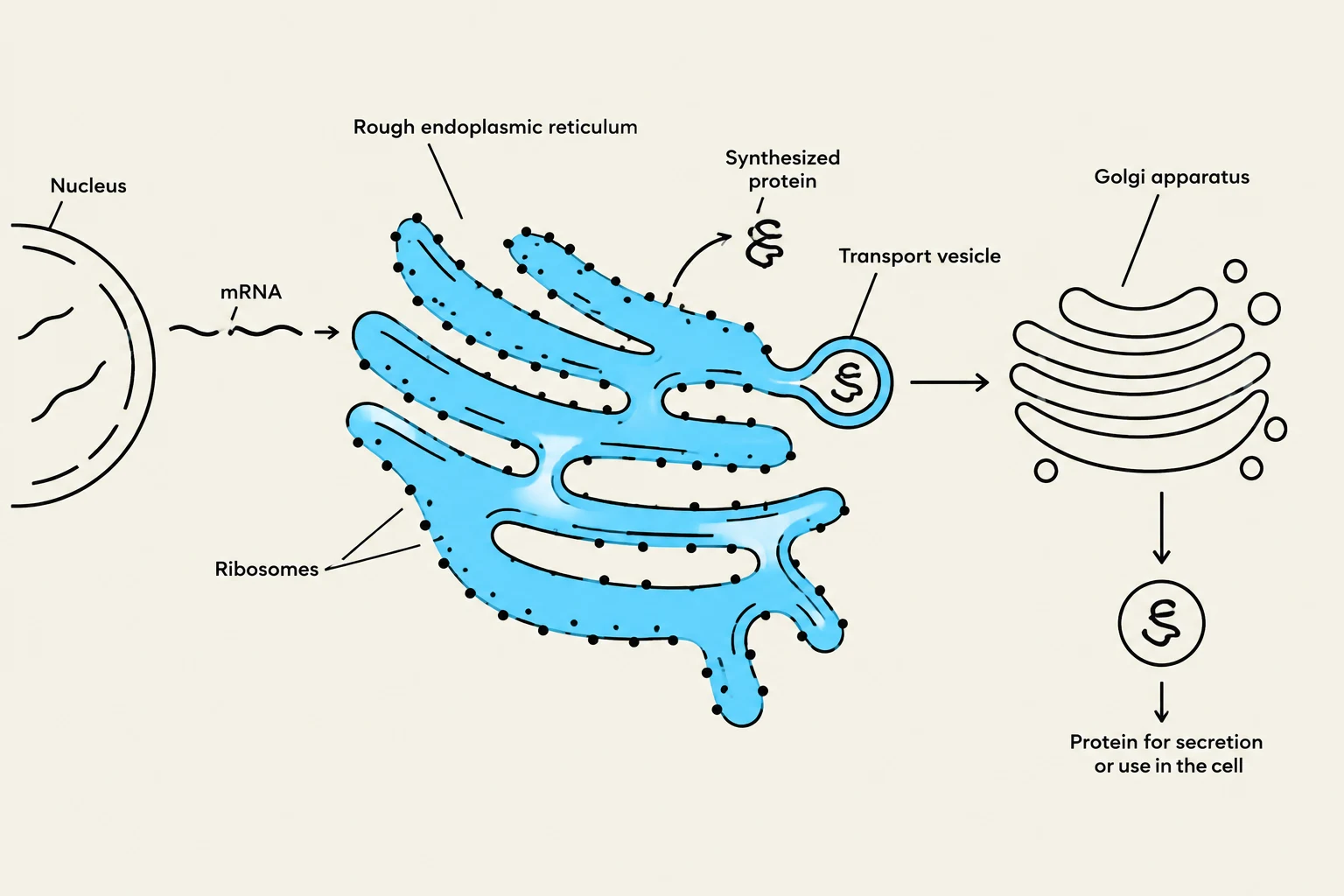
The primary role of the RER is protein production. The process begins when instructions from the DNA in the nucleus are sent via mRNA to the ribosomes. As the ribosomes assemble amino acids into long chains, these proteins enter the interior of the RER. Here, they undergo a critical step: folding. A protein cannot function as a mere string of amino acids; it must be folded into a specific three-dimensional shape to become biologically active.
This diagram illustrates the process of protein synthesis and transport within a cell, starting from the nucleus and involving mRNA, ribosomes, the rough endoplasmic reticulum, transport vesicles, and the Golgi apparatus, ultimately leading to protein secretion or intracellular use.
Smooth Endoplasmic Reticulum (SER) and Lipid Processing
Unlike the RER, the Smooth Endoplasmic Reticulum lacks ribosomes, giving it a smooth appearance under a microscope. The SER is typically located further away from the nucleus.
The SER is specialized for different tasks, most notably lipid processing and detoxification. It is responsible for synthesizing lipids and hormones, which are essential components for building cell membranes and regulating bodily functions. Additionally, the SER plays a vital role in breaking down toxic compounds. For example, cells in the liver are particularly rich in smooth ER because of their heavy involvement in detoxification processes.
Exam Tip: If a question asks you to distinguish between the RER and SER, look for the presence of ribosomes. RER = Protein synthesis (due to ribosomes); SER = Lipid synthesis and detoxification (no ribosomes).
The Transport System: Vesicles
Once proteins and lipids are synthesized and processed in the ER, they are not yet ready for their final destinations. They must be moved through the cell in a controlled manner. To achieve this, the cell uses vesicles.
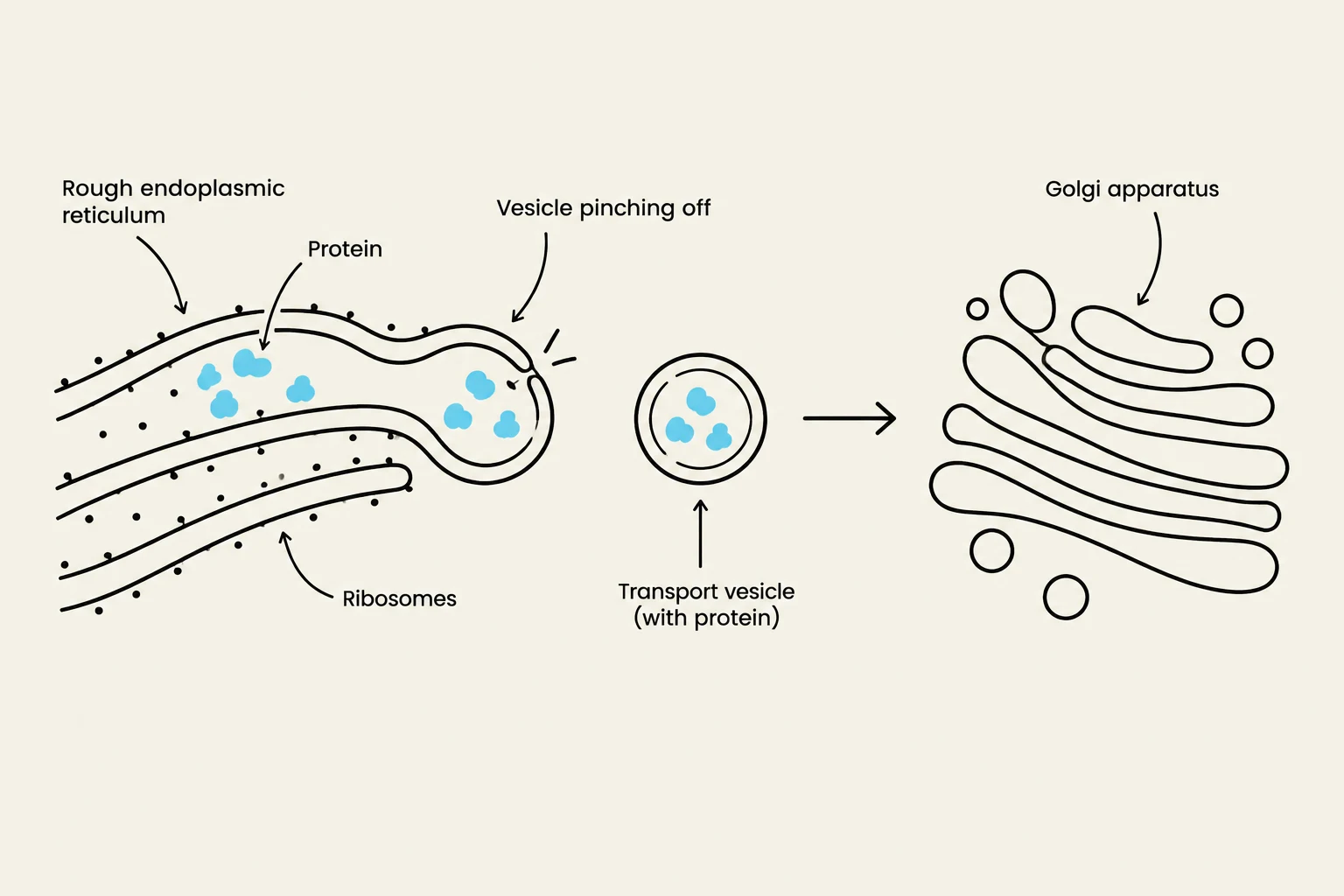
A vesicle is a small, membrane-bound sac. When a portion of the endoplasmic reticulum membrane pinches off, it carries the newly formed proteins or lipids inside it, effectively "packaging" them for transport through the cytoplasm.
Diagram illustrating the process of protein transport from the rough endoplasmic reticulum to the Golgi apparatus via a transport vesicle.
The Golgi Apparatus: The Distribution Hub
If the ER is the factory, the Golgi apparatus is the "Amazon distribution center" of the cell. The Golgi is an enclosed membrane structure that receives products from the ER.
When a vesicle arriving from the ER reaches the Golgi, it fuses with the Golgi membrane, releasing its contents (such as proteins or lipids) into the organelle. The Golgi then performs several key functions:
Further Processing: It may modify the proteins or lipids (e.g., adding sugar chains).
Packaging: It sorts these molecules and packages them into new, specialized vesicles.
Distribution: It directs these vesicles to their final destinations, which could be anywhere in the cell or even outside the cell via secretion.
Worked Example: The Amylase Pathway
To understand how these organelles work together, consider the production of amylase, an enzyme that breaks down starch.
Nucleus: Sends mRNA instructions to the RER.
Rough ER: Ribosomes translate the mRNA into an amylase protein chain, which then folds into its functional 3D shape.
Vesicle Formation: The amylase is packaged into a vesicle that pinches off from the RER.
Golgi Apparatus: The vesicle fuses with the Golgi. The Golgi processes the amylase and packages it into a new secretory vesicle.
Exocytosis: The vesicle moves to the plasma membrane, fuses with it, and releases the amylase outside the cell to begin breaking down starch.
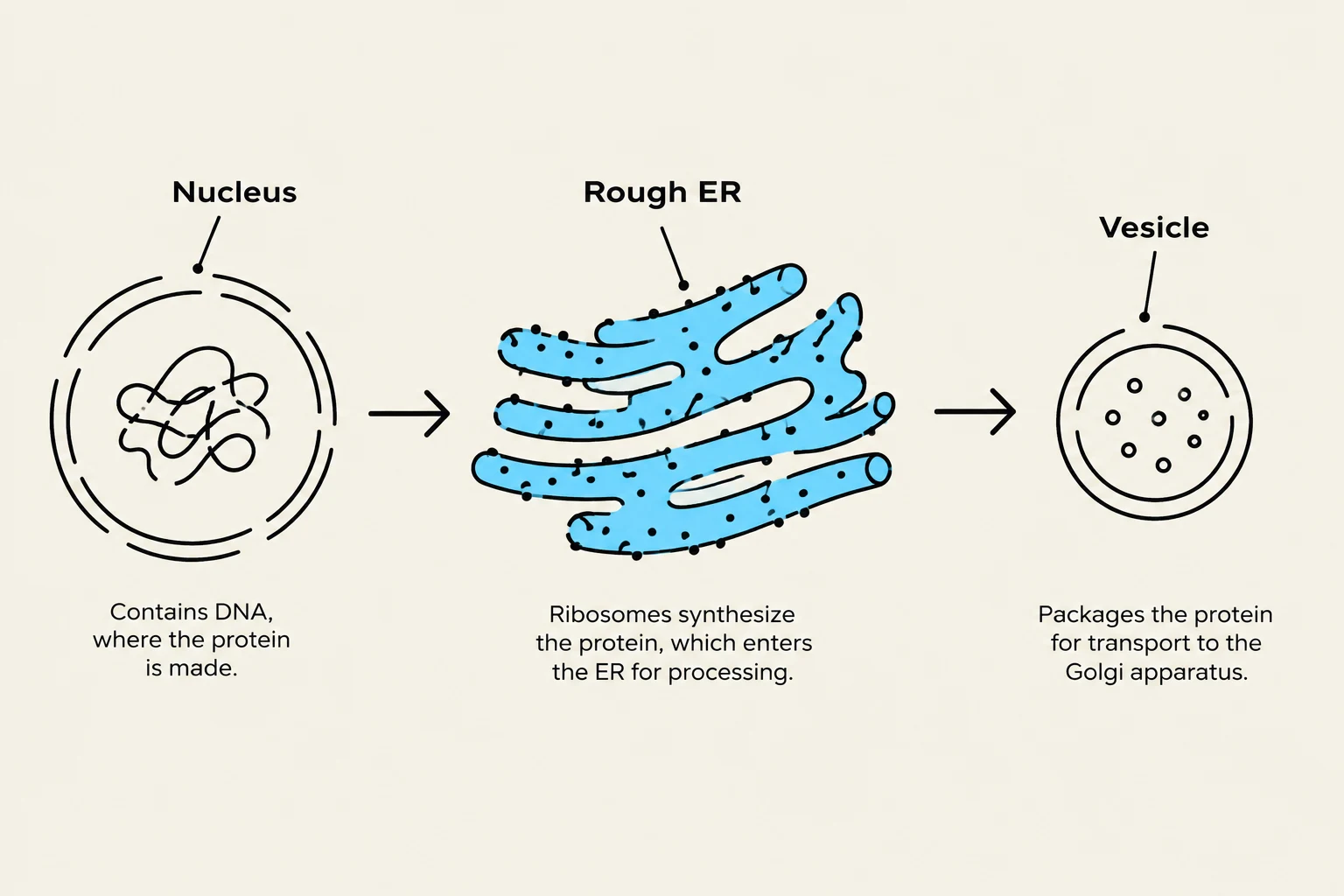
This diagram illustrates the process of protein synthesis and transport within a cell, starting from the nucleus, moving to the rough endoplasmic reticulum (ER) for processing, and finally being packaged into vesicles for transport to the Golgi apparatus.
Summary Table of Organelle Functions
Organelle
Key Feature
Primary Functions
Rough ER
Studded with ribosomes
Protein synthesis and folding
Smooth ER
No ribosomes
Lipid/hormone synthesis, detoxification
Vesicle
Membrane-bound sac
Transporting molecules between organelles
Golgi Apparatus
Enclosed membrane stacks
Packaging, modifying, and distributing molecules
Keep reading for free.
Create an account to finish this reading and make it part of your study routine.