Cellular Energetics: Photosynthesis and Respiration
Explore the fundamental principles of cellular energetics, including thermodynamics, the process of photosynthesis in plants, and the pathways of cellular respiration in organisms. This guide covers energy transfer, light capture, and energy release mechanisms.
Energy is the fundamental currency of life. Every movement, every thought, and every chemical transformation within a living organism requires the transfer and conversion of energy from one form to another. To understand how life persists, we must look at the microscopic dance of electrons and the flow of energy between the sun, plants, and animals. This guide explores the principles of thermodynamics, the complex machinery of photosynthesis, and the pathways of cellular respiration.
The Fundamentals of Energy
Before diving into biological pathways, we must define the physical laws that govern them. Energy exists in two primary forms: Kinetic Energy, which is the energy associated with movement, and Potential Energy, which is stored energy that depends on an object's structure or its position relative to its surroundings.
In biological systems, we are particularly interested in Entropy, which is the measure of disorder or the number of possible positions and motions a molecule can take. According to the laws of thermodynamics, systems tend toward increased disorder. To combat this or to facilitate change, organisms utilize Gibbs Free Energy (G), which represents the amount of energy available in a system to do work.
Chemical reactions are categorized by how they handle this energy:
Endergonic Reactions: These require an input of energy to proceed. They are often anabolic processes, meaning they build large, complex molecules from smaller ones (e.g., photosynthesis).
Exergonic Reactions: These release energy as they proceed. They are often catabolic processes, which involve breaking down large molecules into smaller components (e.g., cellular respiration).
Exam Tip: If a question asks about the direction of a chemical reaction, remember that it is influenced by the concentration of reactants and products.
Photosynthesis: Capturing Light
Photosynthesis is the process by which certain organisms convert light energy into chemical energy stored in food. This process is performed by photoautotrophs (like plants and algae), which use light to make organic molecules. In contrast, chemoautotrophs use environmental chemicals to create organic matter, while heterotrophs must consume organic molecules from other organisms to survive.
The Structure of the Chloroplast
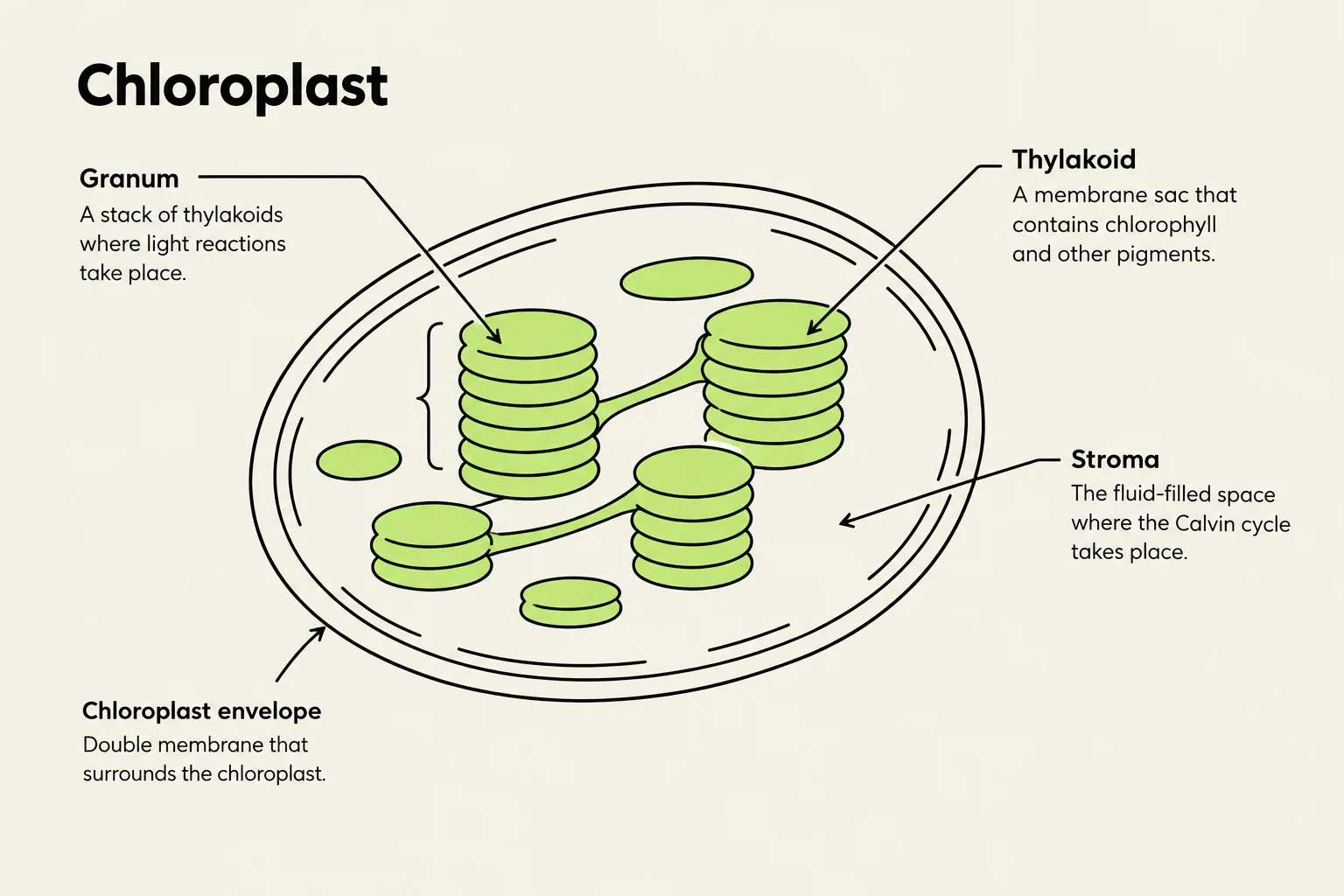
In plants, photosynthesis occurs within the chloroplast. The most active area for photosynthesis is the mesophyll, the middle layer of the leaf where chloroplasts are most abundant. Inside the chloroplast, the structure is highly specialized:
Thylakoids: Flat, pancake-like membranes that store chlorophyll and collect solar energy.
Grana: Stacks of thylakoids that increase the surface area available for light absorption.
Stroma: The fluid surrounding the thylakoids, which contains ribosomes, chloroplast DNA, and serves as the site for the Calvin Cycle.
Diagram illustrating the structure of a chloroplast, labeling its key components: Grana, Thylakoids, Stroma, and Chloroplast envelope.
Stage 1: The Light Reactions
The goal of the light reactions is to convert light energy into chemical energy in the form of ATP and NADPH. This occurs in the thylakoid membranes and relies on photosystems—clusters of pigment molecules bound to proteins.
The primary pigments involved are:
Chlorophyll a: The main pigment that converts light to chemical energy.
Chlorophyll b: An accessory pigment that conveys energy to chlorophyll a.
Carotenoids: Yellow or orange pigments that provide photoprotection and broaden the spectrum of light that can be absorbed.
The process involves two photosystems working in tandem. Photosystem II (P680) absorbs light best at 680 nm; it actually occurs first in the process, using energy to create ATP and utilizing water to donate electrons. These electrons then move to Photosystem I (P700), which absorbs light best at 700 nm and provides the energy necessary to create NADPH.
Stage 2: The Calvin Cycle
The second stage, also known as the light-independent reactions, takes place in the stroma. The purpose is to use the ATP and NADPH produced in the light reactions to synthesize high-energy sugars like G3P (glyceraldehyde-3-phosphate).
The Calvin Cycle consists of three critical phases:
Carbon Fixation: The enzyme Rubisco "fixes" CO2 into a carbohydrate.
Reduction: 6 ATP and 6 NADPH are used to reduce the fixed carbon into 6 molecules of G3P.
Regeneration: While some G3P leaves the cycle to become glucose, the remaining 5 G3P molecules are used to regenerate RuBP (ribulose bisphosphate), allowing the cycle to continue.
Note: It takes two full turns of the Calvin Cycle to produce a single molecule of glucose.
Cellular Respiration: Releasing Energy
While photosynthesis stores energy, cellular respiration is the catabolic pathway that breaks down glucose to release that energy. This process occurs in the mitochondria, a double-membrane organelle. The inner membrane is highly folded into structures called cristae to increase the surface area for energy harvesting.
The Four Stages of Respiration
The pathway of respiration depends heavily on the presence of oxygen:
Glycolysis: Occurs in the cytoplasm. It is an anaerobic process that breaks glucose down into pyruvate.
Pyruvate Oxidation: Occurs in the mitochondrial matrix. This is an aerobic process (requires oxygen) that converts pyruvate to enter the next stage.
Krebs (Citric Acid) Cycle: Occurs in the mitochondrial matrix. This aerobic stage produces electron carriers, specifically NADH and FADH2.
Electron Transport Chain (ETC): Occurs in the inner mitochondrial membrane. This aerobic stage uses electrons from NADH and FADH2 to create a proton gradient, which powers ATP synthase to produce massive amounts of ATP.
Anaerobic Alternatives: Fermentation
If oxygen is unavailable, cells cannot proceed through the Krebs cycle or the ETC. Instead, they rely on fermentation to continue producing energy:
Alcoholic Fermentation: Produces ethanol (common in yeast and some bacteria).
Lactic Acid Fermentation: Produces lactic acid (common in animals, such as human muscle cells during intense exercise).
Summary: The Complementary Cycle
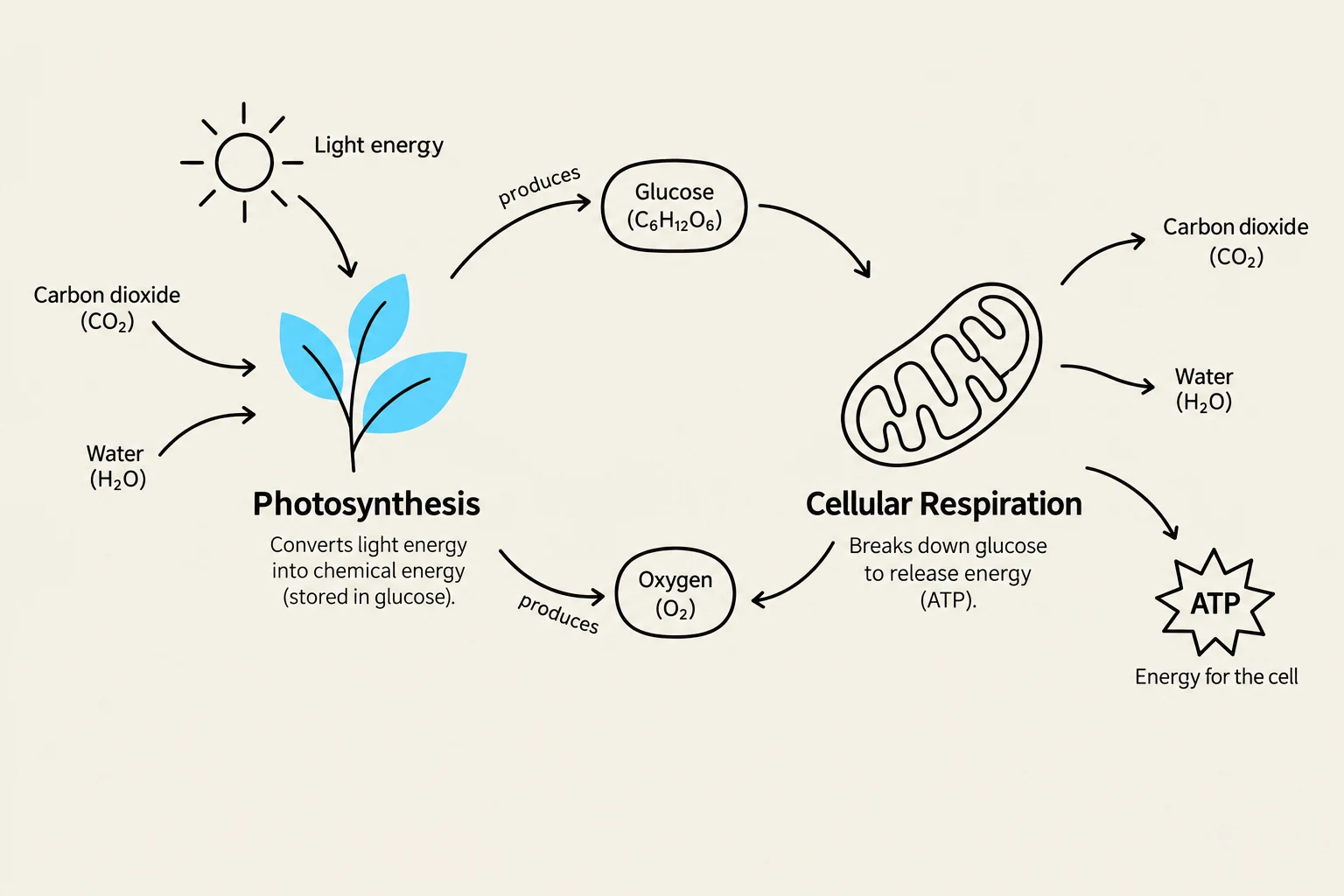
Photosynthesis and cellular respiration are two sides of the same coin. Photosynthesis is an endergonic process that stores energy in glucose, while cellular respiration is an exergonic process that releases it.
Feature
Photosynthesis
Cellular Respiration
Location
Thylakoid membrane
Inner mitochondrial membrane
Electron Source
Light photons (from water)
NADH and FADH2
Products
O2, ATP, & NADPH
NAD+, FAD, H2O, CO2, & ATP
The products of one process serve as the reactants for the other. This creates a continuous cycle of energy flow that sustains life on Earth.
Diagram illustrating the relationship between photosynthesis and cellular respiration, showing the inputs and outputs of each process.
Final Study Tip: To master this topic, practice drawing the chloroplast and mitochondria from memory, and ensure you can explain exactly where each stage of both processes occurs.
Keep reading for free.
Create an account to finish this reading and make it part of your study routine.