Cellular Biology: Structure, Transport, and Energy
An educational guide explaining the fundamental principles of cellular biology, including cell structure, the endomembrane system, membrane transport mechanisms, and the role of enzymes and thermodynamics in metabolism.
Preparing for a biology exam requires more than just memorizing definitions; it requires understanding how microscopic processes drive the life of an entire organism. This guide synthesizes the core principles of cellular biology, focusing on how cells are structured, how they move materials, and how they manage the energy required to stay alive.
Cellular Structure and the Building Blocks of Life
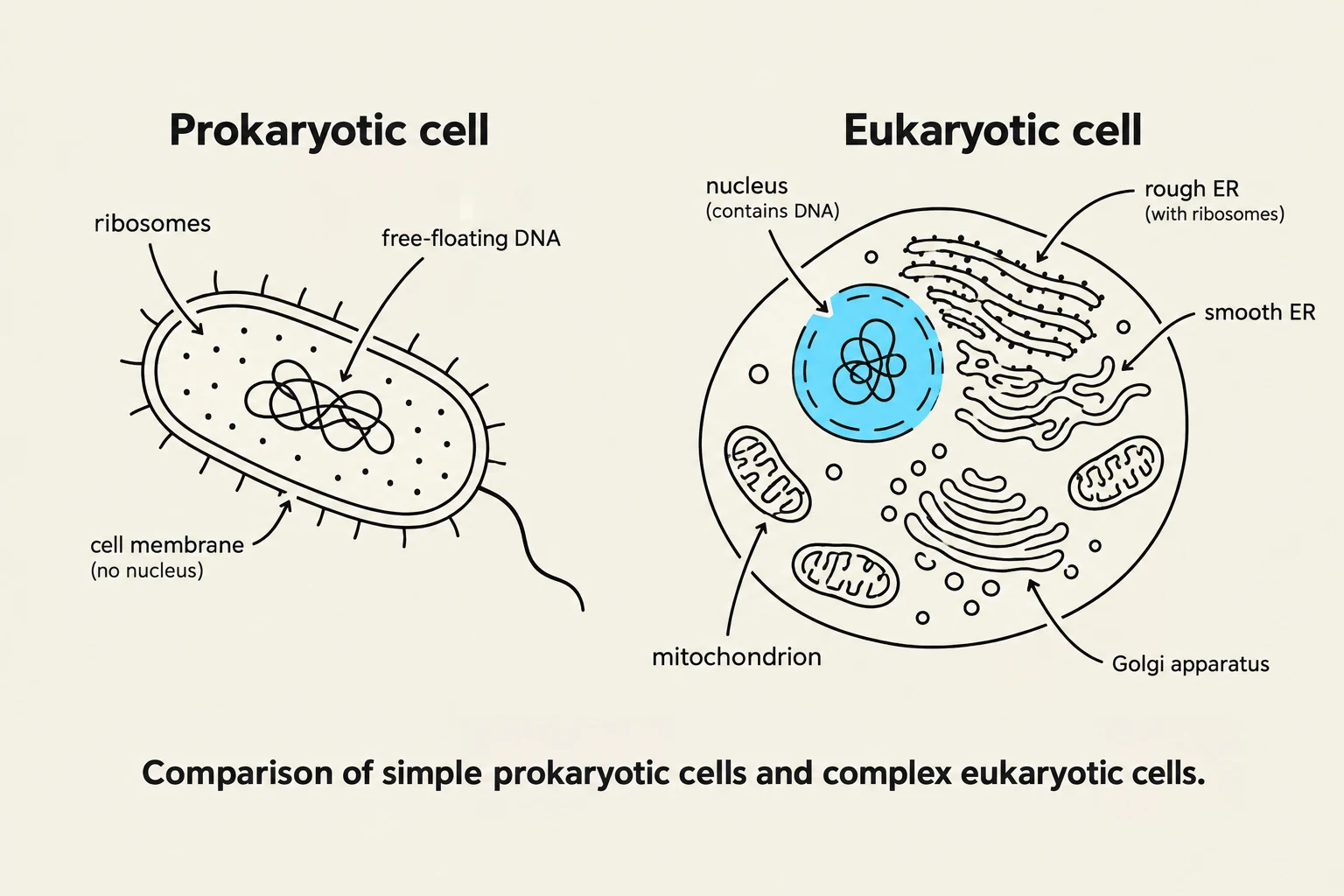
Comparison of simple prokaryotic cells and complex eukaryotic cells.
The foundation of biology is the cell theory, which establishes three fundamental truths: all living things are composed of cells, the cell is the basic unit of life, and all cells arise from existing cells.
Cells are broadly classified into two categories based on their complexity:
Prokaryotes: These are simpler cells, such as bacteria, which lack a nucleus and membrane-bound organelles.
Eukaryotes: These are more complex cells, such as animal cells, which contain a defined nucleus and specialized organelles.
Within these cells, various components work in harmony. The nucleus serves as the control center, holding the DNA (the cell's instructions). The cytoplasm is the fluid that fills the cell, providing a medium for various processes. Ribosomes are the essential "protein makers" found throughout the cell.
The Endomembrane System and Organelles
Cells use a specialized network called the endomembrane system to manage the production and transport of molecules. This system follows a logical "Make → Modify → Package → Ship" workflow:
Rough ER: Studded with ribosomes, it is responsible for protein production.
Smooth ER: Responsible for lipid production.
Golgi Apparatus: Acts as the shipping center, modifying, sorting, and packaging materials into vesicles for transport.
One of the most critical organelles is the mitochondria. Often called the "powerhouse," it performs cellular respiration to produce ATP, which is the usable energy currency for the cell.
Exam Tip: If a question asks about energy production, look for "Mitochondria" and "ATP." If it asks about protein synthesis, look for "Ribosomes" or "Rough ER".
The Cell Membrane and Transport Mechanisms
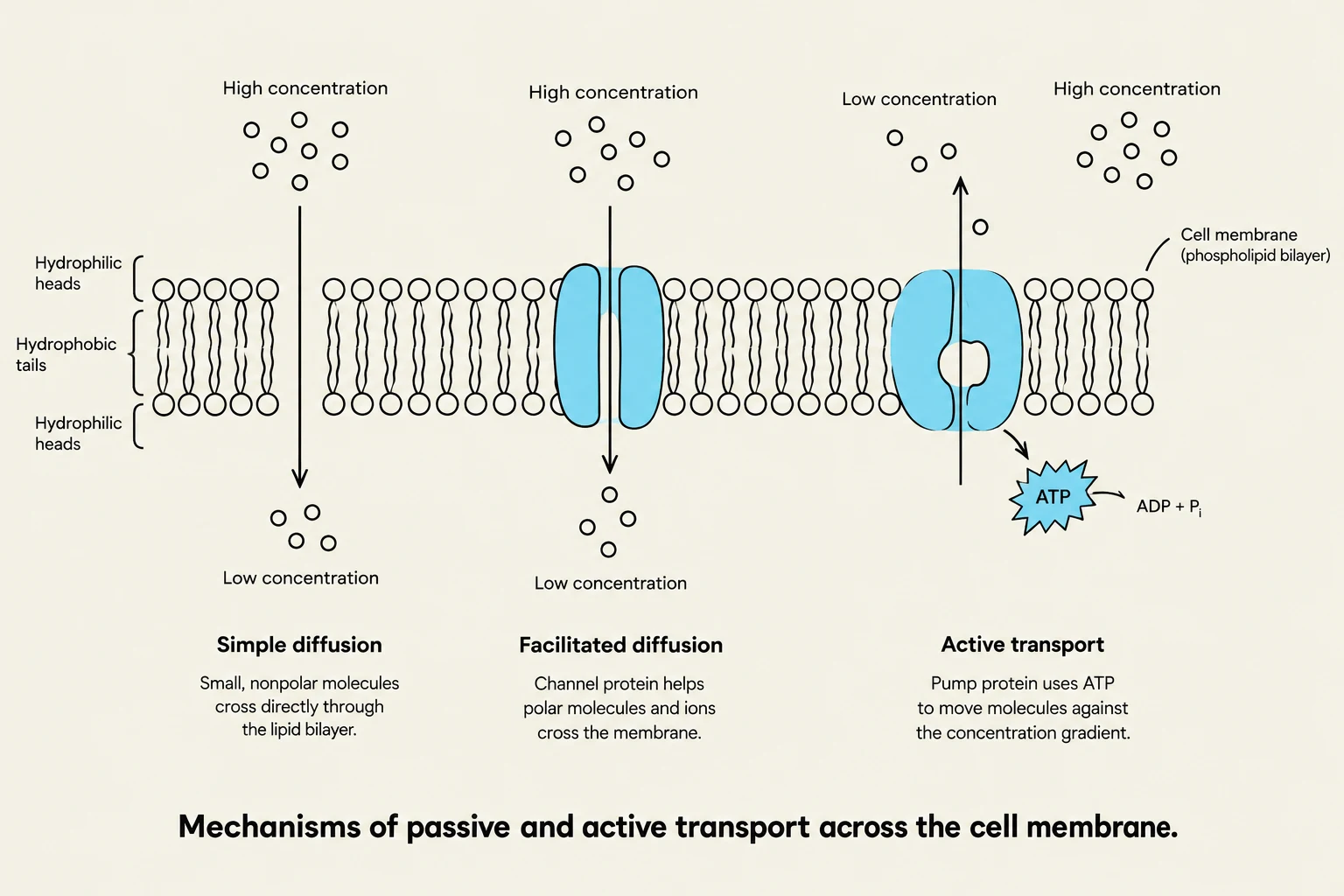
Diagram illustrating simple diffusion, facilitated diffusion, and active transport across a cell membrane, showing the movement of molecules based on concentration gradients and energy requirements.
The cell membrane acts as a boundary, regulating what enters and exits the cell through a property known as selective permeability. The membrane is composed of a phospholipid bilayer. In animal cells, cholesterol is present to assist with membrane stability, while carbohydrate chains help cells recognize one another.
Passive vs. Active Transport
Movement across the membrane is categorized by whether or not the cell must expend energy:
1. Passive Transport (No Energy Required)
Substances move down their concentration gradient (from high to low concentration).
Diffusion: The movement of particles from high to low concentration.
Facilitated Diffusion: Uses membrane proteins to help specific substances cross the bilayer.
Osmosis: A specific type of diffusion involving the movement of water toward areas of higher solute concentration.
2. Active Transport (Energy Required)
When a cell needs to move substances against a gradient or move very large materials, it uses energy.
Endocytosis: Bringing large materials into the cell.
Exocytosis: Sending large materials out of the cell.
Tonicity and Efficiency
When cells are placed in different solutions, water moves via osmosis based on the tonicity of the environment:
Isotonic: Solute concentration is equal; there is no net movement of water.
Hypotonic: Lower solute concentration outside the cell; water "hops in," causing the cell to swell.
Hypertonic: Higher solute concentration outside the cell; water "heads out," causing the cell to shrink.
Efficiency in these processes is heavily influenced by the surface-area-to-volume ratio. Smaller cells have a higher ratio, meaning they have more "outside" (surface area) relative to their "inside" (volume), allowing for faster and more efficient material exchange.
Enzymes and Metabolism
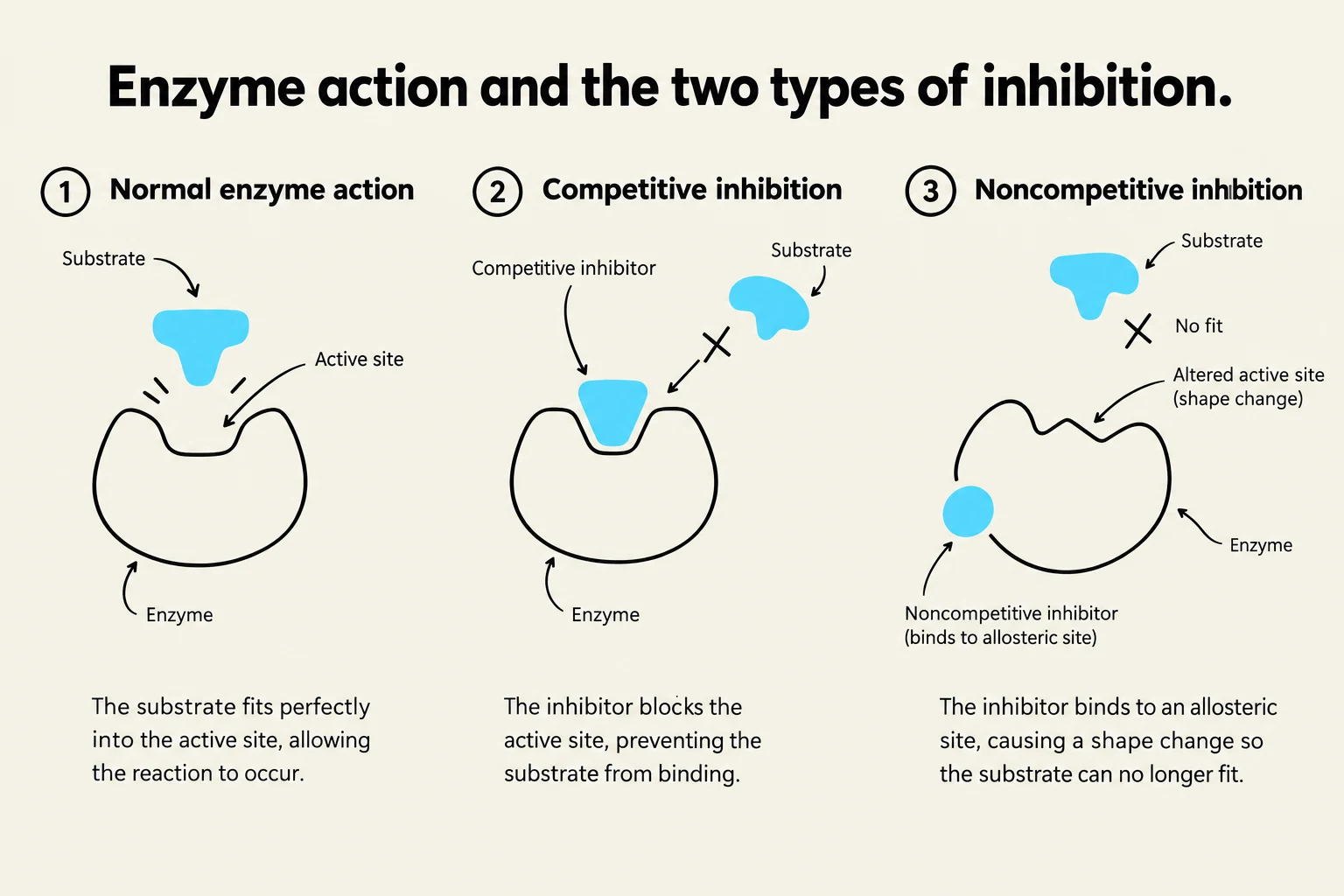
This diagram illustrates normal enzyme action and two types of enzyme inhibition: competitive and noncompetitive. Competitive inhibition occurs when an inhibitor molecule competes with the substrate for the active site of an enzyme. Noncompetitive inhibition occurs when an inhibitor binds to an allosteric site on the enzyme, altering the active site's shape and preventing substrate binding.Metabolism refers to the sum of all chemical reactions within an organism. These reactions are divided into two opposing paths:
Anabolism: Building complex molecules from simpler ones (requires energy).
Catabolism: Breaking down complex molecules into simpler ones (releases energy).
How Enzymes Work
Chemical reactions often require an initial input of energy called activation energy. Enzymes are biological catalysts that speed up reactions by lowering this activation energy.
However, enzymes are sensitive. Their efficiency depends on an optimal pH. If the environment becomes too acidic or too basic, the enzyme can undergo denaturation, where its shape changes so much that it can no longer function.
Enzymes can also be regulated through inhibition:
Competitive Inhibition: An inhibitor competes directly with the substrate for the active site.
Noncompetitive Inhibition: An inhibitor binds to a different part of the enzyme, changing its shape so the substrate no longer fits.
Energy Laws and Biological Cycles
All metabolic processes are governed by the laws of thermodynamics:
First Law: Energy cannot be created or destroyed, only transformed.
Second Law: Energy transfers increase entropy (disorder), and some energy is always lost as heat, making it unavailable for work.
In biology, we track the movement of energy between potential energy (stored energy) and kinetic energy (energy of motion). This is most clearly seen in the relationship between photosynthesis and cellular respiration: