To understand how the human body moves, breathes, and thinks, one must understand bioenergetics: the chemical processes capable of converting foodstuff into adenosine triphosphate (ATP). ATP serves as the immediate source of energy for muscular contraction, acting as a bridge between the energy released from the breakdown of food (exergonic reactions) and the energy required to perform cellular work (endergonic reactions). Because muscle cells store only very limited amounts of ATP, the body relies on three interconnected metabolic pathways to resynthesize it: the ATP-PC system, glycolysis, and aerobic metabolism.
The Rapid Response: ATP-PC System
When exercise begins, the body requires an immediate burst of energy. The simplest and most rapid method of ATP production is the breakdown of phosphocreatine (PC). In this anaerobic process, a phosphate group and its bond energy are donated from PC to adenosine diphosphate (ADP) to reform ATP.
This reaction is catalyzed by the enzyme creatine kinase. While this system is incredibly fast, it is limited by the small amount of PC stored in the muscles, typically providing energy only for short-term, high-intensity bursts lasting between 5 and 15 seconds.
Exam Tip: Remember that the ATP-PC system is the only pathway that does not require oxygen (anaerobic) and provides the fastest rate of ATP resynthesis, but it has the lowest capacity for long-term energy.
Glycolysis: The Anaerobic Pathway
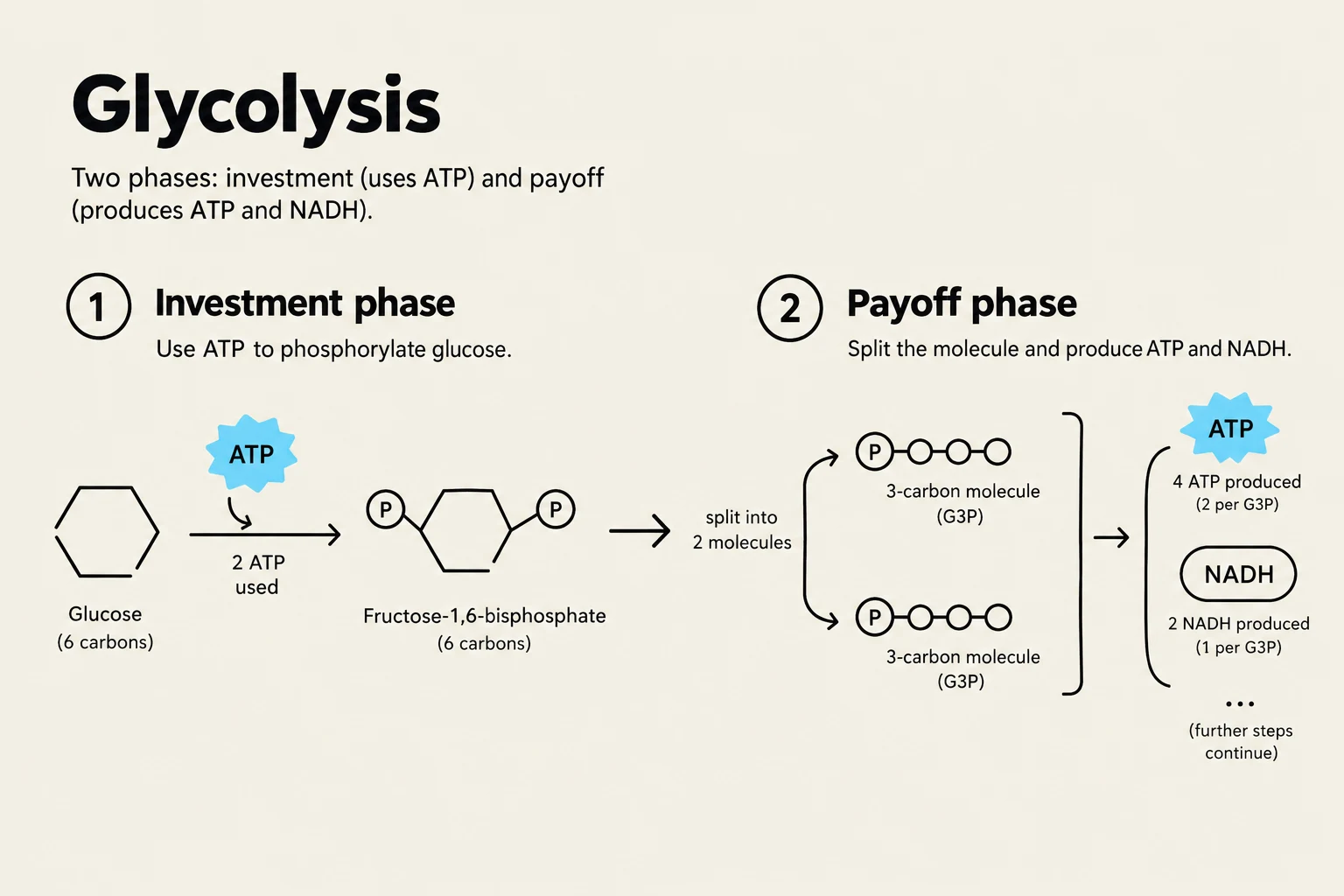
As the initial burst of PC energy fades, the body turns to glycolysis. This is an anaerobic pathway occurring in the sarcoplasm (cytoplasm of the muscle cell) that transfers energy from glucose or glycogen to synthesize ATP. Glycolysis involves ten enzymatically catalyzed reactions and can be divided into two distinct phases:
Energy Investment Phase: The process must be "primed" by using stored ATP to phosphorylate glucose and fructose 6-phosphate.
Energy Generation Phase: The pathway produces a net gain of two ATP molecules per glucose molecule through chemical reactions near the end of the pathway.
A critical component of this process is the coenzyme NAD+. For glycolysis to continue, NAD+ must be available to accept hydrogen atoms, becoming NADH. If the cell cannot process NADH quickly enough through aerobic means, it must regenerate NAD+ through the conversion of pyruvate to lactate, a reaction catalyzed by the enzyme lactate dehydrogenase. This allows glycolysis to persist even when oxygen levels are low.
Glycolysis is a metabolic pathway that converts glucose into pyruvate, producing ATP and NADH in the process. It involves two main phases: the investment phase, where ATP is used to phosphorylate glucose, and the payoff phase, where the molecule is split and ATP and NADH are produced.
Regulation of Glycolysis
The speed of glycolysis is controlled by its primary rate-limiting enzyme, phosphofructokinase (PFK). Because PFK is an allosteric enzyme, its activity is modulated by the energy status of the cell:
Stimulators: High levels of ADP and inorganic phosphate signal that energy is being used and speed up PFK.
Inhibitors: High levels of ATP signal that energy stores are sufficient, providing negative feedback to slow the pathway.
Aerobic Metabolism: The Mitochondria
For long-term, sustained energy production, the cell utilizes aerobic metabolism. This process occurs within the mitochondria and involves two cooperating pathways: the Citric Acid Cycle and the Electron Transport Chain (ETC).
The Citric Acid Cycle (Krebs Cycle)
Before entering the cycle, lactate must be converted back into pyruvate, which then enters the mitochondria and is transformed into acetyl-CoA. The primary purpose of the Citric Acid Cycle is to complete the oxidation of acetyl-CoA and remove electrons from substrates to form the energy carriers NADH and FADH2.
Each turn of the cycle produces:
3 NADH
1 FADH2
1 GTP (which transfers its phosphate to ADP to form ATP via substrate-level phosphorylation).
The rate-limiting enzyme for this cycle is isocitrate dehydrogenase. Like PFK, it is regulated allosterically: it is inhibited by ATP but stimulated by ADP, inorganic phosphate, and increased calcium levels (a signal of muscle contraction).
The Electron Transport Chain and Oxidative Phosphorylation
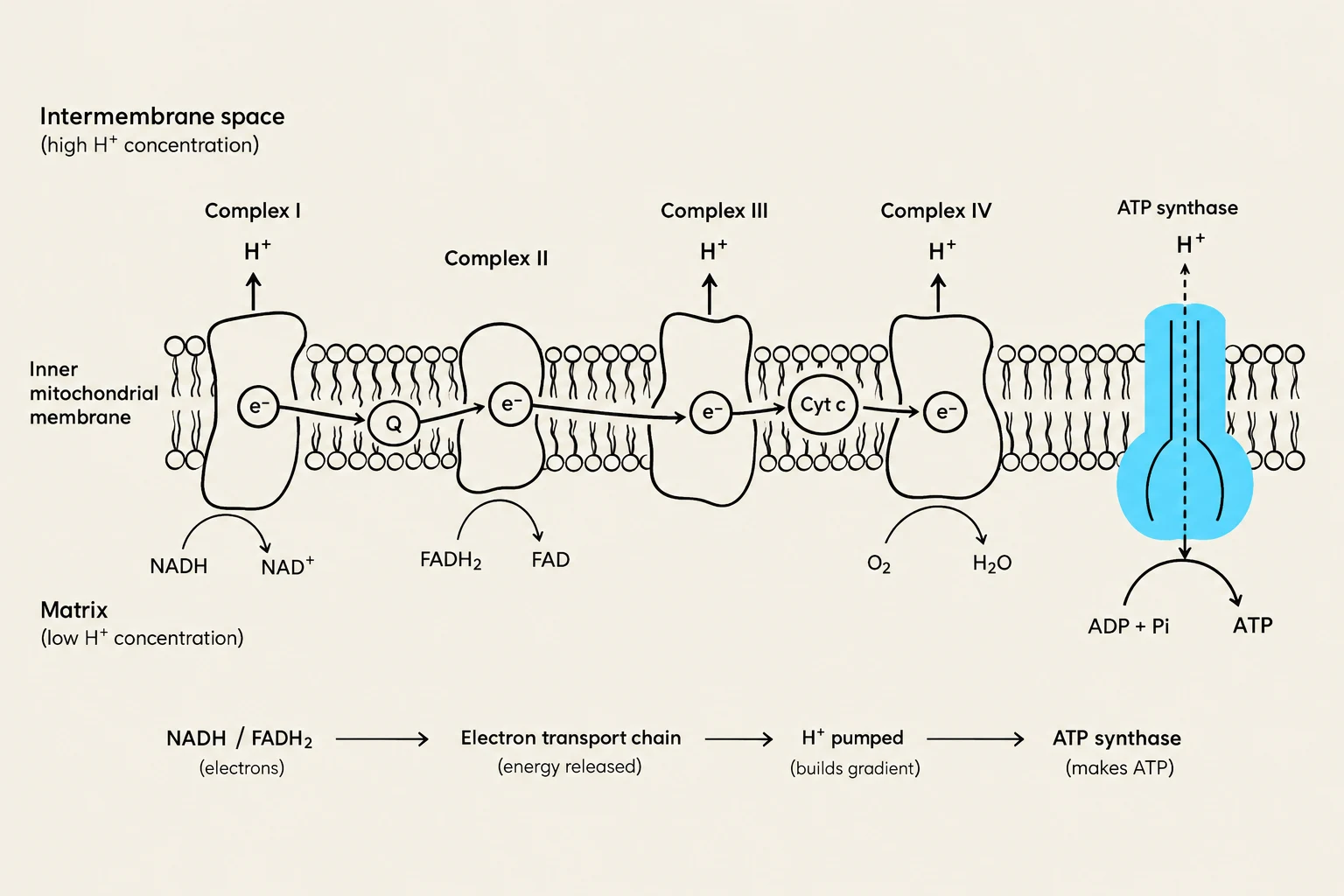
The final and most productive stage of ATP production is oxidative phosphorylation, which takes place in the inner mitochondrial membrane. This stage relies on the Electron Transport Chain (ETC), a series of protein complexes (I-IV).
As electrons from NADH and FADH2 are passed through these complexes, the energy released is used to pump protons (H+ ions) from the mitochondrial matrix into the intermembrane space. This creates an electrochemical gradient. The potential energy stored in this gradient drives protons back into the matrix through a selective channel called ATP synthase, which provides the energy to synthesize ATP from ADP and inorganic phosphate.
Diagram illustrating the electron transport chain and ATP synthesis within the inner mitochondrial membrane.
The rate-limiting enzyme of the ETC is cytochrome c oxidase (Complex IV). At the end of the chain, oxygen acts as the ultimate electron acceptor, combining with electrons and protons to form water.
Energy Yields and Metabolic Regulation
The efficiency of the ETC depends on where the electron carriers enter the chain:
NADH enters at Complex I, triggering more proton pumps and yielding approximately 2.5 ATP per molecule.
FADH2 enters at Complex II, bypassing the first pump, which results in a lower energy yield of approximately 1.5 ATP per molecule.
Summary of Regulation
Metabolic pathways are governed by the cell's energy needs through allosteric regulation. The general rule for all three major systems (ATP-PC, Glycolysis, and the Citric Acid Cycle) is consistent:
High ATP→Inhibition (Slow down production)High ADP/Pi→Stimulation (Speed up production)
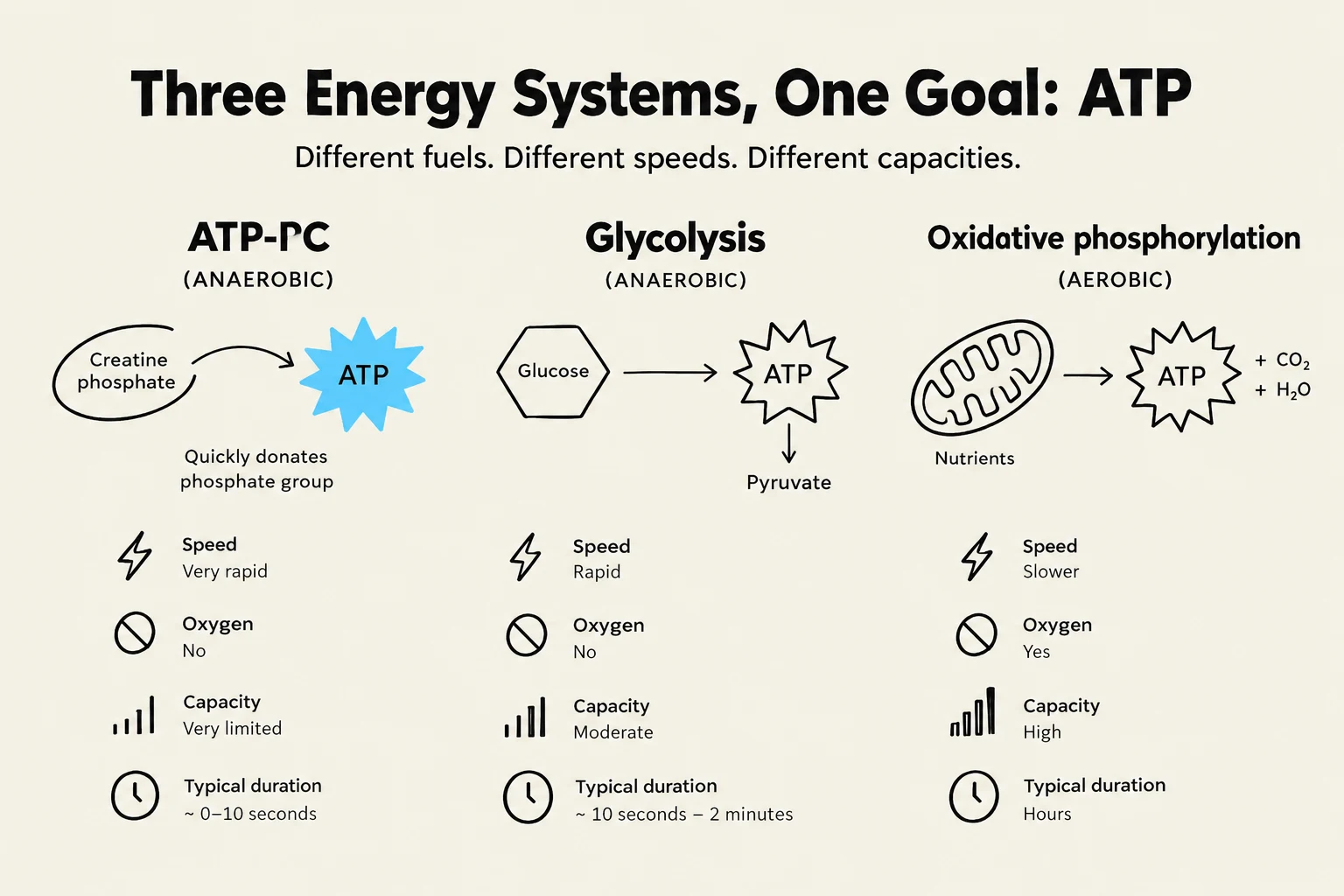
This diagram illustrates the three main energy systems in the human body: ATP-PC, Glycolysis, and Oxidative Phosphorylation, detailing their speed, oxygen requirement, capacity, and typical duration.
Pathway
Oxygen Required?
Primary Site
Rate-Limiting Enzyme
ATP-PC
No
Sarcoplasm
Creatine Kinase
Glycolysis
No
Sarcoplasm
Phosphofructokinase (PFK)
Aerobic
Yes
Mitochondria
Isocitrate Dehydrogenase / Cytochrome C Oxidase
Keep reading for free.
Create an account to finish this reading and make it part of your study routine.