


In the dynamic environment of the human body, cells are constantly subjected to varying levels of physiological and pathological stress. To maintain homeostasis and avoid death, cells possess a remarkable ability to sense these changes and undergo structural or functional modifications. These processes are known as cellular adaptations.
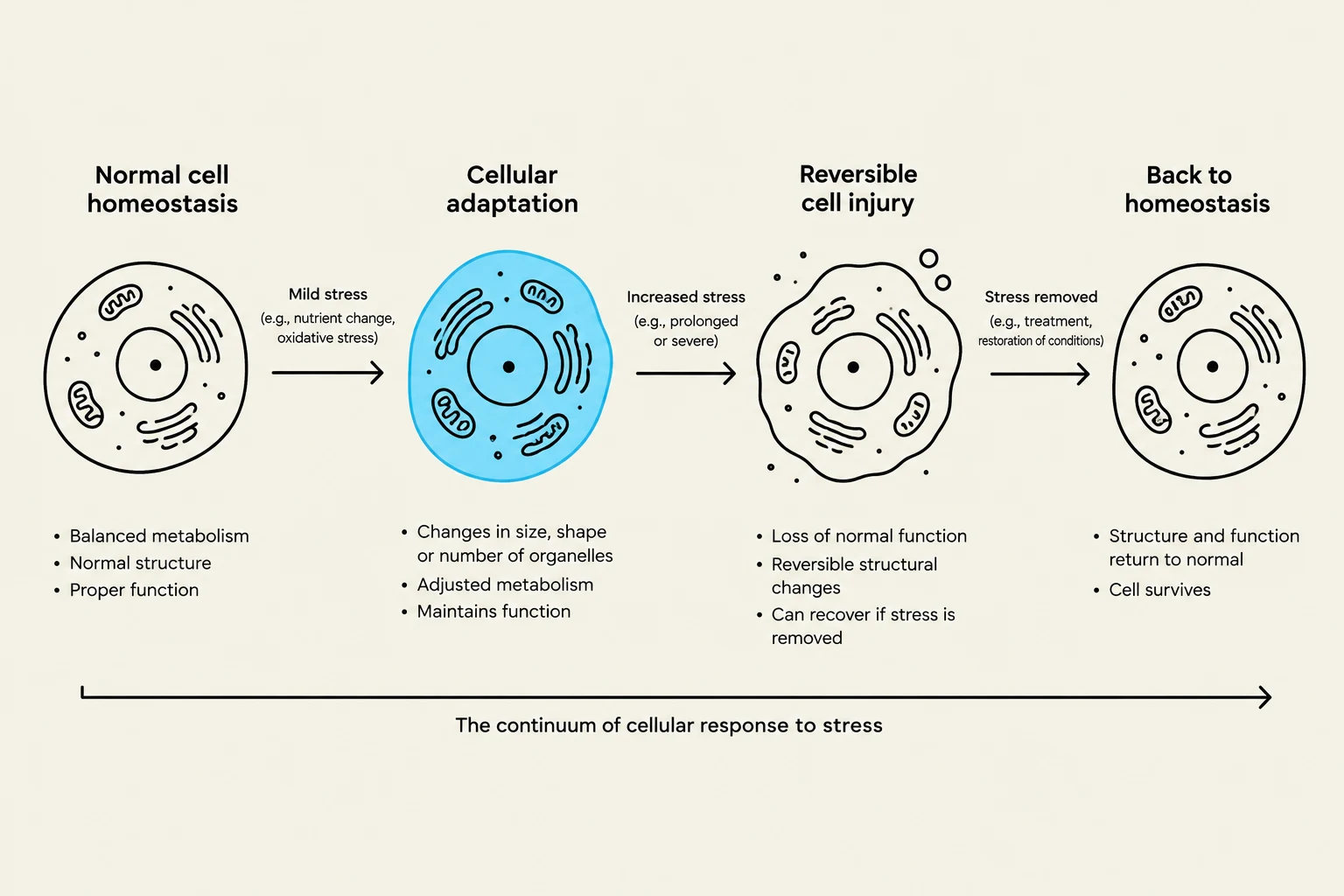
When a cell encounters a stimulus that deviates from its normal range, it can alter its size, number, or even its fundamental type to better suit the new environment. It is crucial to understand that these adaptations are generally reversible; if the stressor is removed, the cell can often return to its original state. However, if the stress exceeds the cell's adaptive capacity, the result is cell injury and, eventually, cell death.
The Spectrum of Adaptation vs. Injury
Before diving into specific mechanisms, it is helpful to visualize where adaptation sits on the spectrum of cellular health. Adaptation is a "middle ground" between normal physiological function and irreversible cell death.
Exam Tip: Always distinguish between adaptation (reversible) and injury (potentially irreversible). If a question asks about a change that can be undone by removing the stimulus, look for terms like hypertrophy, hyperplasia, or metaplasia.
Increasing Size and Number: Hypertrophy and Hyperplasia
When cells need to increase their functional capacity, they typically respond by increasing their mass or their population.
Hypertrophy
Hypertrophy is an increase in the size of individual cells, which subsequently leads to an increase in the size of the organ. This occurs in cells that have a limited capacity to divide (permanent cells), such as cardiac or skeletal muscle cells. The increase in size is driven by the synthesis of more structural proteins and organelles.
Keep reading for free.
Create an account to finish this reading and make it part of your study routine.
Continue reading freeAlready have an account? Log in
Updated