Cell Structures and Functions: Prokaryotes and Eukaryotes
An overview of the fundamental structures and functions of prokaryotic and eukaryotic cells, detailing organelles and their roles in cellular processes. Covers genetic material, protein synthesis, energy conversion, and structural support.
Cells are the fundamental units of life, serving as the building blocks for every living organism on Earth. While all cells share certain basic requirements—such as a plasma membrane to separate life from the nonliving environment—they vary significantly in complexity and organization. To understand how life functions at a microscopic level, we must distinguish between the two primary categories of cells: prokaryotes and eukaryotes, and explore the specialized "machinery" that allows them to thrive.
Prokaryotic Cell Structures
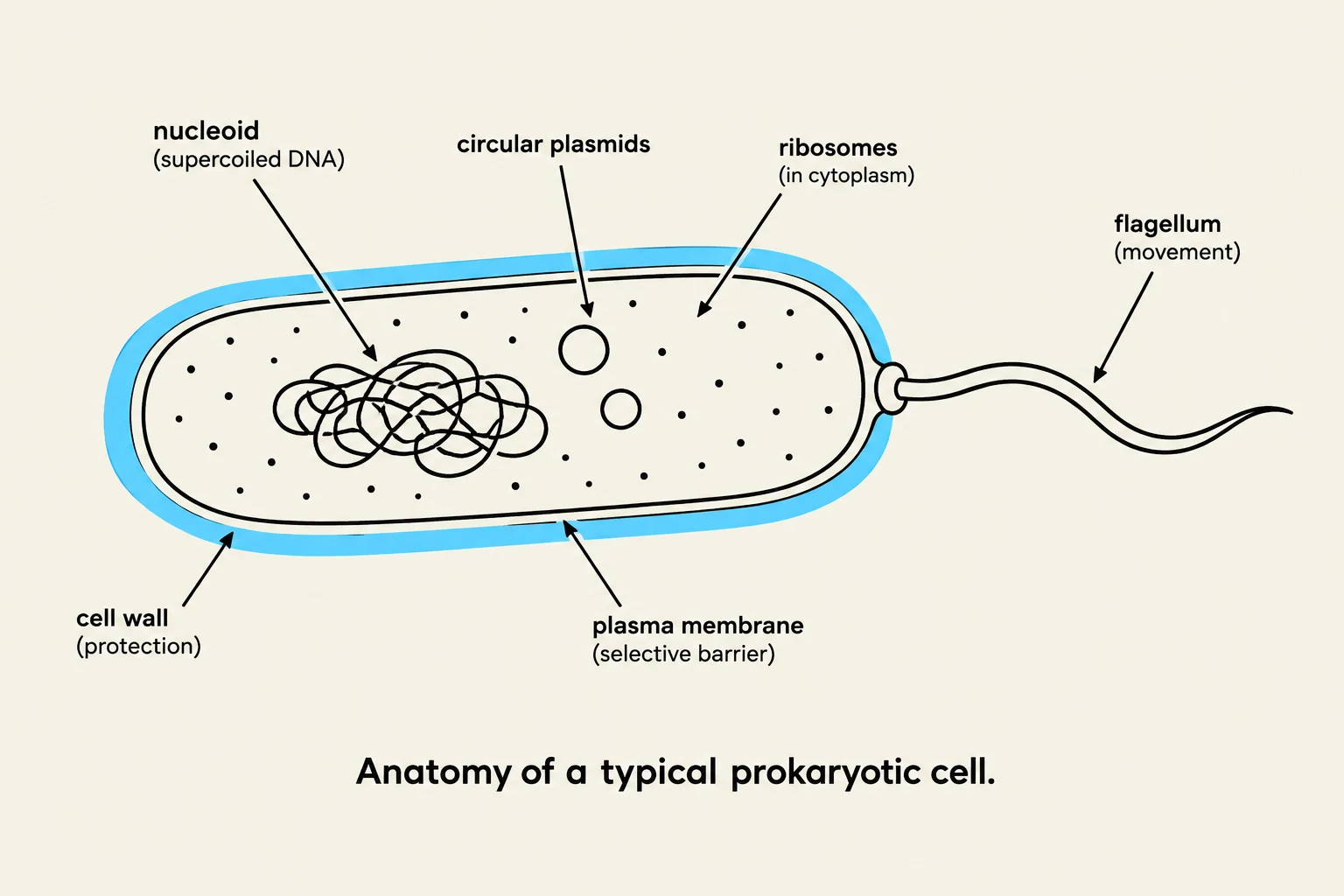
Anatomy of a typical prokaryotic cell.
Prokaryotic cells, which include bacteria and archaea, are generally smaller and simpler than eukaryotic cells. They lack membrane-bound organelles, meaning their chemical processes occur within the cytoplasm or across the plasma membrane rather than in specialized compartments.
Key features of a prokaryotic cell include:
Genetic Material: Instead of a nucleus, the DNA is organized into a chromosome located in a region called the nucleoid. To fit within this space, the chromosome is supercoiled. Many bacteria also possess plasmids, which are additional DNA molecules that help the cell adapt to unusual environmental circumstances.
Protein Synthesis: Ribosomes serve as the primary sites for protein synthesis.
Protection and Movement: Many bacteria utilize a cell wall to protect against osmotic stress. For movement, some species possess flagella.
Eukaryotic Cell Structures and Compartmentalization
Eukaryotic cells are characterized by their complexity and the presence of membrane-bound organelles. This organization leads to a phenomenon known as compartmentalization.
Study Tip: Why Compartmentalize?
Compartmentalization provides two major evolutionary advantages:
It separates incompatible chemical reactions (e.g., synthesis vs. degradation).
It increases efficiency by maintaining high concentrations of reactants and clustering enzymes together, which shortens the diffusion distance.
The Control and Manufacturing Centers
The Nucleus
The nucleus is the largest organelle in the eukaryotic cell. It is enclosed by a double membrane known as the nuclear envelope, which is supported by a structure called the nuclear lamina. The nucleus houses the cell's DNA and contains the nucleolus, the specific site where ribosomal RNA (rRNA) is synthesized and ribosomes are assembled.
The Endomembrane System
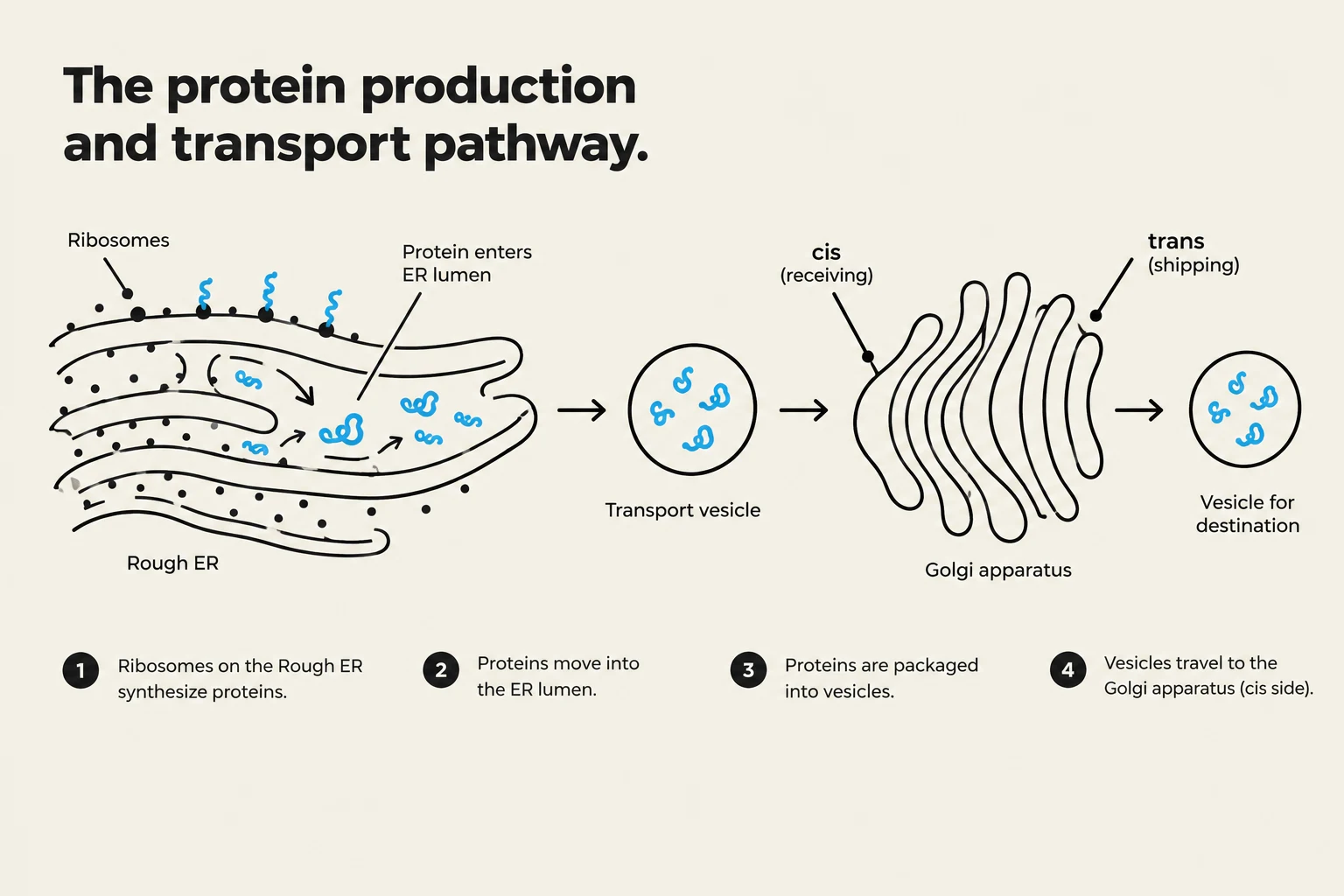
Diagram illustrating the pathway of protein production and transport within a cell, from ribosomes on the Rough ER to the Golgi apparatus and vesicles for destination.
The endomembrane system is a coordinated network responsible for the synthesis, modification, and transport of proteins and lipids.
Endoplasmic Reticulum (ER): This network of membrane-bound sacs and tubules has two distinct regions.
Rough ER: Studded with ribosomes on its cytoplasmic surface, it is the site where secreted and transmembrane proteins are synthesized. The lumen (internal space) of the ER contains enzymes that fold and modify these proteins.
Smooth ER: Lacks ribosomes and is specialized for lipid synthesis, the detoxification of harmful substances, and the storage of calcium ions.
Golgi Apparatus: Acting as the cell's "shipping center," the Golgi consists of flattened sacs called cisternae. It has a distinct polarity: the cis side receives proteins from the rough ER, while the trans side ships them to their final destinations.
Ribosomes: These molecular machines are found in the cytosol and are composed of two subunits (large and small). Their primary function is to synthesize proteins.
Waste Management and Oxidation
Lysosomes
Lysosomes are the cell's digestive system, involved in solid-waste processing and material storage. They maintain an acidic internal environment using a proton pump in their membrane. This acidity is crucial because lysosomes contain acid hydrolases—enzymes that function best in low-pH conditions to break down macromolecules.
Lysosomes acquire material through three main mechanisms:
Phagocytosis: "Cellular eating" of large particles.
Autophagy: The recycling of the cell's own damaged organelles.
Receptor-mediated endocytosis: The targeted ingestion of specific extracellular molecules.
Peroxisomes
Peroxisomes are centers for oxidation reactions. A byproduct of these reactions is hydrogen peroxide (H2O2), which can be toxic to the cell. To manage this, peroxisomes contain the enzyme catalase, which safely converts hydrogen peroxide into water and oxygen. In plants, specialized peroxisomes called glyoxosomes help convert products of photosynthesis into storable sugar.
Energy Conversion and Storage
Mitochondria and Chloroplasts
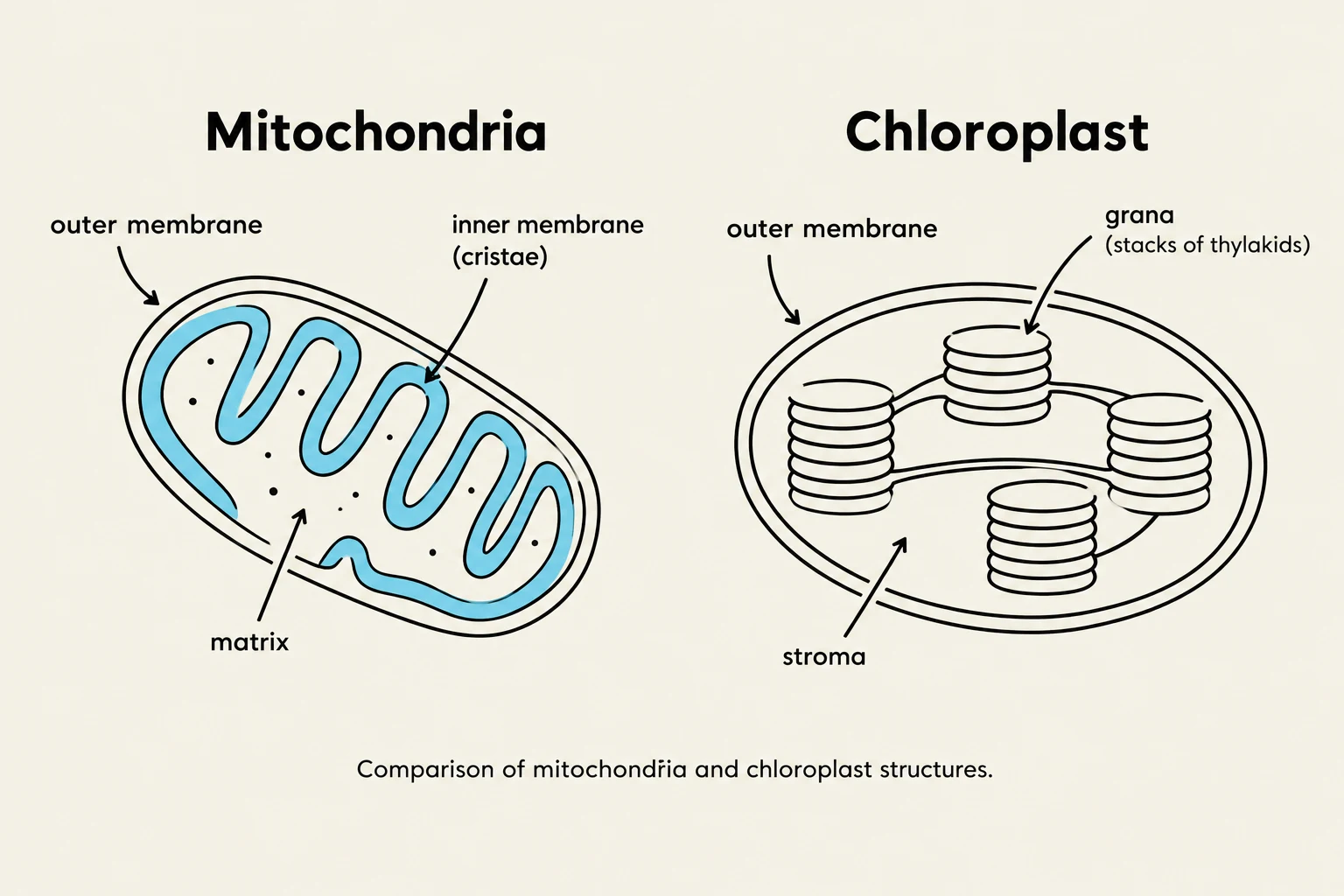
Comparison of mitochondria and chloroplast structures.
Both mitochondria and chloroplasts are unique in that they contain their own circular DNA and ribosomes, and they can divide independently of the cell.
Mitochondria: Known as the sites of ATP (energy) synthesis. They feature an outer membrane and an inner membrane that is folded into structures called cristae to increase surface area. The fluid inside the inner membrane is called the mitochondrial matrix.
Chloroplasts: Found in plants, these organelles convert sunlight into chemical energy in the form of sugar. They contain flattened sacs called thylakoids, which are stacked into structures called grana. The fluid surrounding the thylakoids is known as the stroma.
Vacuoles
In plant cells, vacuoles often occupy the majority of the cell's volume. They serve as massive storage depots for water, ions, and proteins, and can even store noxious substances to protect the plant from predators.
Structural Support: The Cytoskeleton and Cell Walls
While organelles handle chemical tasks, the cell requires a physical framework to maintain its shape and organize its contents.
The Cytoskeleton: This is a dynamic system of protein filaments. It provides structural support, facilitates cellular movement, aids in the transport of materials within the cell, and organizes all organelles into a cohesive unit.
Cell Walls: Unlike the flexible plasma membrane, cell walls provide rigid protection. They are found in algae, fungi, and plant cells, and are composed of carbohydrate rods and fibers embedded in a stiff polysaccharide matrix.
Keep reading for free.
Create an account to finish this reading and make it part of your study routine.