Explains the three main stages of cell signaling: reception, transduction, and response. Covers the role of the cell membrane, ligands, receptors, second messengers, and signal amplification in cellular communication.
In the complex environment of a multicellular organism, cells must constantly communicate to coordinate growth, metabolism, and movement. This communication is not achieved through direct contact alone, but through a sophisticated process known as a cell signaling pathway. At its core, this is a method of information transfer where an external stimulus is converted into a specific functional response within the cell. This process, known as signal transduction, allows a cell to sense its environment and react appropriately to maintain homeostasis.
The Biological Barrier: The Membrane Environment
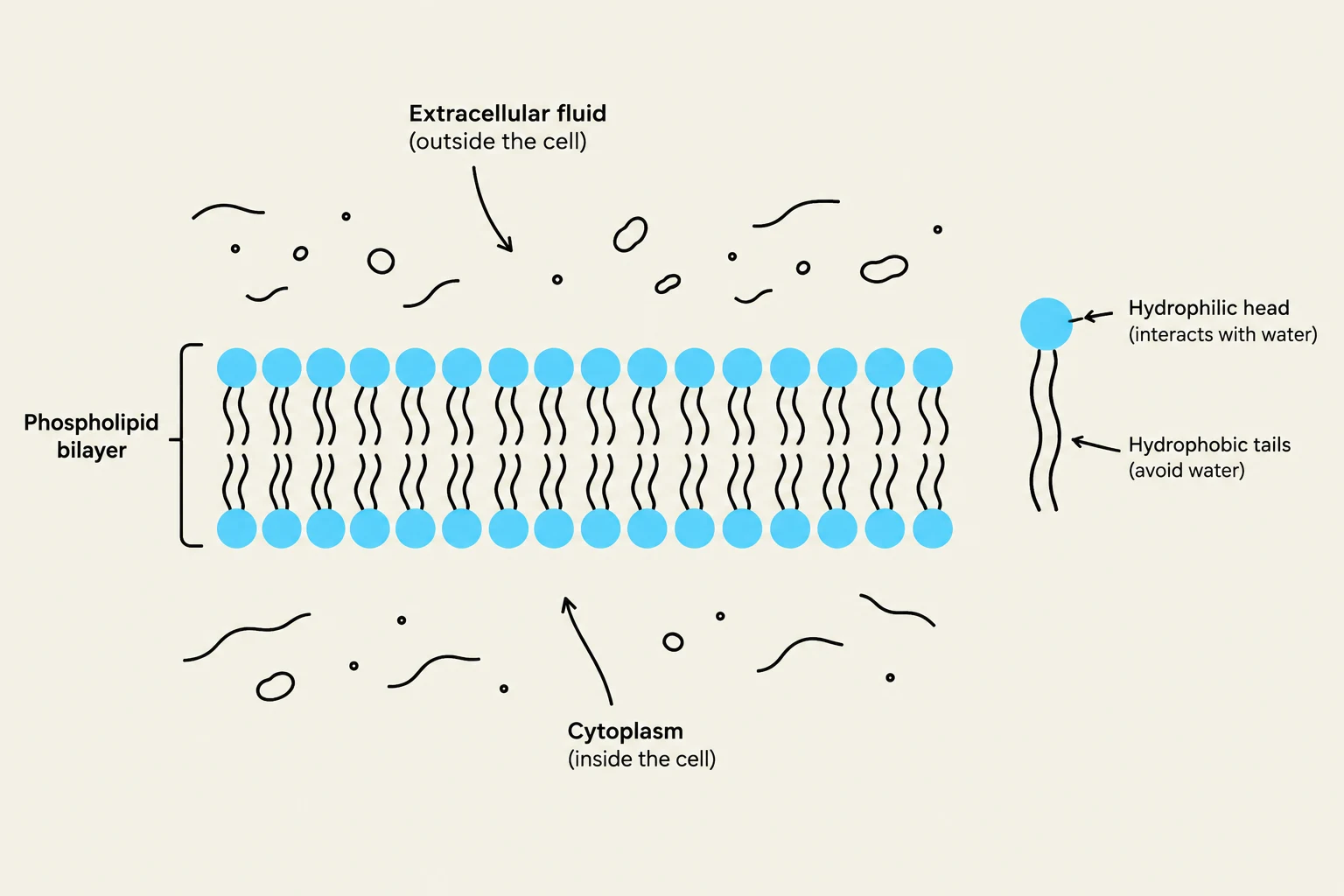
To understand how a signal moves from the outside to the inside, we must first look at the physical boundary of the cell. The cell is divided into two distinct chemical environments: the extracellular fluid, which surrounds the cell, and the cytoplasm, the internal jelly-like substance where most metabolic activities occur.
Separating these two environments is the biological membrane, specifically organized as a phospholipid bilayer. This bilayer consists of two layers of phospholipids, with hydrophilic (water-loving) heads facing the aqueous environments of the fluid and cytoplasm, and hydrophobic (water-fearing) tails tucked away in the center. This structure is crucial because it acts as a selective barrier, ensuring that the cell can regulate which signals enter and which molecules remain outside.
Diagram illustrating the structure of a phospholipid bilayer, showing hydrophilic heads interacting with extracellular fluid and cytoplasm, and hydrophobic tails avoiding water.
Exam Tip: Remember that the phospholipid bilayer is not just a wall; it is a functional platform. Without the specific arrangement of the bilayer, membrane-bound receptors would not be able to maintain the orientation necessary to catch ligands from the extracellular fluid.
Step 1: Reception – Catching the Signal
The signaling process begins with reception. A signaling molecule, often called a ligand or a first messenger, travels through the extracellular fluid. For a cell to "hear" this message, the ligand must bind to a specific membrane receptor—a protein embedded within the phospholipid bilayer.
The relationship between a ligand and its receptor is highly specific, much like a lock and key. Only a ligand with the correct shape and chemical properties can dock into the receptor's binding site. Once the ligand binds, the receptor undergoes a conformational change—a shift in its physical shape—which "notifies" the interior of the cell that a signal has arrived.
Step 2: Transduction – The Intracellular Relay
Once the receptor has changed shape, the signal must be carried from the membrane into the depths of the cell. This is the transduction phase. This stage is rarely a single step; instead, it is a cascade of molecular interactions that move the message forward.
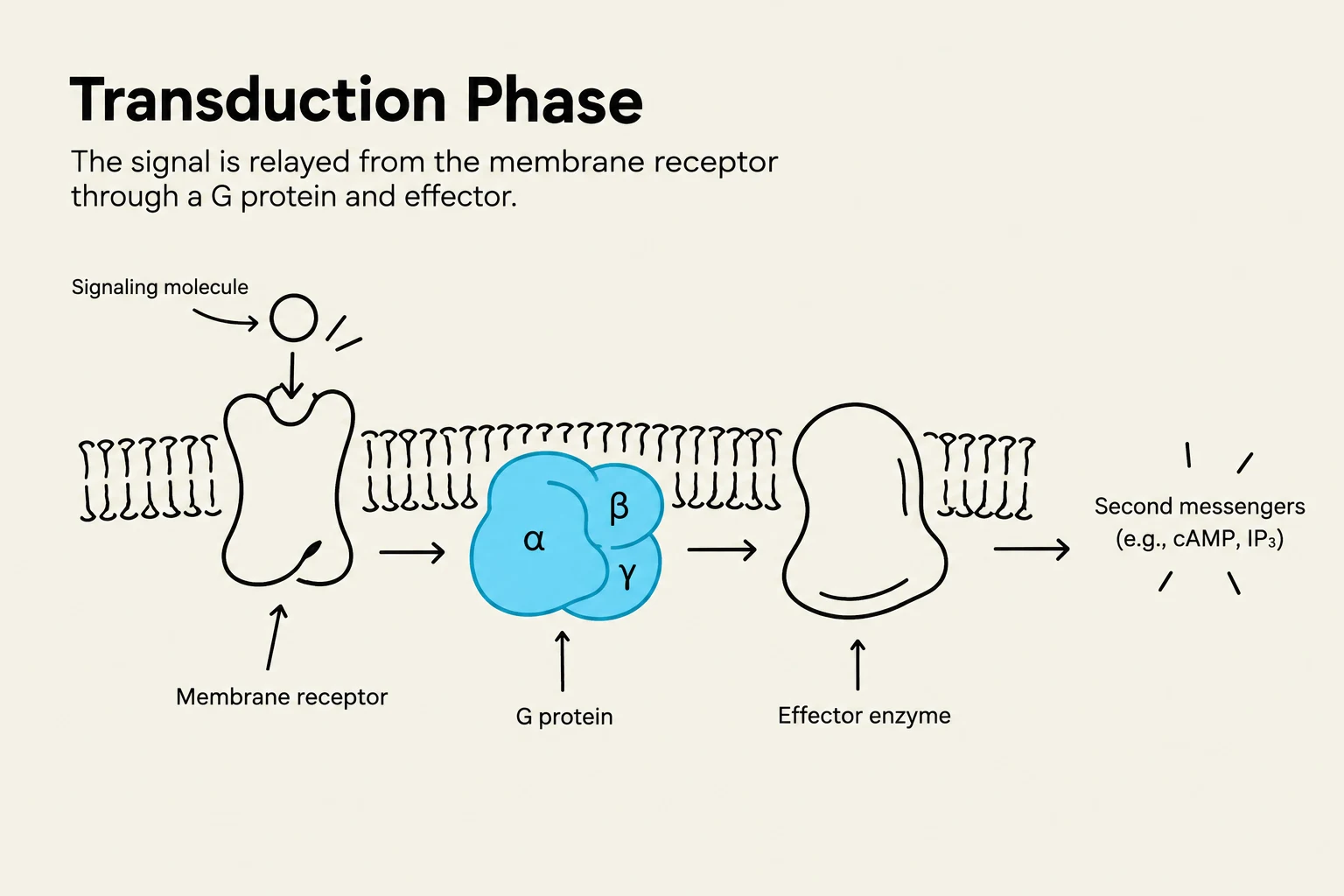
In many pathways, the activated receptor interacts with a G protein (a relay protein) located on the inner surface of the membrane. This G protein then activates an effector protein, such as an enzyme, which serves as the next link in the chain.
A critical component of transduction is the creation of second messengers. While the ligand is the "first messenger," second messengers are small, non-protein molecules (like cyclic AMP) that are released or activated within the cytoplasm to spread the signal rapidly.
Diagram illustrating the transduction phase of cell signaling, where a signaling molecule binds to a membrane receptor, activating a G protein which then interacts with an effector enzyme to produce second messengers.
Signal Amplification
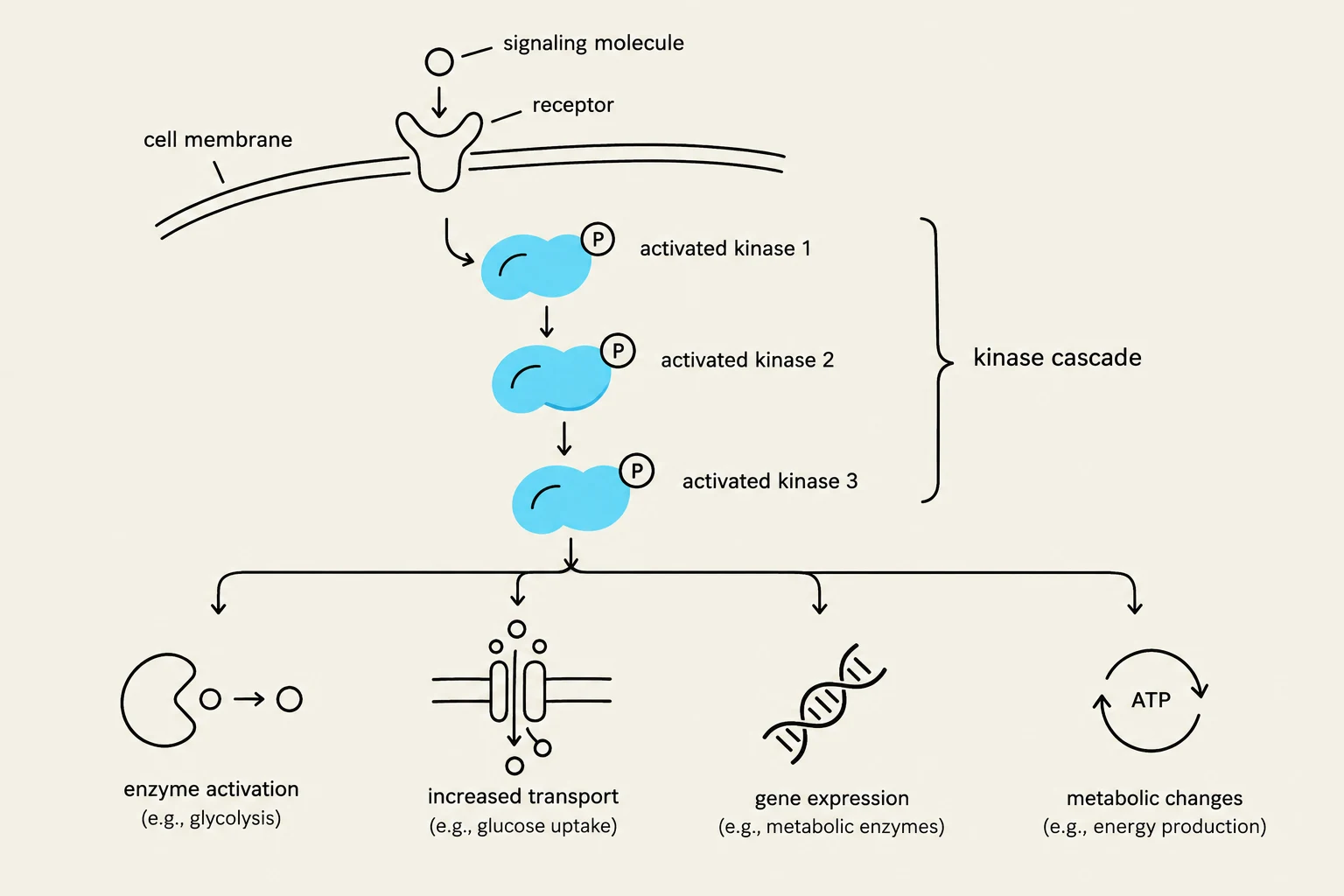
One of the most important features of the transduction phase is amplification. A single ligand binding to a single receptor does not just produce one result; instead, it triggers the production of many second messengers. These second messengers, in turn, activate various kinases (enzymes that add phosphate groups to other proteins).
Mathematically, we can think of this as an exponential increase in active molecules:
Signal Strength∝(Number of Activated Kinases)n
where n represents the number of steps in the cascade. This ensures that a very small external stimulus can result in a massive and rapid cellular response.
Step 3: Response – The Cellular Outcome
The final stage of the pathway is the cellular response. This is the "action" part of the process, where the transduced signal finally results in a change in the cell's behavior. Because the signal has been amplified and distributed through the cytoplasm, the response can be widespread and multifaceted.
Common types of cellular responses include:
Metabolic changes: Activating or deactivating enzymes to speed up or slow down chemical reactions (e.g., breaking down glycogen for energy).
Gene expression: Sending signals into the nucleus to turn specific genes "on" or "off," leading to the production of new proteins.
Structural changes: Modifying the cytoskeleton to allow the cell to move, change shape, or divide.
This diagram illustrates a kinase cascade, a signaling pathway where a series of kinases are activated sequentially. This cascade ultimately leads to various cellular responses, including enzyme activation, increased transport, gene expression, and metabolic changes.
Study Summary Table: The Three Stages of Signaling
Stage
Primary Location
Key Components
Main Function
Reception
Extracellular/Membrane
Ligand, Receptor
Detection of the external signal
Transduction
Membrane/Cytoplasm
G proteins, Second messengers, Kinases
Signal conversion and amplification
Response
Cytoplasm/Nucleus
Enzymes, DNA, Cytoskeleton
Execution of the biological command
By organizing these steps into a highly regulated sequence, the cell ensures that it only responds to the correct signals, at the correct time, and with the appropriate intensity.
Keep reading for free.
Create an account to finish this reading and make it part of your study routine.