Explores passive and active transport mechanisms across the cell membrane, including diffusion, osmosis, facilitated diffusion, filtration, endocytosis, and exocytosis. Discusses the role of concentration gradients, energy (ATP), and transport proteins in moving substances.
The cell membrane acts as a sophisticated gatekeeper, regulating the passage of substances to maintain the internal environment necessary for life. To ensure that nutrients enter and waste products exit, cells utilize various transport mechanisms. These mechanisms are broadly categorized into two types: passive transport, which requires no energy, and active transport, which requires the expenditure of cellular energy.
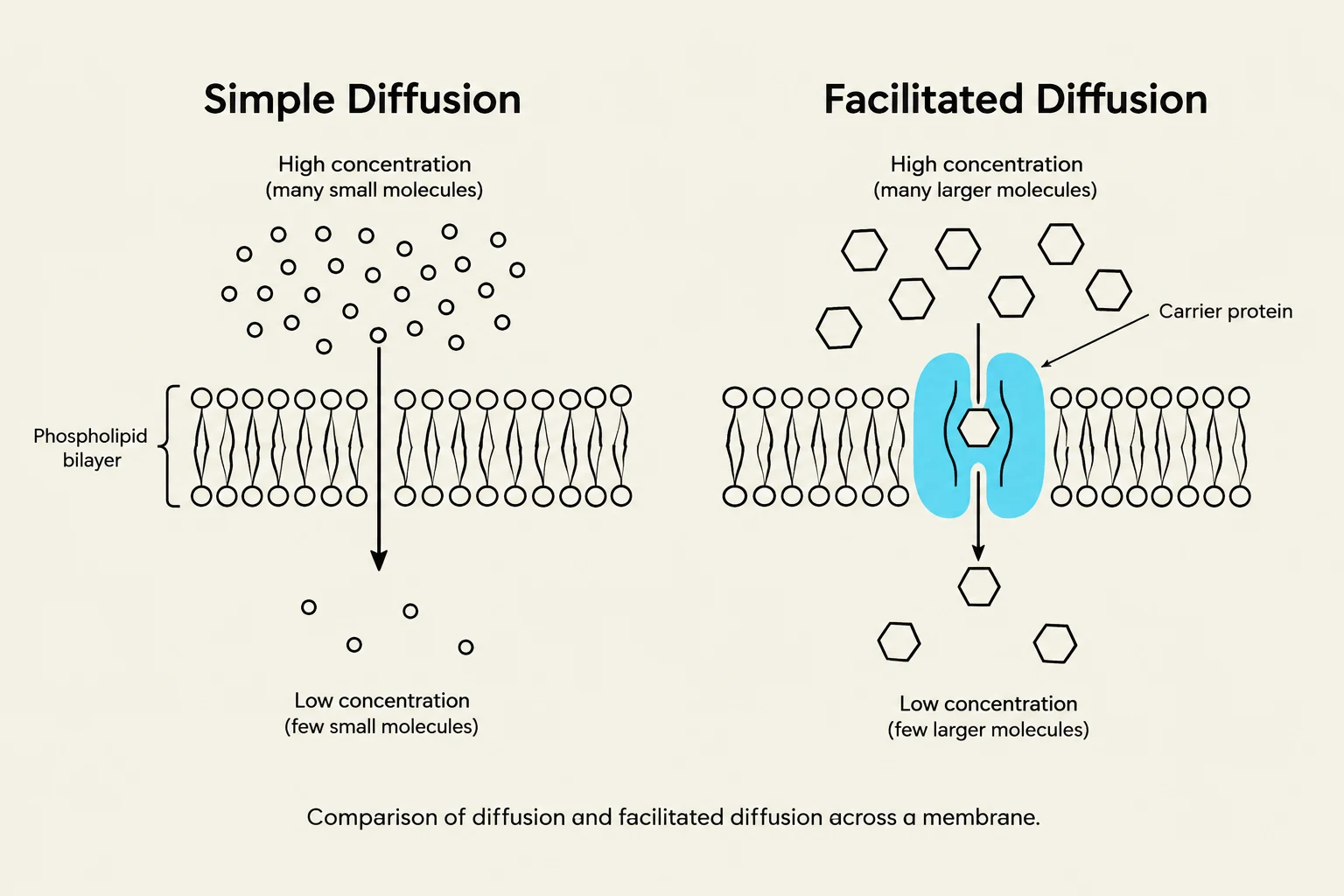
Comparison of simple diffusion and facilitated diffusion across a cell membrane, illustrating the movement of molecules from high to low concentration with and without the assistance of a carrier protein.
Passive Transport Mechanisms
Passive transport refers to the movement of substances across the cell membrane without the expenditure of cellular energy. In these processes, substances typically move down their concentration gradient—from an area of high concentration to an area of low concentration.
Diffusion and Facilitated Diffusion
Diffusion is the spontaneous movement of a substance from an area of high concentration to an area of low concentration.
While some small molecules can pass directly through the membrane, others require assistance. Facilitated diffusion involves a "helper molecule" (such as a carrier protein) that assists the movement of substances from an area of high concentration to an area of low concentration.
Osmosis and Tonicity
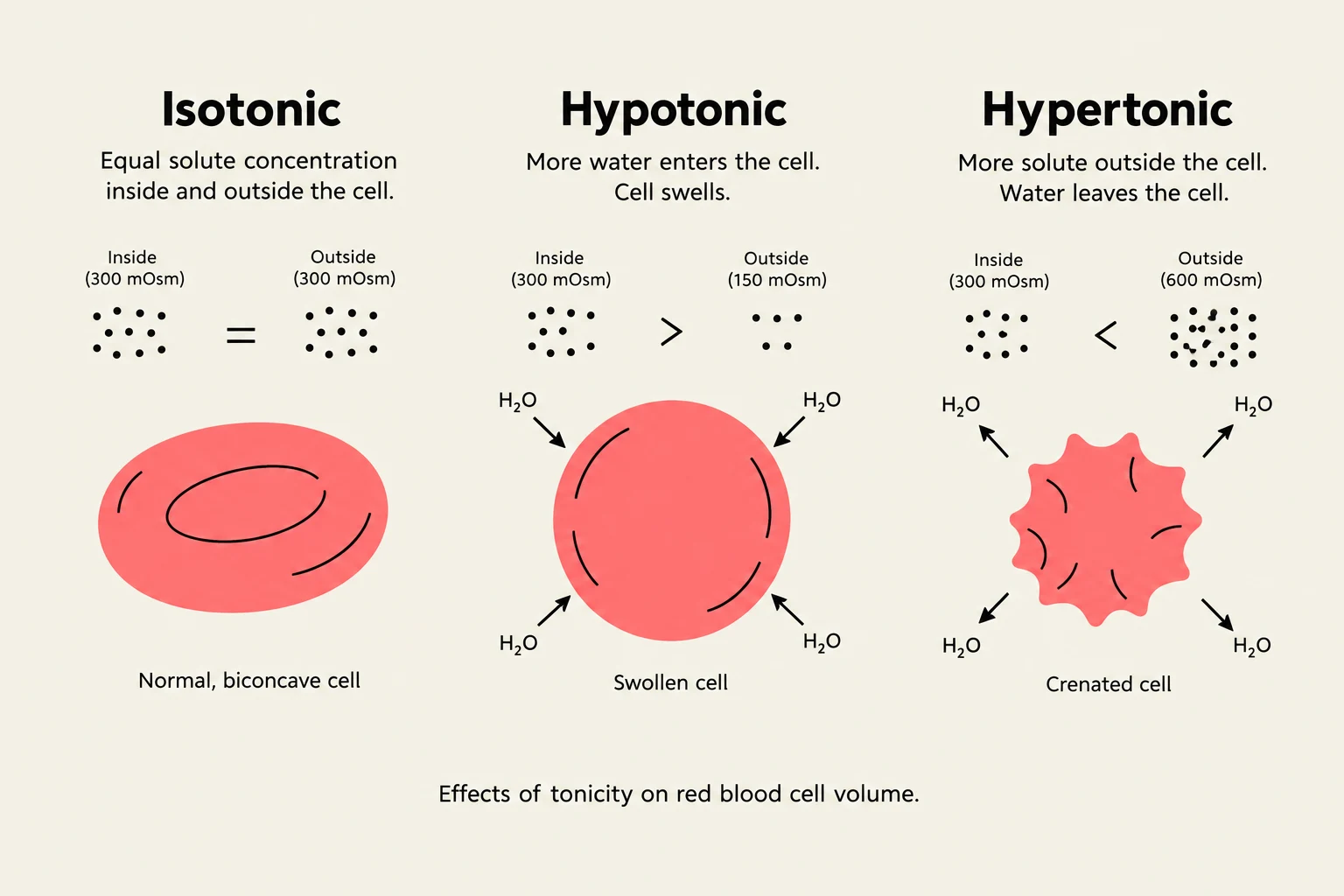
Diagram illustrating the effects of isotonic, hypotonic, and hypertonic solutions on red blood cell volume, showing how water movement affects cell shape.Osmosis is a specific type of diffusion involving the movement of water (the solvent) across a semipermeable membrane. Water moves from an area with a higher concentration of water to an area with a lower concentration of water.
The effect of a solution on a cell's volume and pressure is known as tonicity. Understanding tonicity is crucial in clinical settings, particularly when considering how different solutions affect red blood cells (RBCs):
Isotonic solution: The concentration of the solution is the same as the intracellular fluid, resulting in no net movement of water and no change in cell volume.
Hypotonic solution: The solution has a lower concentration of solutes than the cell. This causes water to rush into the cell, which can cause red blood cells to burst (lyse).
Hypertonic solution: The solution has a higher concentration of solutes than the cell. This causes water to leave the cell, leading the red blood cells to shrink (crenate).
Exam Tip: Remember that "Hypo" sounds like "Hippo"—a hypotonic solution makes the cell swell up like a big hippo!
Filtration
Filtration is a passive process driven by physical force rather than concentration gradients alone. It involves the pushing of water and dissolved substances from an area of high pressure to an area of low pressure.
Active Transport Mechanisms
Unlike passive transport, active transport requires the cell to expend energy to move substances. This is necessary when the cell needs to move substances "uphill"—that is, from an area of low concentration to an area of high concentration.
The Active Transport Pump and ATP
To move substances against their concentration gradient, the cell utilizes an active transport pump. This process requires an input of energy in the form of ATP (adenosine triphosphate).
Example: The Potassium Pump
A vital physiological example is the movement of potassium ($K^+$). The cell naturally maintains a higher concentration of potassium inside the cell than in the surrounding vascular space. To move potassium into the cell despite this gradient, the cell must use energy (ATP) via an active transport pump.
Bulk Transport: Endocytosis and Exocytosis
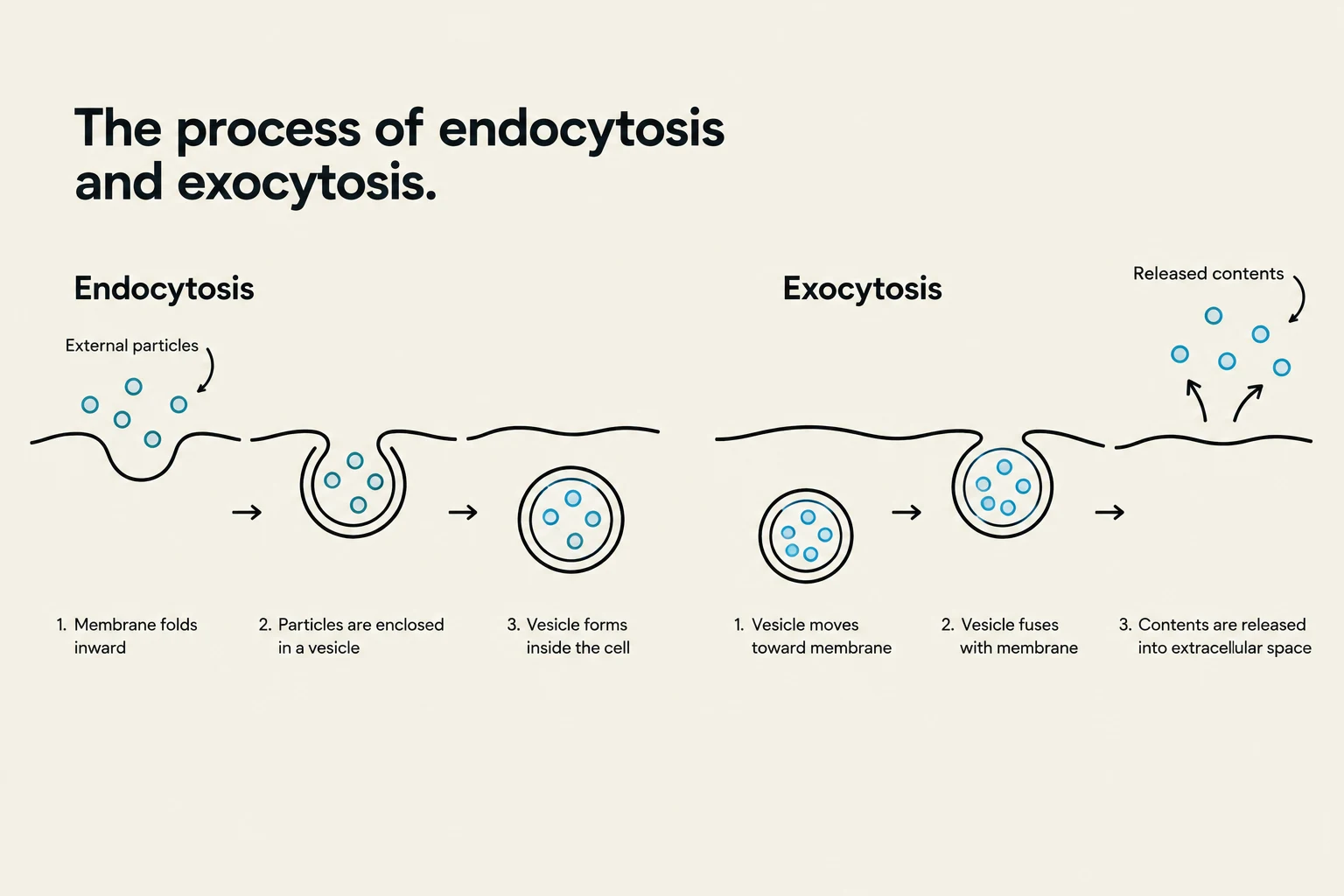
Diagram illustrating the biological processes of endocytosis and exocytosis, showing how cells take in and release substances.
When cells need to move large quantities of materials or very large particles, they use bulk transport mechanisms.
Endocytosis
Endocytosis is the process of taking in or ingesting substances by the cell membrane. This can be further categorized into two types:
Phagocytosis: Often called "cell eating," this involves the cell membrane engulfing solid particles. A common example is white blood cells (WBCs) engulfing and destroying bacteria.
Pinocytosis: Often called "cell drinking," this involves the engulfing of liquid droplets.
Exocytosis
Exocytosis is the opposite of endocytosis. It is the process by which the cell secretes cellular products out of the cell.
Keep reading for free.
Create an account to finish this reading and make it part of your study routine.