Explains the cell cycle, its phases (Interphase and Mitotic phase), checkpoints (G1, G2, M), and molecular regulators (cyclins, Cdks, tumor suppressors). Details how failures in regulation lead to cancer, including proto-oncogenes, oncogenes, and metastasis.
The cell cycle is a highly organized process that allows cells to grow, replicate their DNA, and divide into two identical daughter cells. In multicellular organisms, this process is essential for growth, tissue repair, and the replacement of old cells. However, because cell division involves the replication of genetic material, it carries inherent risks. To ensure accuracy, the cell employs a sophisticated control system to monitor the health and readiness of the cell at various stages. When these regulatory mechanisms fail, the result can be the uncontrolled proliferation known as cancer.
The Mechanics of the Cell Cycle
The eukaryotic cell cycle is divided into two main phases: Interphase and the Mitotic phase.
Interphase
Interphase is the period of preparation and growth that occupies the majority of the cell's life. It consists of three distinct sub-phases:
G1 (First Gap): The cell grows and increases its cytoplasmic volume.
S (Synthesis): The cell duplicates its chromosomes, ensuring that each new cell will have a complete set of DNA.
G2 (Second Gap): The cell continues to grow and prepares specifically for division.
If a cell receives signals that it is not time to divide, or if it lacks the necessary nutrients, it may exit the cycle and enter the G0 phase, a non-dividing state.
Mitosis and Cytokinesis
The Mitotic phase involves the actual division of the cell. Mitosis is the process of dividing the nucleus to ensure daughter cells receive identical sets of chromosomes. This is followed by cytokinesis, where the cytoplasm is physically divided into two separate cells.
Study Tip: Remember the order of mitosis stages using the mnemonic PMAT: Prophase, Metaphase, Anaphase, and Telophase.
Checkpoints: The Cell's Quality Control
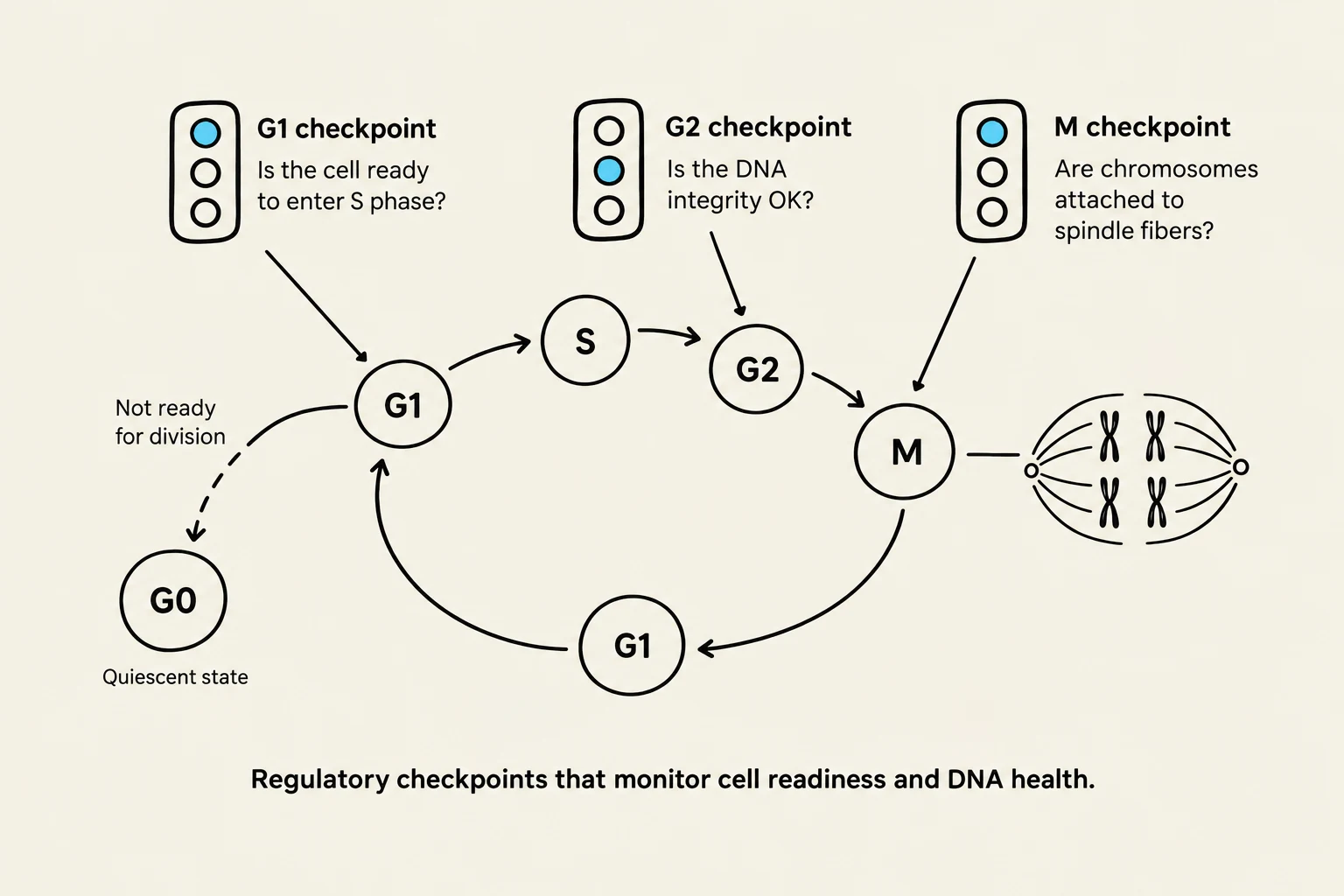
This diagram illustrates the cell cycle with its regulatory checkpoints: G1, G2, and M checkpoints, which ensure cell readiness and DNA health before division.
To prevent errors—such as damaged DNA being passed on to offspring—the cell utilizes a control system consisting of checkpoints. These checkpoints act as "stop or go" signals that monitor specific cellular conditions.
G1 Checkpoint: This is a critical decision point. The cell determines if it is large enough and has enough nutrients to proceed. If conditions are not met, the cell may enter the G0 phase.
G2 Checkpoint: This checkpoint ensures that DNA replication in the S phase was completed accurately and that the DNA is not damaged before the cell enters mitosis.
M Checkpoint: Occurring during metaphase, this checkpoint ensures that all chromosomes are properly attached to the mitotic spindle before anaphase begins.
Normal cells also follow two important physical rules:
Density-dependent inhibition: Cells stop dividing when they become too crowded and come into contact with one another.
Anchorage dependence: Most cells must be attached to a solid surface, such as the extracellular matrix, to divide.
Molecular Regulators: Positive and Negative
The movement through the cell cycle is governed by two groups of intracellular molecules: positive regulators and negative regulators.
Positive Regulators
Positive regulators promote the progression of the cell cycle. The primary players here are cyclins and cyclin-dependent kinases (Cdks).
Cyclins are proteins whose concentrations fluctuate predictably throughout the cycle.
Cdks are enzymes that are activated when they bind to specific cyclins.
When a cyclin reaches a certain level, it binds to its partner Cdk, forming a complex (such as the Maturation-Promoting Factor, or MPF) that triggers the next phase of the cycle through phosphorylation.
Negative Regulators
Negative regulators act as "brakes" to stop the cell cycle if something is wrong. Key negative regulators include:
Retinoblastoma protein (Rb): Prevents the cell from progressing past the G1 checkpoint until it is ready.
p53: A protein that can halt the cycle to allow for DNA repair or trigger cell death if the damage is irreparable.
p21: An inhibitor that helps stop the cycle in response to signals from p53.
When Regulation Fails: Cancer
This diagram illustrates how mutations in regulatory genes can lead to uncontrolled cell growth, a hallmark of cancer. In a normal cell, oncogenes promote cell division and tumor suppressor genes prevent uncontrolled growth, maintaining a balanced cell cycle. In a cancer cell, mutations can cause oncogenes to become hyperactive, driving excessive cell division, while tumor suppressor genes may be broken, failing to stop this growth, resulting in uncontrolled division.
Cancer is essentially a disease of the cell cycle. Cancer cells are those that have escaped the normal regulatory controls. They often divide rapidly, ignore growth factor requirements, and lack density-dependent inhibition.
Genetic Drivers of Cancer
The transition from normal to cancerous growth usually involves mutations in two types of genes:
Proto-oncogenes to Oncogenes: Proto-oncogenes are normal genes that code for positive regulators. When these genes mutate, they can become oncogenes, which are "overactive" versions of the gene that constantly signal the cell to divide.
Tumor Suppressor Genes: These genes code for negative regulators that prevent uncontrolled division. If these genes are mutated or inactivated, the cell loses its ability to stop the cycle even when DNA is damaged.
Tumors and Metastasis
Uncontrolled cell division leads to the formation of a tumor, which is an abnormal mass of cells.
Benign tumors: These remain at the original site of formation and do not spread.
Malignant tumors: These are cancerous. They can invade surrounding tissues and spread to other parts of the body through the blood or lymph systems.
The process by which cancer cells spread to distant organs is known as metastasis.
Keep reading for free.
Create an account to finish this reading and make it part of your study routine.