Cell Communication: Signaling Mechanisms and Cellular Responses
Explore the fundamental process of cell communication, including the purpose of signaling, the roles of ligands and receptors, different types of cell signaling, and the three stages of signal transduction leading to cellular responses.
In the complex world of biology, cells are not isolated islands. Instead, they exist in a constant state of dialogue with their surroundings and one another. Cell communication is the fundamental process by which cells detect, interpret, and respond to signals in their environment. This ability to "listen" to the world allows organisms to survive changing conditions and enables multicellular organisms to function as a single, coordinated unit.
The Purpose of Signaling
Cells utilize signaling for two primary reasons: sensing environmental changes and facilitating cell-to-cell coordination.
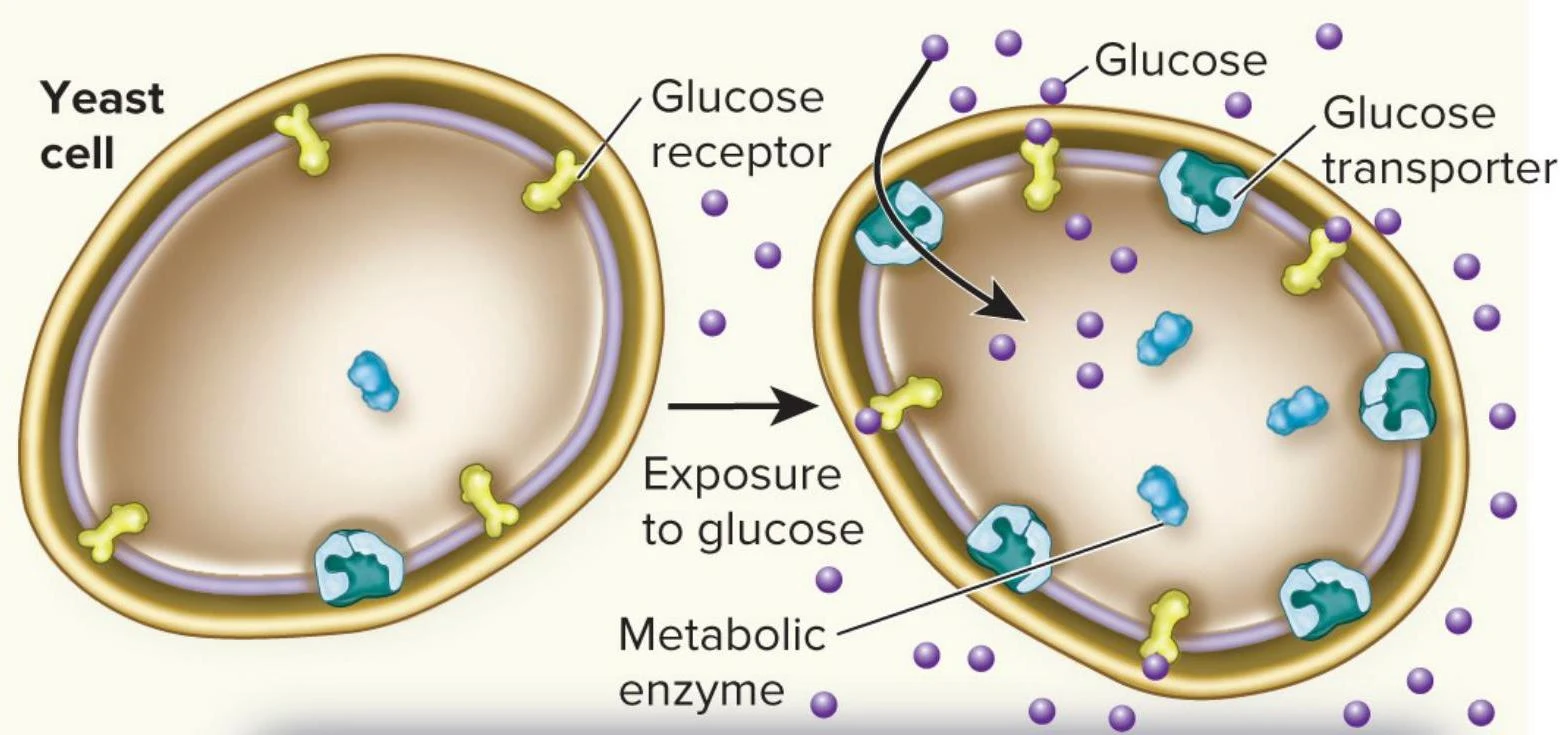
First, sensing the environment is critical for survival. For example, when yeast cells detect glucose in their environment, they respond by increasing the number of glucose transporters and metabolic enzymes to efficiently uptake and use that energy.
Diagram illustrating glucose uptake by a yeast cell via glucose transporters and receptors, and the presence of metabolic enzymes within the cell.
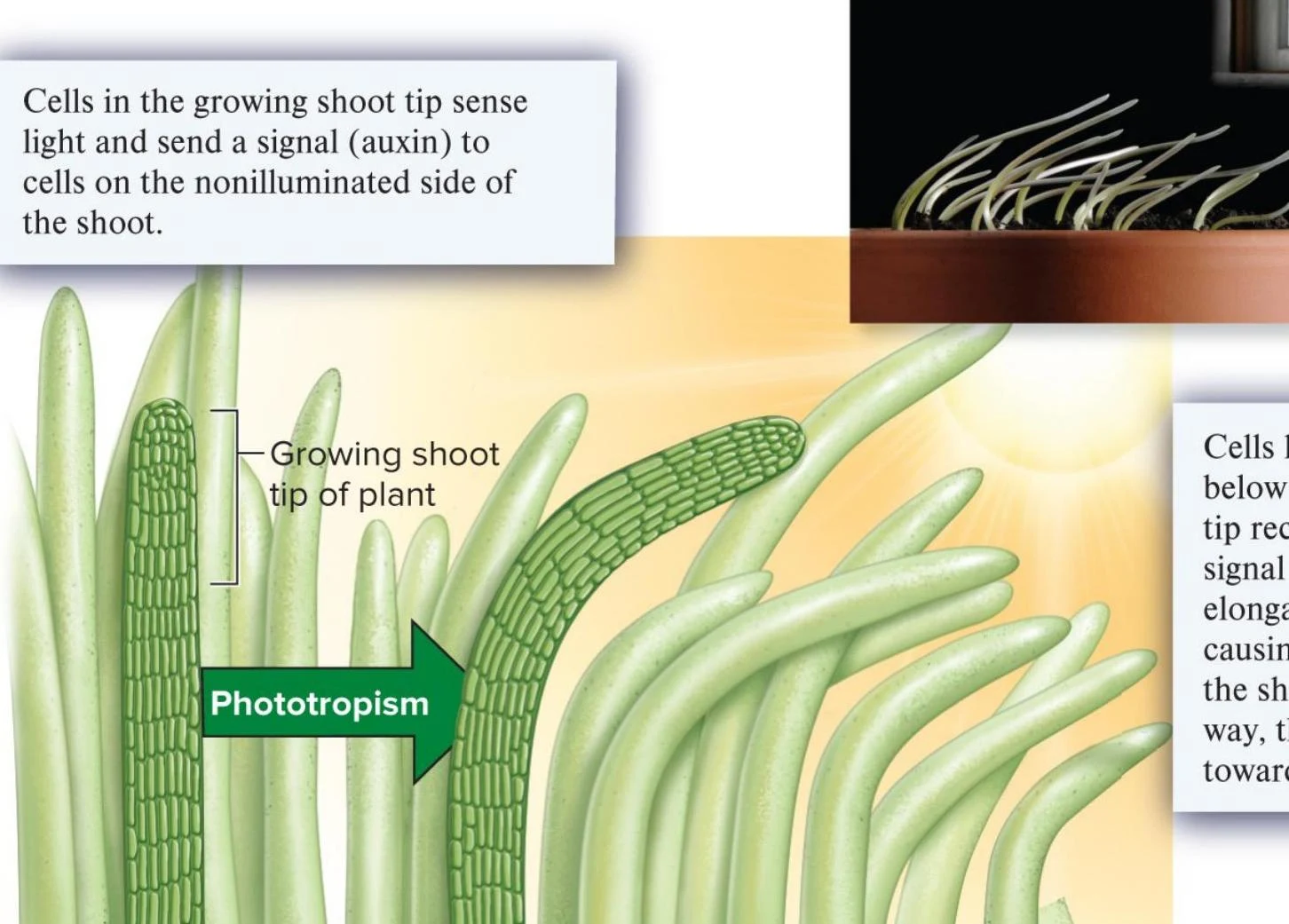
Second, in multicellular organisms, signaling allows cells to share information to coordinate complex behaviors. A classic example is phototropism in plants. When a plant shoot senses light, the hormone auxin is transmitted to the cells on the nonilluminated side, causing them to elongate and bending the shoot toward the light.
This illustration depicts phototropism, the growth of a plant in response to light. The growing shoot tip senses light and sends a signal, auxin, to cells on the nonilluminated side, causing them to elongate and bend the shoot towards the light.
Signals can even be used to trigger apoptosis, or programmed cell death, ensuring that damaged or unnecessary cells are removed from the organism.
The Language of Cells: Ligands and Receptors
To communicate, cells use specific molecular "keys" and "locks." The ligand is the signaling molecule (such as an ion or a small molecule) that binds to a protein. The receptor is the cellular protein that recognizes the ligand and undergoes a change in shape to transmit the message.
The interaction between a ligand and a receptor is highly specific, often described by a "lock-and-key" or "induced-fit" model. This binding is reversible and can be quantified by the dissociation constant (Kd), which is inversely related to the affinity between the ligand and the receptor. The relationship is expressed as:
Exam Tip: Remember that a lowerKd value indicates a higher affinity between the ligand and the receptor. When the ligand concentration is significantly higher than the Kd, most receptors will be occupied.
Unlike an enzyme, which chemically transforms a substrate into a new product, a receptor typically does not alter the chemical structure of its ligand; instead, the binding induces a conformational change in the receptor that activates its function.
Five Types of Cell Signaling
Cells use different mechanisms to send signals depending on the distance the message must travel and the intended target.
Signaling Type
Distance
Mechanism
Key Example
Direct Intercellular
Immediate
Molecules pass through cell junctions (e.g., gap junctions)
Heart muscle electrical coordination
Contact-Dependent
Adjacent
Membrane-bound ligand binds to an adjacent receptor
Embryonic development (Notch signaling)
Autocrine
Self
Cell secretes signals that bind to its own surface
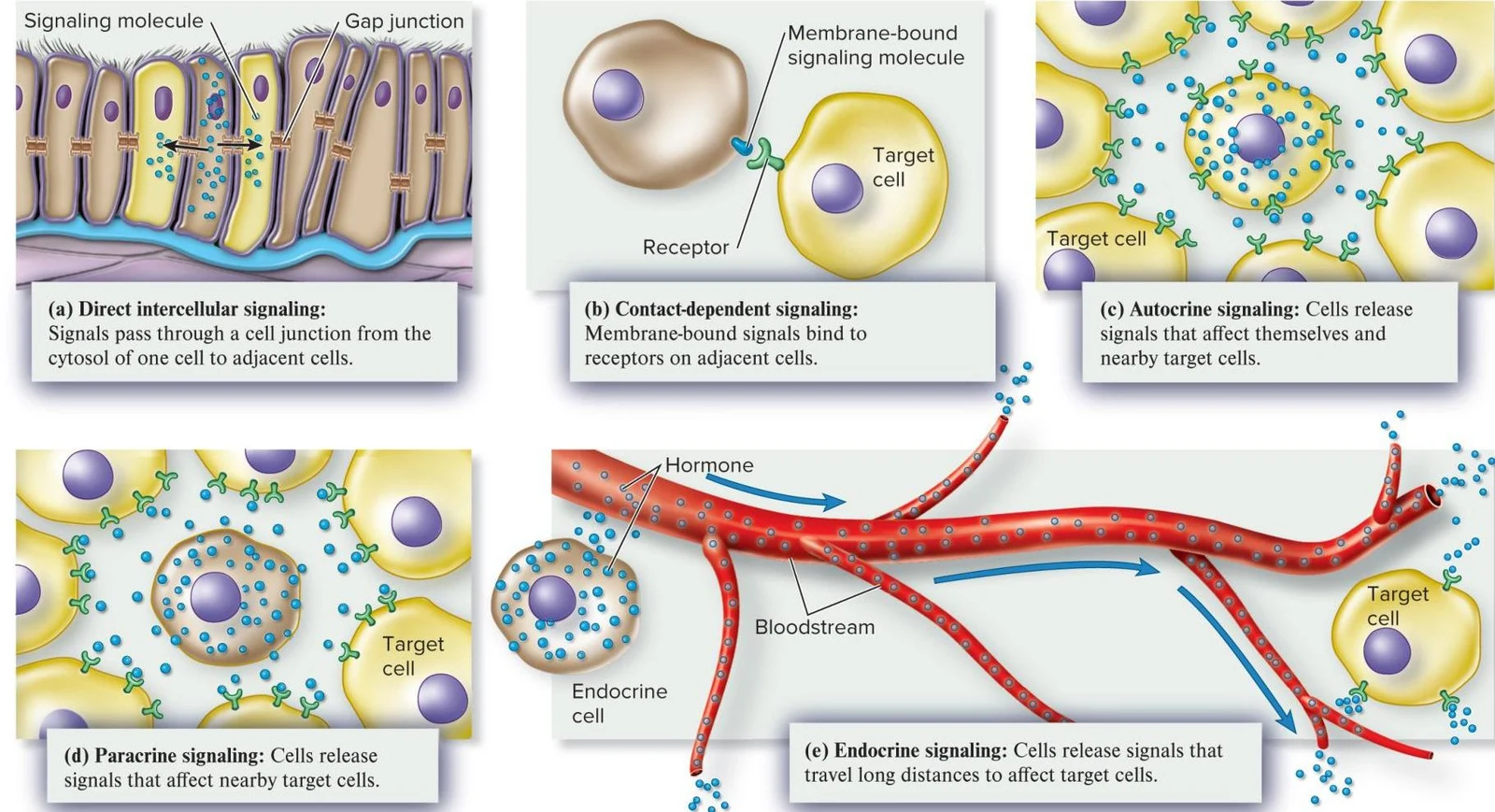
This illustration depicts five types of cell signaling: direct intercellular signaling, contact-dependent signaling, autocrine signaling, paracrine signaling, and endocrine signaling.
The Three Stages of Signaling
Regardless of the type, the process of cell signaling generally follows three distinct stages:
1. Receptor Activation
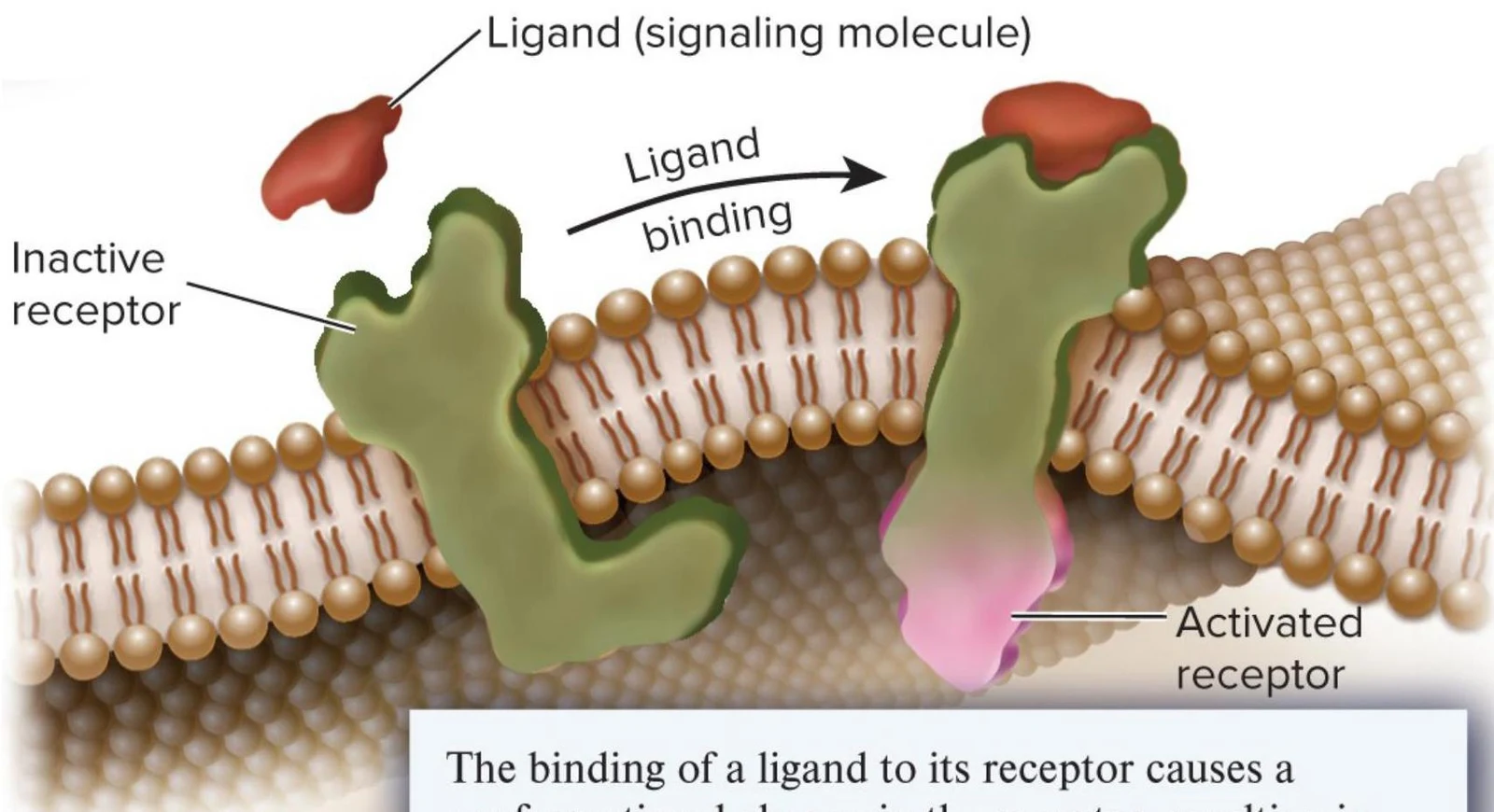
The signaling molecule (ligand) binds to the receptor, causing a conformational change that activates the receptor's function.
Illustration showing a ligand binding to an inactive receptor on a cell membrane, leading to an activated receptor.
2. Signal Transduction
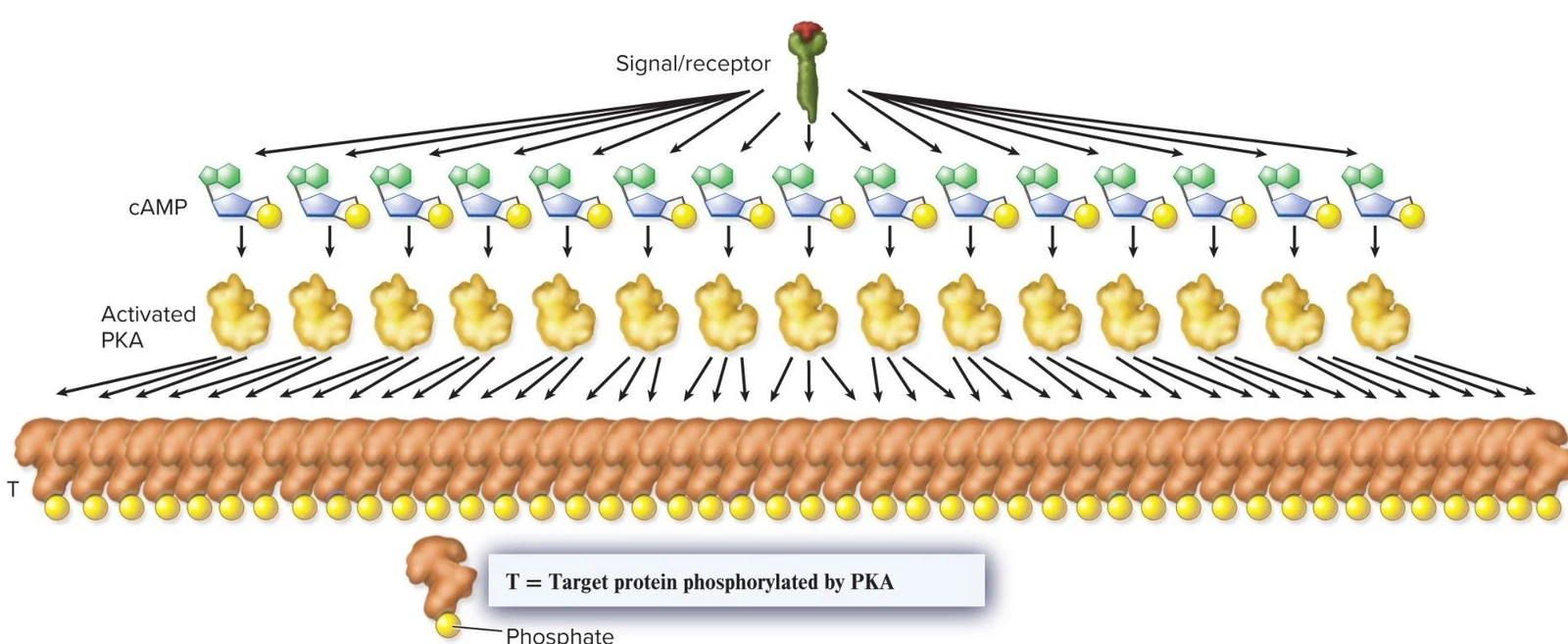
The activated receptor initiates a signal transduction pathway, which is a sequence of protein changes that convert the initial extracellular signal into a different intracellular signal. This often involves second messengers—small, non-protein, water-soluble molecules like cAMP or calcium ions that rapidly relay the signal throughout the cell.
Second messengers offer two major advantages:
Signal Amplification: A single ligand binding to one receptor can trigger the production of many second messenger molecules, which in turn activate many more proteins.
Speed: They can diffuse rapidly through the cytosol.
This diagram illustrates the signal transduction pathway initiated by a signal/receptor, leading to the activation of cAMP and subsequently PKA. Activated PKA then phosphorylates target proteins.
3. Cellular Response
The pathway culminates in a specific action within the cell. Common responses include:
Altering enzyme activity: Changing metabolic pathways (e.g., breaking down glycogen).
Changing structural proteins: Altering cell shape or movement.
Regulating gene expression: Affecting transcription factors to turn specific genes on or off.
Major Classes of Receptors
Receptors are categorized by their location and how they function:
Enzyme-linked receptors: These have an extracellular binding domain and an intracellular domain with catalytic activity (often a protein kinase). An example is the Epidermal Growth Factor (EGF) receptor, which triggers a kinase cascade to stimulate cell division.
G-protein-coupled receptors (GPCRs): These interact with a separate G-protein. When a ligand binds, the G-protein exchanges GDP for GTP, causing it to dissociate and activate downstream effectors like adenylyl cyclase.
Ligand-gated ion channels: Binding of a ligand opens or closes a channel, allowing ions to flow across the membrane.
Intracellular receptors: Found in the cytosol or nucleus, these bind to ligands (like steroid hormones) that can diffuse through the plasma membrane.
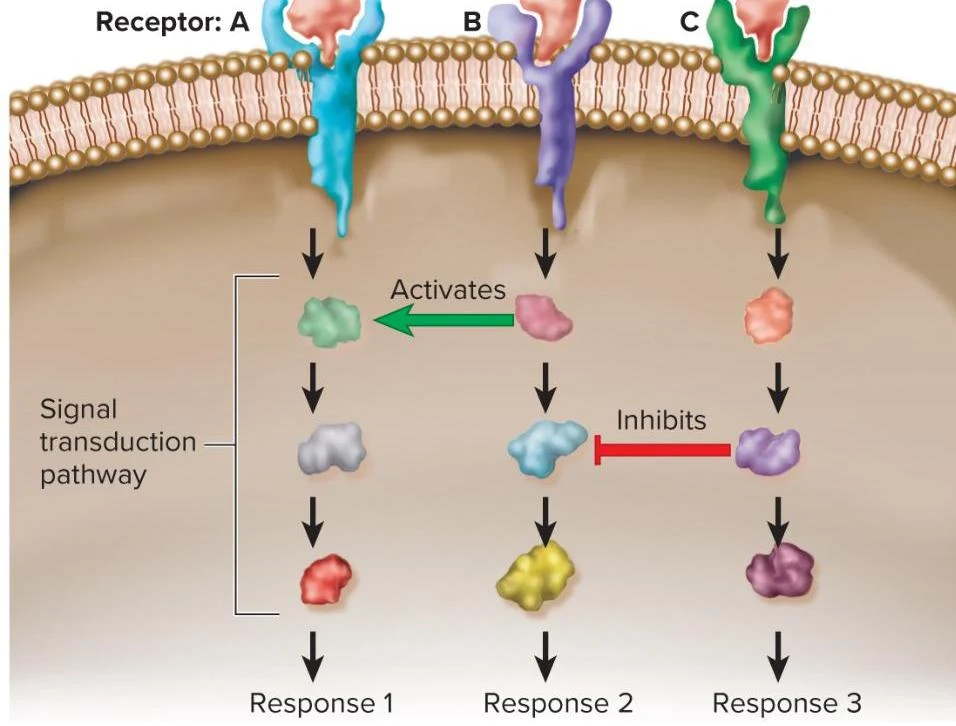
Note on Crosstalk: Signaling pathways do not exist in isolation. Crosstalk occurs when components of one pathway affect another, allowing the cell to integrate multiple signals to produce a finely tuned response.
This diagram illustrates three different signal transduction pathways initiated by receptors A, B, and C. Pathway B shows activation and inhibition steps, leading to Response 2, while pathways A and C lead to Responses 1 and 3 respectively.
Keep reading for free.
Create an account to finish this reading and make it part of your study routine.