An overview of fundamental cell structures and functions, cell division (mitosis and meiosis), the innate and adaptive immune responses, pathogen evasion strategies, and principles of genetics, epigenetics, and biotechnology.
Understanding the fundamental mechanisms of life requires a dual focus: the internal machinery of the cell and the complex defense systems that protect the organism from external threats. This review explores the architecture of the cell, the processes of genetic division, the intricacies of the immune response, and the genetic principles that govern inheritance and modern biotechnology.
Cell Structure and Function
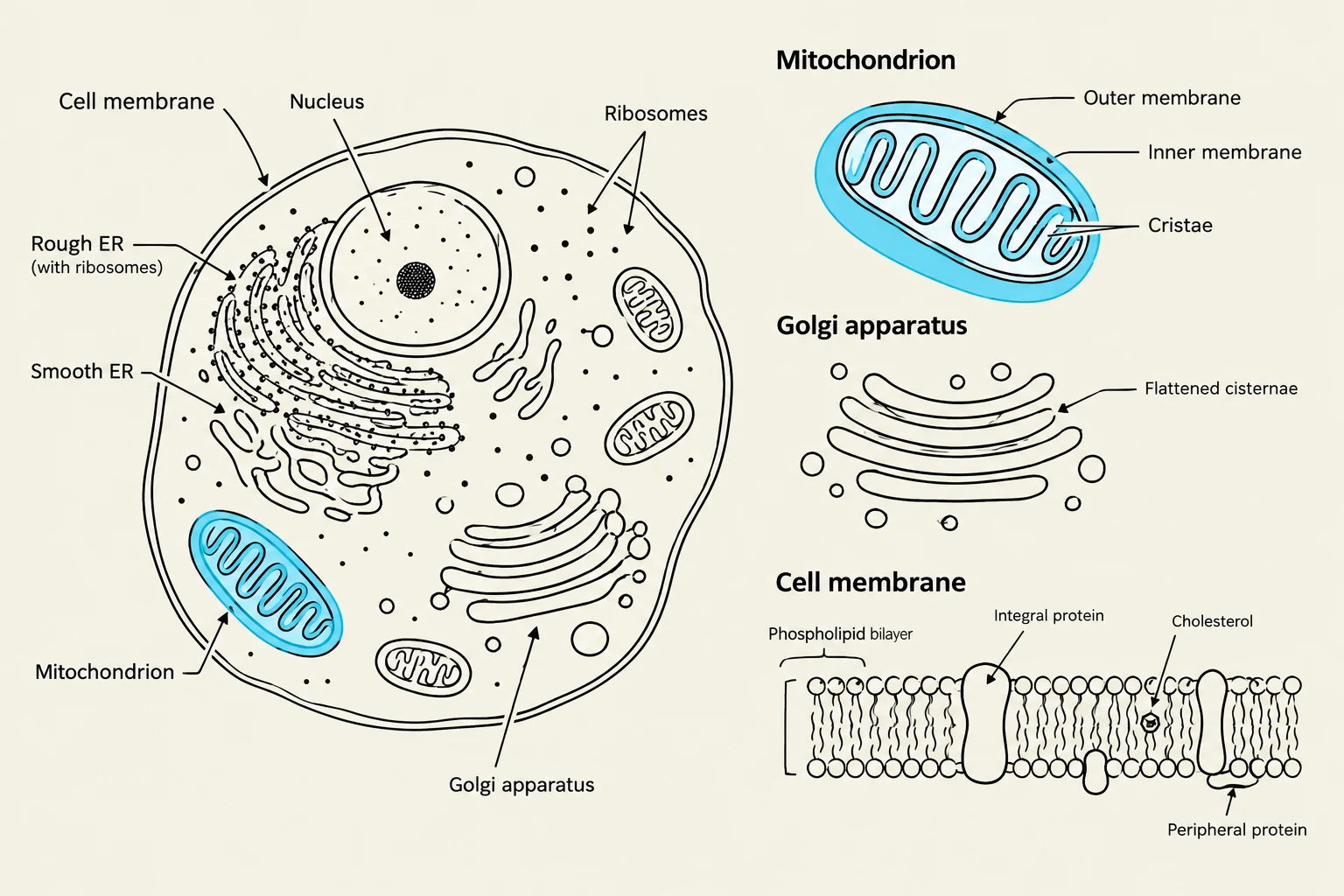
Diagrams illustrating the structure of an animal cell, including the mitochondrion, Golgi apparatus, and cell membrane.
The cell is a highly organized unit where specialized organelles perform distinct roles to maintain homeostasis.
Mitochondria: Known as the powerhouse of the cell, these organelles possess two membranes, with the inner membrane forming folds called cristae to increase surface area for energy production (ATP) via cellular respiration. Notably, they contain their own DNA, supporting the endosymbiotic theory.
Golgi Apparatus: A series of flattened sacs called cisternae that modify, sort, and package proteins and lipids. It also produces lysosomes and works in tandem with the Endoplasmic Reticulum (ER).
Cell Membrane: A selectively permeable phospholipid bilayer composed of proteins, cholesterol, and carbohydrates. It facilitates communication through receptors and controls the movement of substances to protect cell integrity.
Ribosomes: Non-membrane-bound structures made of RNA and proteins that serve as the site of protein synthesis (translation of mRNA into polypeptides).
Cell Division: Mitosis vs. Meiosis
Cellular reproduction occurs through two distinct processes: mitosis and meiosis.
Mitosis is used for somatic cell growth and repair. A critical moment occurs during the S phase of interphase, when DNA replicates, causing each chromosome to consist of two identical sister chromatids.
Meiosis serves a different purpose: the production of gametes (sperm and eggs) for sexual reproduction. Unlike mitosis, meiosis promotes genetic variation through independent selection, ensuring that offspring are genetically unique.
Exam Tip: If a question asks about the purpose of meiosis, look for keywords like "gametes," "sexual reproduction," or "genetic variation." If it asks about mitosis, look for "growth," "repair," or "somatic cells."
The Immune Response: Innate vs. Adaptive
Diagram illustrating the complement system mechanisms of opsonization and membrane lysis, showing how bacteria are targeted for destruction by macrophages and the formation of the Membrane Attack Complex.
The immune system is divided into two primary arms: the innate and the adaptive responses.
The Innate Immune Response
The innate response is non-specific, rapid, and possesses no memory of previous pathogen encounters. It relies on several layers of defense:
Physical and Chemical Barriers: These include the skin, mucous membranes, and cilia. Chemical defenses include stomach acid, enzymes like lysozymes in tears/saliva, and Antimicrobial Peptides (AMPs), which disrupt microbial membranes.
Early Detector Cells: Macrophages (which phagocytize pathogens and release cytokines), Mast cells (which release histamine), and Dendritic cells (which capture pathogens).
Signaling Molecules: Histamine (vasodilation), Prostaglandins (pain/fever), Leukotrienes (chemotaxis), and Cytokines (which can trigger fever or attract neutrophils).
Pattern Recognition: Cells use Pattern Recognition Receptors (PRRs), such as Toll-Like Receptors (TLRs), to detect PAMPs (Pathogen-Associated Molecular Patterns) or DAMPs (Damage-Associated Molecular Patterns).
The Adaptive Immune Response
The adaptive response is highly specific and creates immunological memory. A key component is the B cell. When B cells are activated, they differentiate into plasma cells, which are responsible for producing antibodies.
The Complement System
The complement system assists inflammation through three pathways:
Classical Pathway: Triggered by antibodies (links adaptive to innate).
Lectin Pathway: Triggered by mannose-binding lectin (MBL) detecting microbial sugars.
Alternative Pathway: A "patrol" system triggered by direct contact with microbial surfaces.
The system functions via opsonization (tagging pathogens with C3b for easier phagocytosis) and lysis (forming the Membrane Attack Complex, or MAC, to punch holes in pathogens).
Pathogen Profiles and Evasion
Bacteria
Bacteria are classified by their cell wall properties.
Gram-positive: Often produce exotoxins. Examples include Staphylococcus aureus (a common skin/wound pathogen) and Streptococcus pyogenes (which uses M protein to repel phagocytes).
Gram-negative: Often associated with endotoxins (Lipid A). Examples include E. coli (UTIs, sepsis) and Neisseria meningitidis (meningitis).
Bacteria use various strategies to evade the innate immune system, such as forming biofilms (e.g., Pseudomonas aeruginosa) or using capsules to prevent phagocytosis.
Viruses and Prions
Viruses: Non-living entities that require a host cell to replicate. Retroviruses (like HIV) use the enzyme reverse transcriptase to convert their RNA genome into DNA once inside a host cell. HIV specifically targets CD4+ T Helper Cells.
Prions: Misfolded proteins that contain no genetic material. They cause neurodegeneration by inducing normal proteins to misfold, leading to diseases like Creutzfeldt-Jakob Disease.
Genetics, Epigenetics, and Biotechnology
Genetic Transmission
Inheritance follows specific patterns:
Autosomal Dominant: Only one affected parent (Aa) is needed to pass the trait to 50% of offspring.
Autosomal Recessive: Two carrier parents (Aa) have a 25% chance of having an affected child (aa).
Phenylketonuria (PKU) is a classic example of an autosomal recessive metabolic disorder where the inability to convert phenylalanine to tyrosine leads to toxic buildup.
Epigenetics and CRISPR
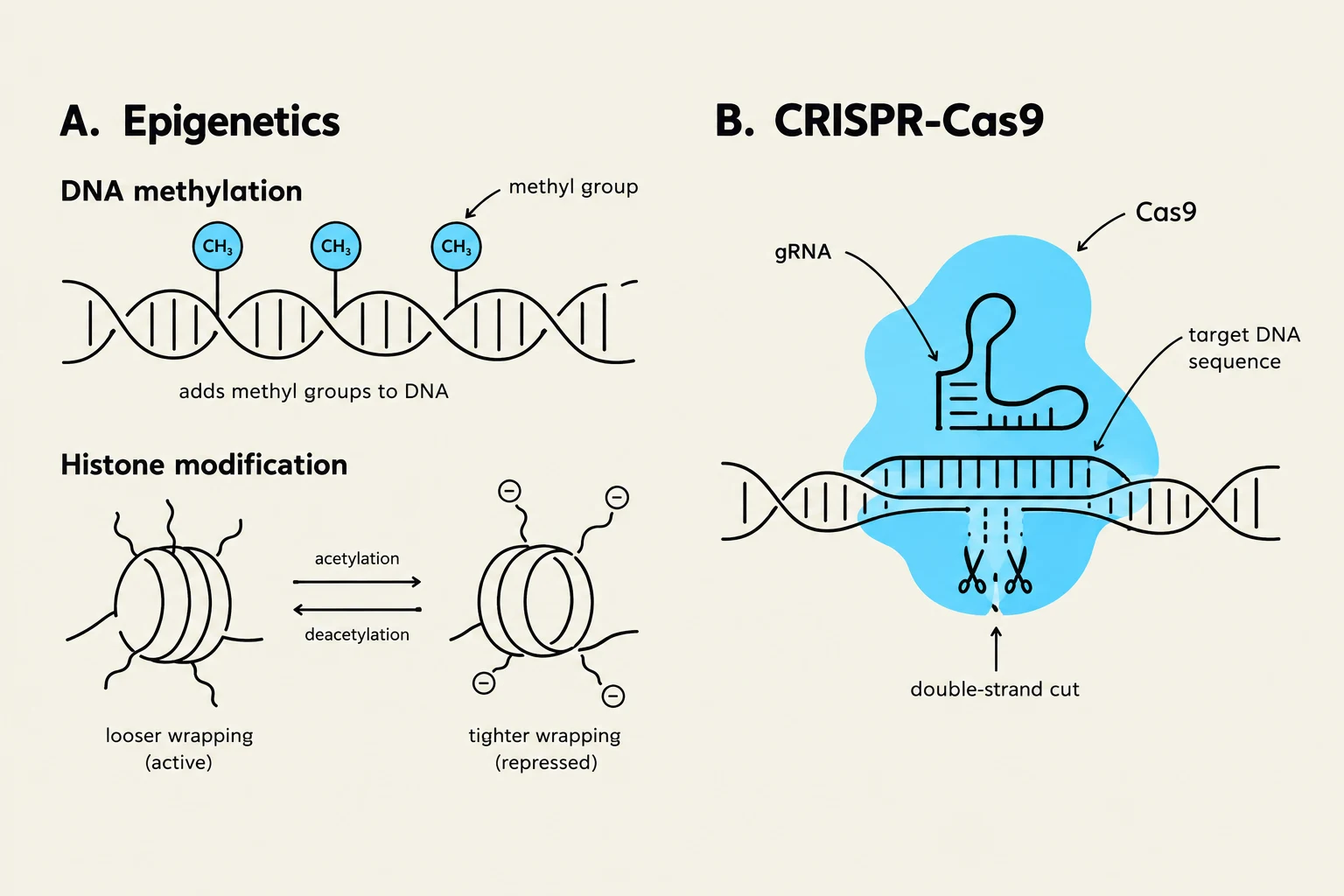
Diagrams illustrating epigenetic mechanisms: DNA methylation and histone modification, and the CRISPR-Cas9 gene editing system.Epigenetics involves changes in gene expression (turning genes "on" or "off") without altering the DNA sequence itself. This occurs through DNA methylation or histone modification.
CRISPR is a gene-editing tool adapted from bacterial defense systems. It uses a guide RNA (gRNA) to lead the Cas9 enzyme to a specific DNA site to make a cut. While revolutionary, it raises ethical concerns regarding "designer babies" (germline editing) and off-target mutations.
Clinical Considerations: Maternal and Paternal Age
Maternal Age: Increased risk of nondisjunction during meiosis, leading to aneuploidy (e.g., Trisomy 21).
Paternal Age: Increased risk of point mutations and epigenetic changes due to continuous cell division.
Keep reading for free.
Create an account to finish this reading and make it part of your study routine.