Cell Biology: Characteristics of Life and Cell Types
An overview of the characteristics that define life, the differences between prokaryotic and eukaryotic cells, and the functions of various cell organelles. Includes explanations of photosynthesis and cellular respiration.
What distinguishes a living organism from a non-living object? The answer lies in the complex, organized, and highly regulated processes occurring at the microscopic level. To understand life, we must first understand the cell—the smallest unit capable of performing life processes.
The Characteristics of Life
All living things, regardless of their complexity, share a specific set of biological characteristics. These traits ensure that organisms can survive, reproduce, and adapt to their environments.
Cellular Organization: Life is organized into cells. Unicellular organisms consist of a single cell that performs all necessary functions, while multicellular organisms are composed of many cells organized into increasingly complex levels: cells form tissues, tissues form organs, organs form organ systems, and organ systems form the organism.
Homeostasis: This is the process of maintaining a stable, balanced internal environment even when external conditions change. For example, a single-celled amoeba uses its cell membrane to regulate its internal state.
Metabolism: Living things must convert food into energy to grow, repair themselves, and maintain homeostasis. This involves chemical reactions like cellular respiration, where glucose is broken down to produce ATP (energy).
Growth and Development: Organisms increase in size and change from simple forms into specialized adult forms. This is guided by genetic material (DNA).
Reproduction: To ensure species survival, organisms must produce offspring or copies of themselves.
Response to Stimuli: Living things can sense and react to changes in their internal or external environment.
Evolution: Over many generations, populations change as helpful traits become more common, helping the species survive and reproduce.
Exam Tip: Remember that while viruses contain genetic material and can reproduce using a host, they are generally not considered living because they do not meet all the characteristics of life independently.
The Two Main Types of Cells
Cells are broadly categorized into two groups based on their internal structure: prokaryotic and eukaryotic.
Prokaryotic Cells
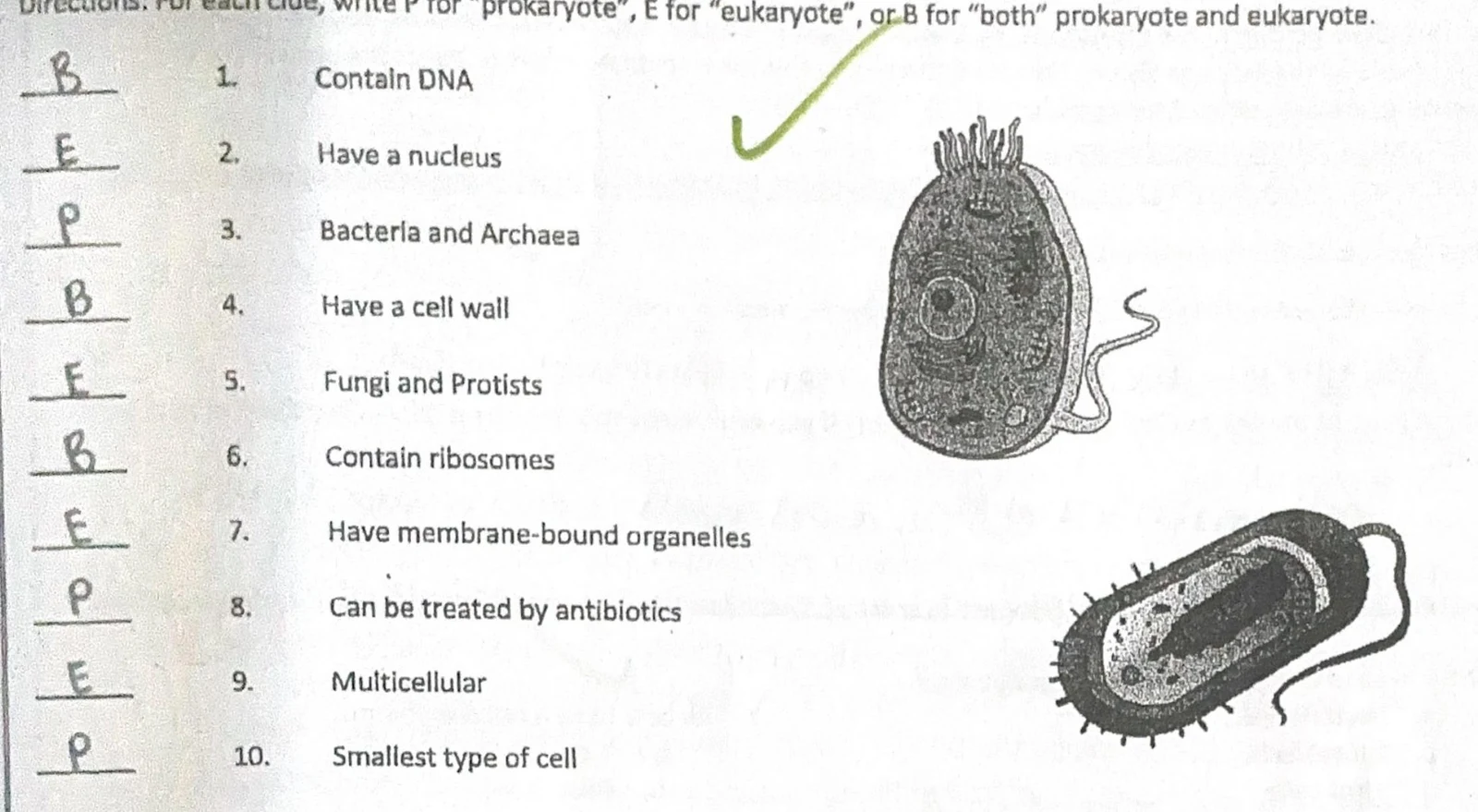
Prokaryotic cells are typically single-celled organisms that lack a membrane-bound nucleus. While they are simpler than eukaryotes, they still possess essential components like a cell membrane and ribosomes. Bacteria and Archaea are primary examples of prokaryotes.
Eukaryotic Cells
Eukaryotic cells are more complex and contain a nucleus enclosed by a membrane. These cells also contain specialized structures called organelles. Eukaryotes can be unicellular (like some protists) or multicellular (like plants and animals).
Diagrams illustrating a eukaryotic cell and a prokaryotic cell, with accompanying descriptions of their characteristics.
Cellular Anatomy: Organelles and Their Functions
An organelle is a specialized structure within a cell's cytoplasm that performs a specific function. Think of the cell as a factory where different departments handle different tasks.
The Control and Production Center
Cell Membrane: A phospholipid layer that acts as a protective barrier, controlling what enters (food, oxygen, water) and exits (waste) the cell.
Nucleus: The "command center" of the eukaryotic cell. It is a membrane-bound organelle that contains the organism's DNA, which provides the instructions for making proteins.
Ribosomes: Small structures made of RNA and protein that serve as the site of protein synthesis. They can float freely or be attached to the Endoplasmic Reticulum.
Endoplasmic Reticulum (ER): A system of membranes that assists in the production, processing, and transport of proteins and lipids. The Rough ER is studded with ribosomes, while the Smooth ER is not.
Processing and Transport
Golgi Complex (Apparatus): This pancake-shaped organelle functions like a shipping department; it packages, labels, and sorts materials to be sent out of the cell.
Vesicle: Small sacs or cavities used to transport materials within the cell or to the membrane for export.
Lysosome: Found mostly in animal cells, these contain digestive enzymes to break down waste, old cell parts, or foreign invaders.
Vacuole: Small, membrane-bound sacs used for the storage of water, nutrients, or waste.
Energy and Support
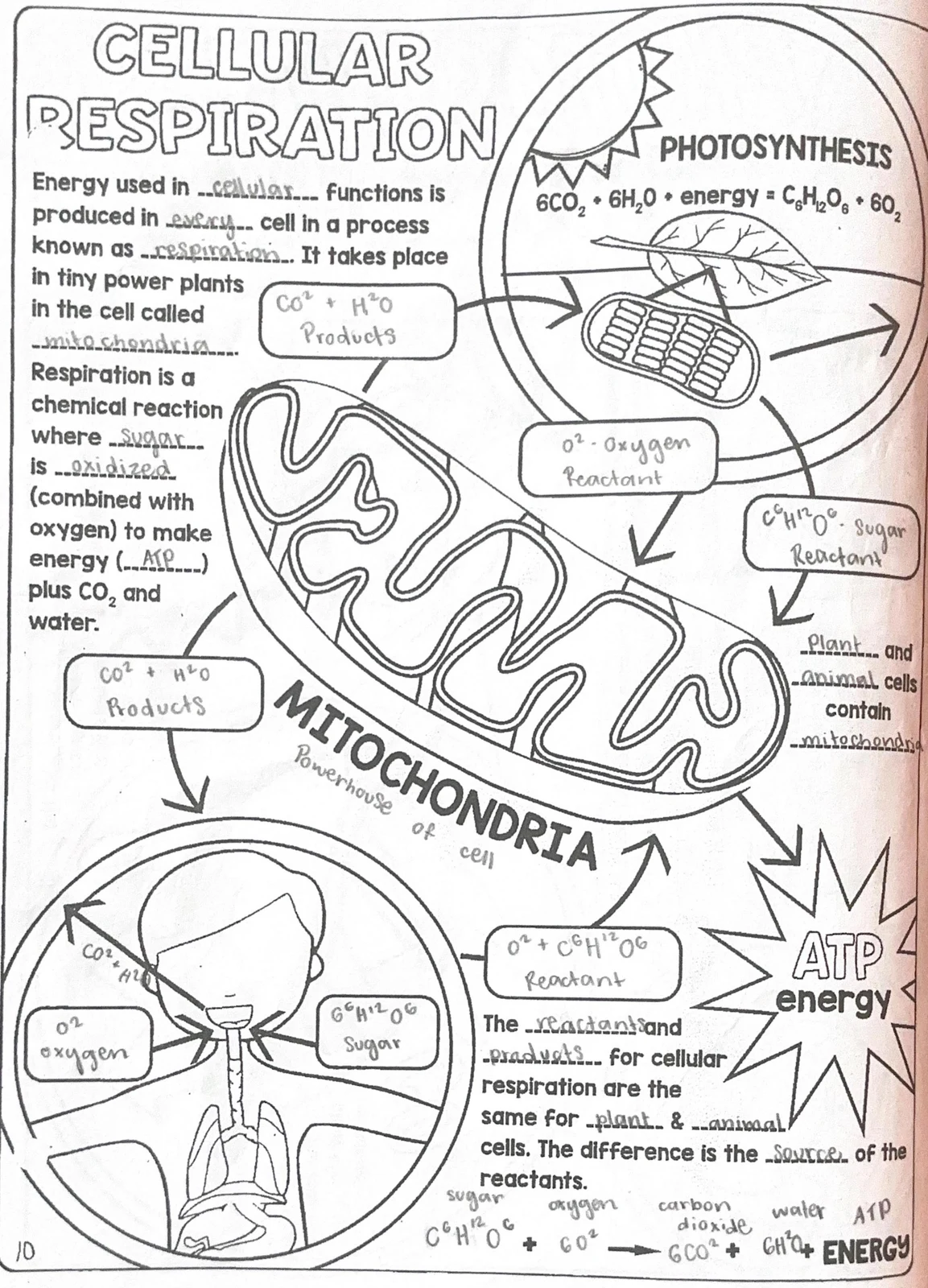
Mitochondrion: Known as the "powerhouse" of the cell, this double-membraned organelle is the site of cellular respiration. It breaks down food to release energy in the form of ATP.
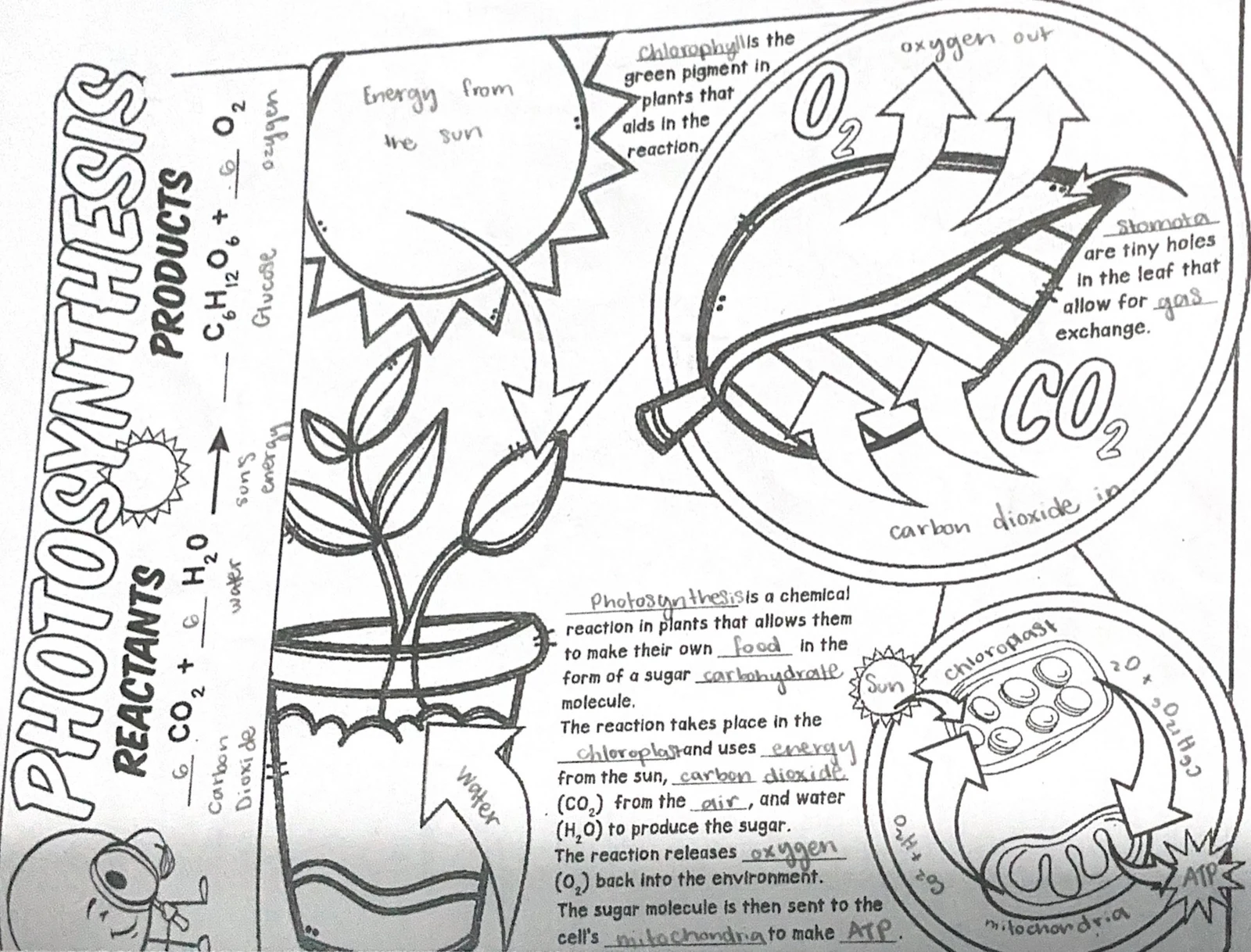
Chloroplast (Plants Only): These organelles contain chlorophyll and are the site of photosynthesis, converting sunlight, CO2, and H2O into sugar (carbohydrates) and oxygen.
Cell Wall (Plants and some others): A rigid outer structure made of cellulose that provides support and protection.
Cytoskeleton: A network of tubules (microfilaments and microtubules) that provides structural support to the cell.
This diagram illustrates the process of photosynthesis, detailing the reactants (carbon dioxide, water, and sun's energy) and products (glucose and oxygen). It also shows the role of chlorophyll, stomata, chloroplasts, and mitochondria in this vital plant process.
Energy Transformations: Photosynthesis vs. Respiration
While plants and animals differ in how they obtain food, they share a fundamental way of using it.
Autotrophs (like plants) make their own food through photosynthesis. They use energy from the sun to convert carbon dioxide and water into sugar.
Heterotrophs (like animals) must consume other organisms to obtain energy.
Both types of organisms perform cellular respiration to actually use the energy stored in sugar. In this process, sugar is oxidized (combined with oxygen) to produce energy (ATP), CO2, and water.
This diagram illustrates cellular respiration and photosynthesis, explaining the reactants and products involved in energy production within cells, specifically highlighting the role of mitochondria.
The chemical relationship can be summarized by looking at the reactants and products:
\text{Glucose} + \text{Oxygen} \rightarrow \text{Carbon Dioxide} + \text{Water} + \text{ATP}
\end{aligned}$$
## The Scientific Method
To study these biological concepts, scientists use the **Scientific Method**. This systematic approach begins with **observation** rather than just forming a hypothesis. A hypothesis must be testable, meaning scientists must be able to design investigations that either support or disprove it. In an experiment, the **independent variable** (the manipulated variable) is changed to see its effect, while the **control group** is left alone to provide a baseline for comparison.