An overview of Chemical, Biological, Radiological, Nuclear, and Explosives (CBRNE) threats, including definitions, hazard categories, and safety protocols for identification and mitigation.
In high-stakes environments, the ability to rapidly identify and mitigate threats is the difference between life and death. Professionals must be prepared to encounter a wide spectrum of hazards, ranging from invisible chemical vapors and biological pathogens to the devastating physical force of an Improvised Explosive Device (IED). This article explores the fundamental principles of CBRNE—Chemical, Biological, Radiological, Nuclear, and Explosives—providing a framework for understanding these threats and the safety protocols required to manage them.
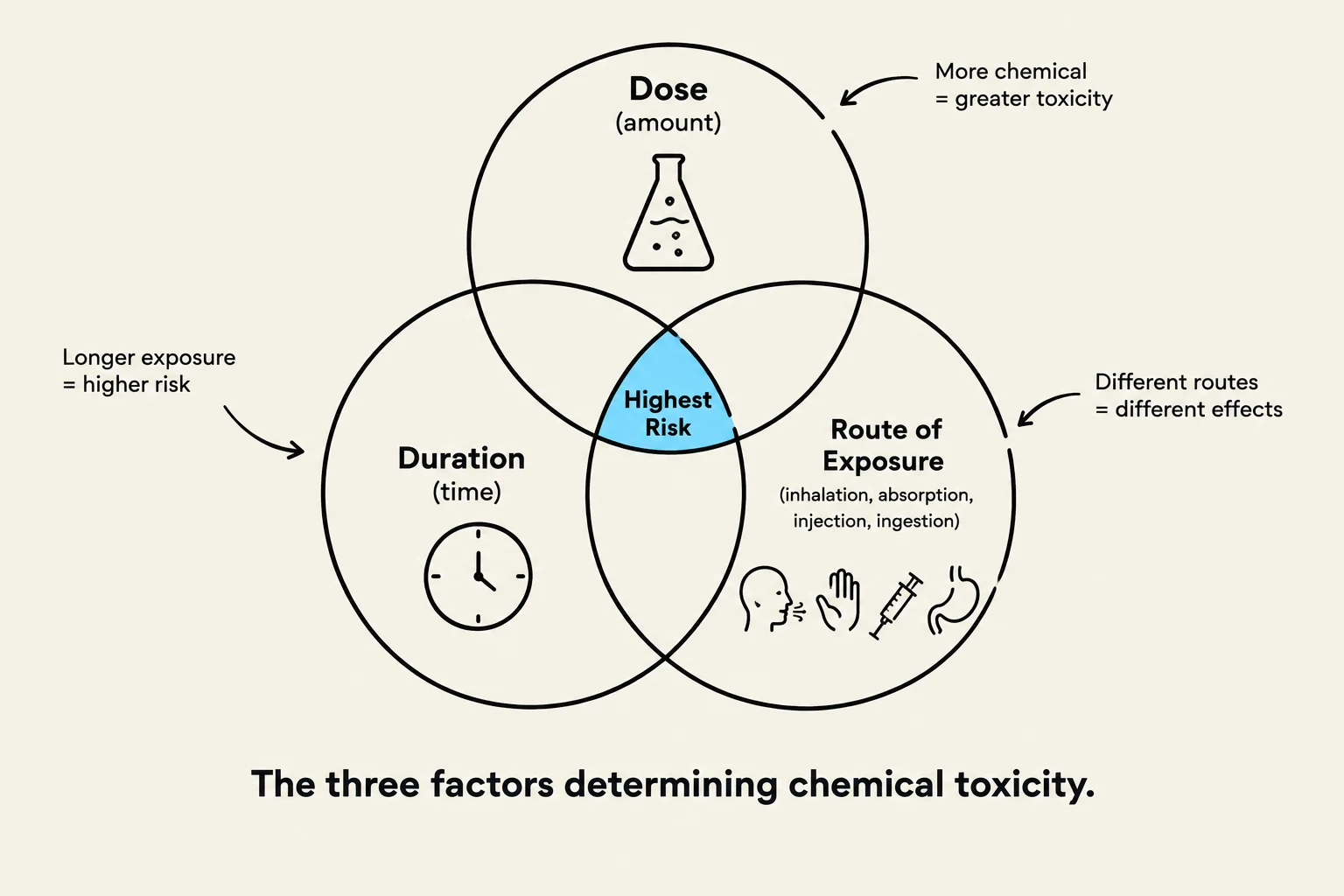
This diagram illustrates the three key factors that determine chemical toxicity: dose (amount), duration (time), and route of exposure. The intersection of these factors, particularly at higher doses, longer durations, and specific exposure routes, leads to the highest risk.
Understanding CBRNE Definitions
The acronym CBRNE serves as a foundational classification for specialized threats:
Chemical: Substances that cause harm through toxicity.
Biological: Living organisms or toxins that cause disease.
Radiological: The use of radioactive materials to cause harm or dispersal.
Nuclear: Threats involving nuclear fission, fusion, or nuclear weapons.
Explosives: Materials that undergo rapid chemical reactions to produce pressure and heat.
Chemical Threats and Toxicity
Chemical hazards are categorized into three distinct groups based on their origin and intent:
Chemical Weapon Agents (CWA): Specifically designed for warfare.
Toxic Industrial Chemicals (TIC): Common industrial substances that become hazardous during accidents or intentional misuse; these are often considered the most dangerous to bomb technicians.
Explosive Precursor Chemicals (EPC): Substances used to manufacture improvised explosives.
When assessing a chemical threat, three critical factors determine its toxicity: dose (the amount absorbed), duration (the length of time exposed), and the route of exposure (inhalation, absorption, injection, or ingestion).
Chemical Warfare Agents
Warfare agents are further classified by their physiological effects on the human body:
Blister Agents: Cause severe chemical burns to the skin and lungs (e.g., mustard gas).
Blood Agents: Prevent the blood from carrying oxygen (e.g., cyanide, arsenic).
Choking Agents: Prevent oxygen exchange in the lungs (e.g., chlorine, phosgene).
Nerve Agents: Attack the nervous system (e.g., VX nerve gas).
Exam Tip: For bomb technicians, protecting against inhalation (using APR or SCBA) and absorption (using splash suits and gloves) is the highest priority.
Biological Threats
Biological threats consist of bacteria, viruses, toxins, and other organisms like fungi. Unlike chemical agents, there is currently no suitable field detection method for biological threats.
Identification often relies on environmental indicators. For example, the presence of castor beans is a significant indicator that you may be dealing with a Ricin lab.
Radiological and Nuclear Hazards
Radiological and nuclear threats involve the release of energy from the atomic structure. An atom consists of a nucleus (protons and neutrons) surrounded by a cloud of electrons. By adding or replacing neutrons, different isotopes are created, some of which are unstable and radioactive.
Types of Radiation and Safety Protocols
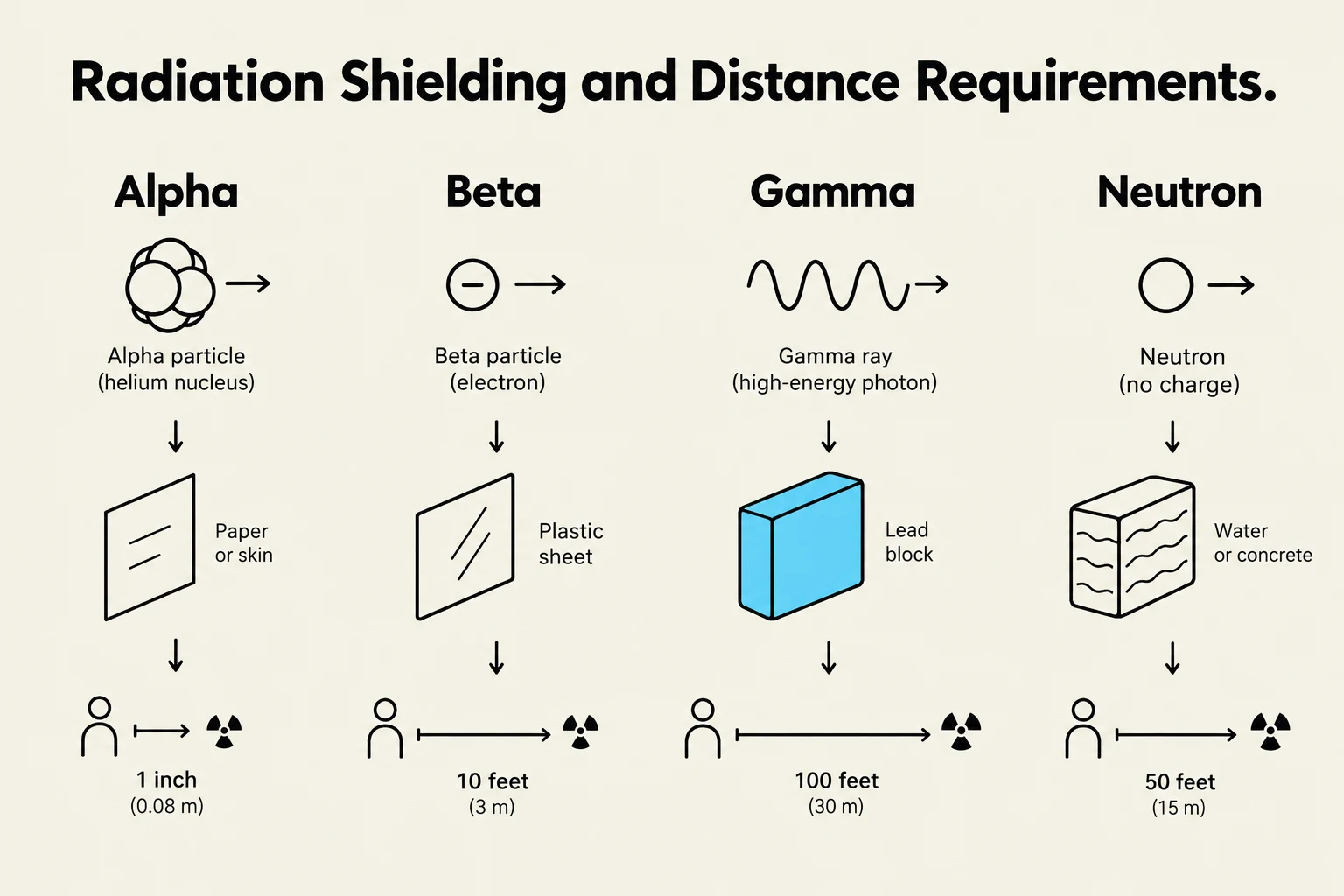
This diagram illustrates the shielding and distance requirements for different types of radiation: alpha, beta, gamma, and neutron. It shows the type of material needed to block each radiation type and the safe distance to maintain from the source.
Different types of radiation require specific shielding and safe distances to mitigate risk:
Radiation Type
Description/Effect
Shielding
Safe Distance
Alpha
Highly destructive if internalized
N/A
1–2 inches
Beta
Affects skin, eyes, and internal organs
Plastic
20 feet
Gamma
Affects the whole body
Lead
100 feet
Neutron
Indicates nuclear weapons or INDs; affects whole body
Water
Several hundred feet
Radiation Safety Principles
To manage radiological risk, professionals follow the ALARA principle: As Low As Reasonably Achievable. This is achieved through three primary methods:
Time: Minimizing the duration of exposure.
Distance: Increasing the space between yourself and the source.
Shielding: Placing appropriate materials between you and the source.
The 2×4 Rule: When managing radiation, distance is twice as effective as time. Doubling your distance from a source reduces your exposure to 1/4 the original amount.
It is vital to distinguish between exposure (being near a source) and contamination (physical contact with the source). Furthermore, understand the difference between dose (the total amount absorbed) and dose rate (the intensity of the dose over time).
RDD vs. RED
In the context of an Improvised Nuclear Device (IND), threats are often classified as:
Radiological Dispersal Devices (RDD): Often called "dirty bombs," designed to spread radioactive material.
Radiological Exposure Devices (RED): Designed to expose people to radiation without necessarily dispersing material.
Explosive Hazards and IEDs
An explosion is a chemical reaction occurring in an exceedingly short period, producing high temperatures and a large quantity of gas. Explosives are categorized into primary (highly sensitive initiators) and secondary (require a booster/initiator).
Improvised Explosive Components
Improvised devices often use common materials to create a "FOX" (Fuel/Oxidizer) combination:
Nitro Methane: A commercial hobby fuel that, when mixed with Ammonium Nitrate, creates a powerful binary explosive.
HPOM (Hydrogen Peroxide Organic Material): Requires a peroxide concentration of 60–70% to be effective.
IED Safety and Tactics
When confronting an Improvised Explosive Device (IED), the primary mission is to prevent the loss of life. Technicians should follow these safety considerations:
Maximize distance from the device.
Minimize the number of personnel exposed.
Minimize time on target.
Utilize shielding and remote operations (such as robots) whenever possible.
Robots should be used for initial entry to perform visual investigations and to rule out booby-traps.
Critical Safety Note: When dealing with IEDs, always be aware of anti-disturbance mechanisms (e.g., mercury, tilt, or vibratory switches) designed to trigger the device if it is moved or tampered with.
Keep reading for free.
Create an account to finish this reading and make it part of your study routine.