An overview of the global conflict of World War I, detailing its belligerents, the July 1914 Crisis, and the underlying causes such as nationalism and alliance networks, as well as its profound impact on the world.
World War I, often referred to as "The Great War," was a transformative global conflict that reshaped the political, social, and economic landscape of the 20th century. It was not merely a localized dispute but a systemic collapse of international stability that involved the world's most powerful nations. To understand why this conflict occurred and how it changed the world, one must look beyond the immediate spark of an assassination and examine the deep-seated structural tensions that had been building for decades.
The Belligerents: A Divided Europe
By 1914, Europe was divided into two primary competing blocs of nations. These groupings were defined by formal military agreements intended to provide security, but they ultimately ensured that a local conflict would escalate into a continental war.
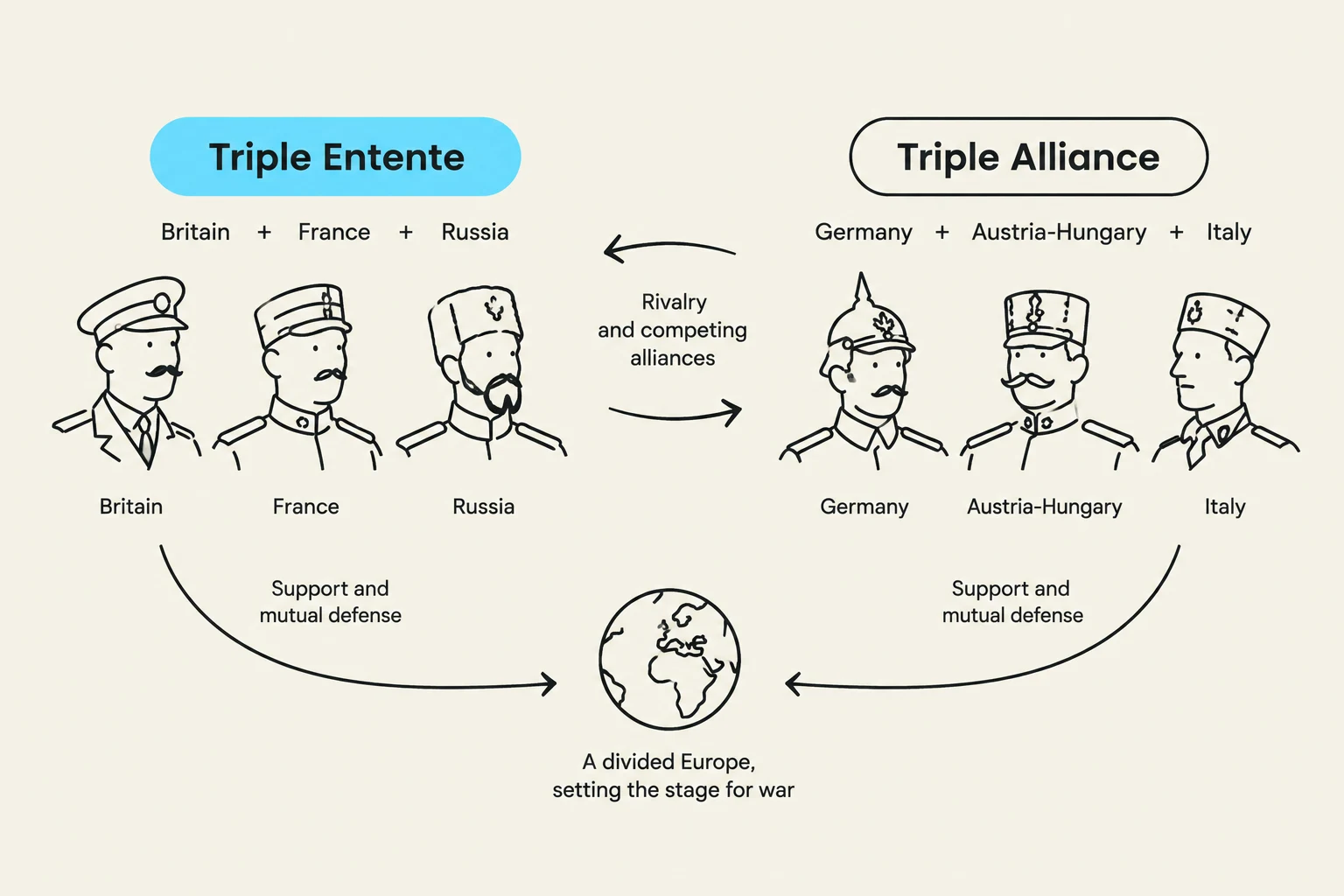
The first major group was the Triple Entente (also known as the Allied Powers), which primarily consisted of Britain, France, and Russia. Opposing them was the Triple Alliance (the Central Powers), which included Austria-Hungary, Germany, and Italy.
Diagram illustrating the Triple Entente (Britain, France, Russia) and the Triple Alliance (Germany, Austria-Hungary, Italy), highlighting their rivalry and mutual defense pacts, which contributed to a divided Europe and set the stage for war.
Exam Tip: When studying the belligerents, remember that while Italy was part of the Triple Alliance initially, the alliances shifted as the war progressed. Focus on the core members: Britain, France, Russia, Germany, and Austria-Hungary.
The Outbreak: The July 1914 Crisis
While the underlying causes were long-term, the immediate trigger was a rapid-fire series of diplomatic and military escalations known as the July 1914 Crisis.
The crisis began on June 28, 1914, with the assassination of Archduke Franz Ferdinand, the heir to the Austro-Hungarian throne. This event set off a chain reaction:
The Blank Check: Germany issued a "blank check" to Austria-Hungary, promising unconditional support.
The Ultimatum: Austria-Hungary issued a harsh ultimatum to Serbia; when Serbia rejected parts of it, Austria-Hungary declared war.
Mobilization: Russia, acting to protect Serbia, began mobilizing its forces.
Escalation: Germany responded by declaring war on Russia and France, invading Luxembourg and Belgium to execute strategic plans.
British Entry: Following the German invasion of neutral territories, Britain declared war on Germany on August 4.
Debated Causes: Why Did War Happen?
Historians fiercely debate whether the war was an "inadvertent" accident caused by bad diplomacy or a calculated move by aggressive states. Several key concepts help explain these different perspectives.
Nationalism and Alliance Networks
Nationalism acted as a powerful, destabilizing force. It was a primary source of competition between nations and a significant problem for multi-ethnic empires like Austria-Hungary, where various ethnic groups sought independence.
This was compounded by Alliance Networks. While intended to deter war through strength, these networks meant that a single spark in the Balkans could pull every major power into the fray through a series of interlocking obligations.
Realist Perspectives: Defensive vs. Offensive
In international relations theory, two main schools of thought explain the outbreak of the war:
1. Defensive Realism and the Security Dilemma
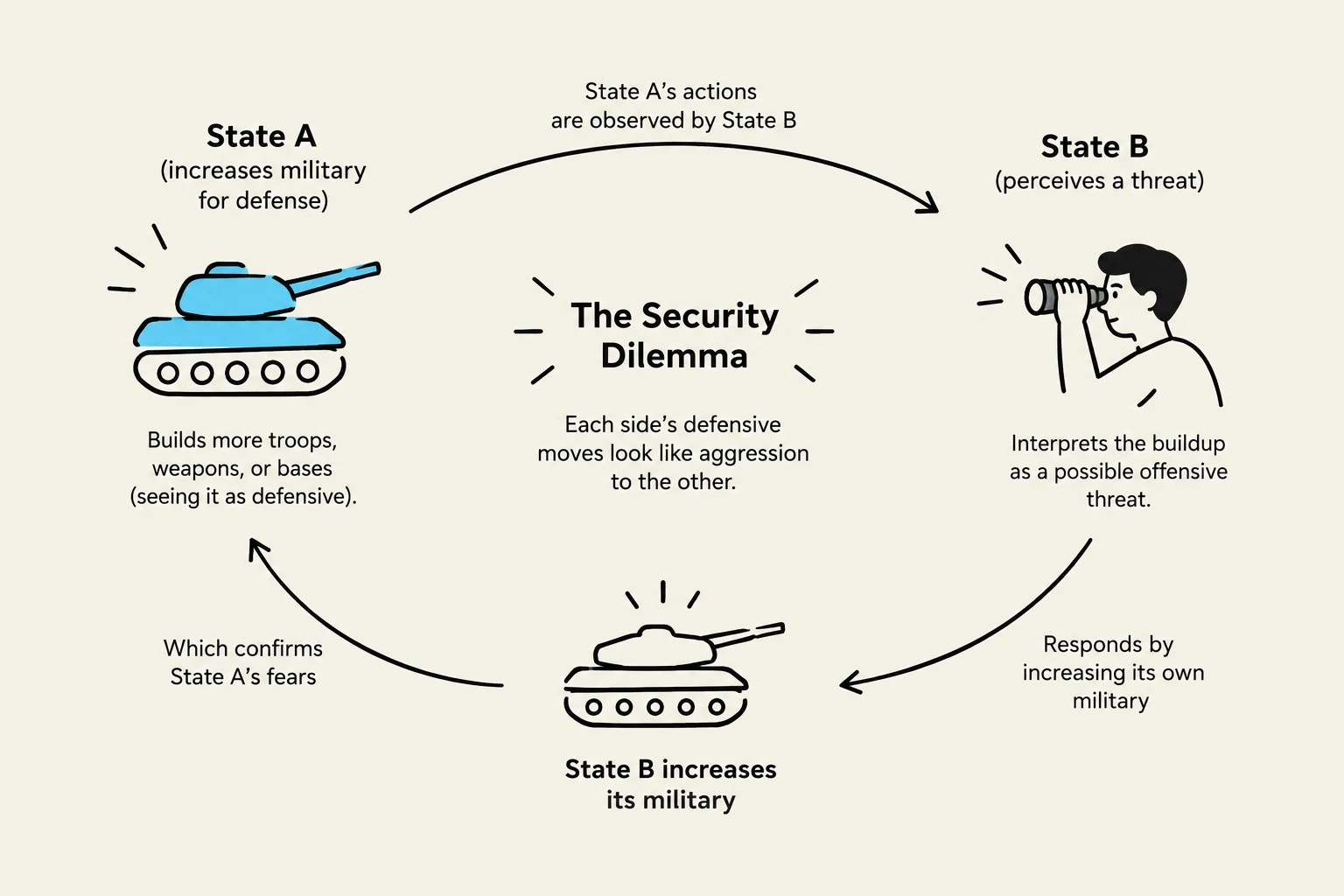
Defensive realists argue that WWI was a classic case of the security dilemma. In a security dilemma, one state increases its military strength to feel safe, but this action is perceived as a threat by its neighbors, who then increase their own strength in response. This creates a cycle of fear and escalation. This was exacerbated by the "cult of the offensive"—the military belief that the side that attacked first and most aggressively would win, which pressured leaders to mobilize quickly rather than negotiate.
The Security Dilemma illustrates how defensive military actions by one state can be perceived as aggressive by another, leading to a cycle of escalation.
2. Offensive Realism
Conversely, offensive realists argue that the war was not an accident. They suggest that Germany, driven by a desire for European hegemony, actively sought to expand its power. From this view, the crisis dynamics were not to blame; rather, the structural drive for dominance made a large-scale conflict inevitable.
The Impact: Total War and Global Change
The war was characterized as a total war, meaning that entire societies—not just armies—were mobilized for the conflict. This involved the total redirection of economic, industrial, and human resources toward the war effort.
The human and political costs were staggering. The war resulted in approximately 9 million soldiers and 10 million civilians dying. The following table illustrates the heavy toll taken on the major belligerents:
Nation
Population (Millions)
Dead (Millions)
Wounded (Millions)
Civilians Dead (Millions)
Britain
40
0.7
1.7
0.3
France
39
1.4
1.7
0.5
Germany
64
2.0
4.1
0.6
Austria-Hungary
51
1.1
5.3
2.3
Russia
161
1.7
3.8
5.1
Note: Data compiled from.
Beyond the immediate casualties, the war fundamentally altered the world map. It led to the collapse of four major empires and facilitated the rise of the United States as a dominant global power. The conflict moved warfare from traditional battlefield engagements into the era of grueling trench warfare, leaving a legacy of trauma and political upheaval that would define the century to come.
Keep reading for free.
Create an account to finish this reading and make it part of your study routine.