


In the world of chemistry, atoms are constantly seeking stability. Most atoms are not content to exist in their neutral state; instead, they undergo transformations to achieve a more stable electronic configuration. One of the most fundamental processes in ionic bonding is the formation of a cation. A cation is a positively charged ion that is created when a neutral atom loses one or more electrons.
The Fundamentals of Charge and Electrons
To understand how a cation forms, we must first look at the balance of charges within a neutral atom. An atom consists of a nucleus containing protons (positive charge) and neutrons (neutral charge), surrounded by a cloud of electrons (negative charge). In a neutral state, the number of protons in the nucleus exactly equals the number of electrons orbiting it.
When an atom undergoes a chemical reaction, it may lose electrons. Because electrons carry a negative charge, losing them creates an imbalance. If an atom loses one electron, it now has one more proton than it has electrons, resulting in a net charge of . This process is the essence of cation formation.
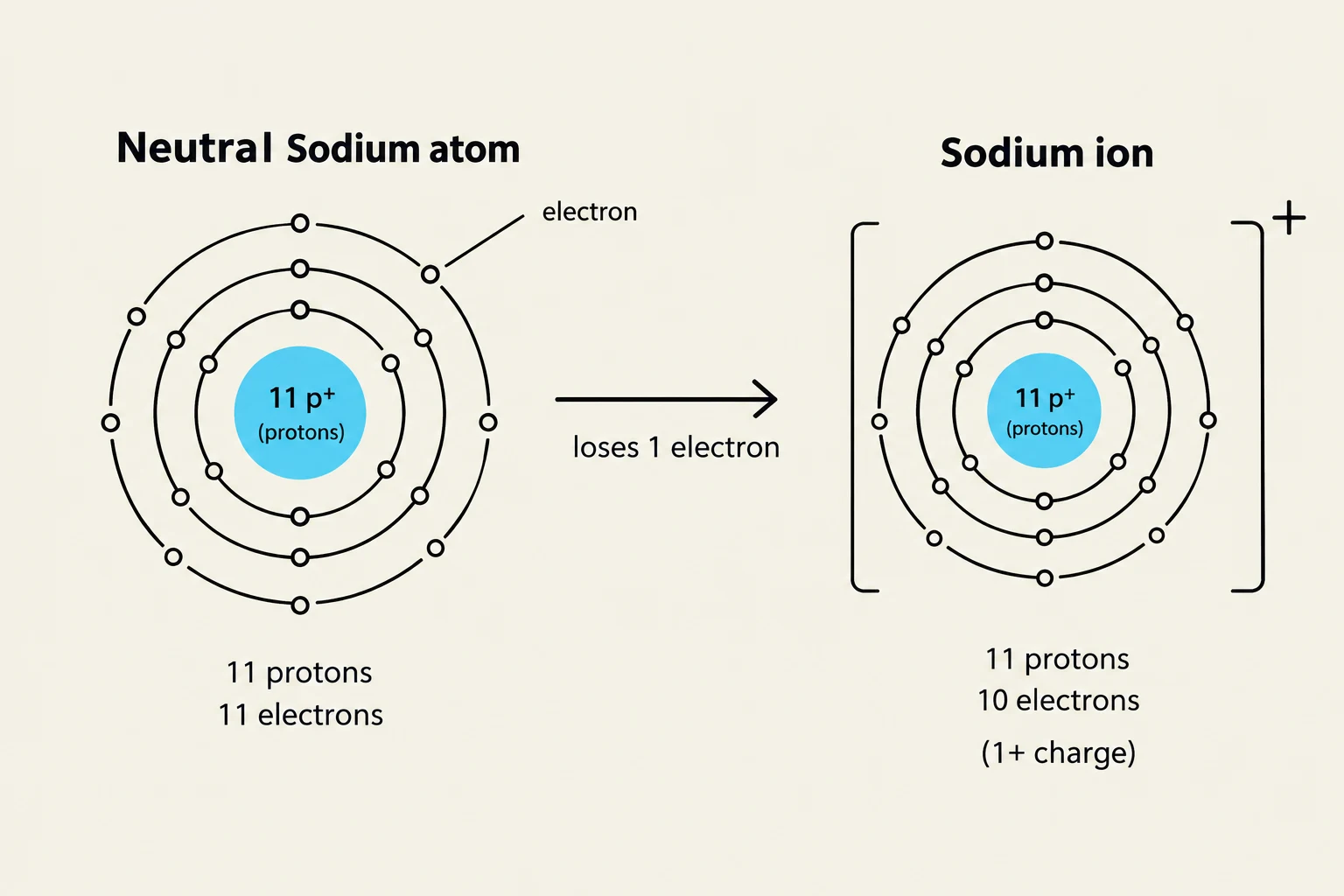
Exam Tip: Always remember that the number of protons never changes during the formation of an ion. If the number of protons changed, you would be creating a completely different element. Only the electron count changes.
Keep reading for free.
Create an account to finish this reading and make it part of your study routine.
Continue reading freeAlready have an account? Log in
Updated