This guide explains the importance of caregiver assessments in healthcare, covering the evaluation of caregiver roles, identification of stress and burnout, and assessment of support capabilities and resources. It emphasizes integrating these assessments into care planning for better patient and caregiver outcomes.
In the modern healthcare landscape, patient care is rarely a solo endeavor. Whether managing a chronic illness, a terminal diagnosis, or a cognitive decline, the patient relies heavily on a network of informal caregivers—usually family members or friends. While these individuals are indispensable, they are also highly vulnerable to physical, emotional, and financial exhaustion. For healthcare providers, performing a thorough Caregiver Assessment is not just a courtesy; it is a clinical necessity to ensure the safety of both the patient and the caregiver.
Understanding the Caregiver's Role
The first step in a comprehensive assessment is identifying the specific roles the caregiver has assumed. Caregiving is rarely a single task; it is a multifaceted spectrum of responsibilities that can be categorized into several domains. These include direct clinical care (administering medication, wound care), instrumental activities (managing finances, transportation, grocery shopping), and emotional support (companionship, psychological stability).
When assessing the family's role, clinicians must look beyond the "primary" caregiver to understand the entire family ecosystem. A single individual may be overwhelmed because they are attempting to fulfill every role, or conversely, a family may have many members who are underutilized.
This diagram illustrates the three main domains of caregiving: Clinical, Instrumental, and Emotional, all contributing to Whole Person Care and leading to better outcomes for both the recipient and the caregiver.
Clinical Tip: Always ask, "Who is responsible for [specific task]?" rather than "Who is the caregiver?" This helps uncover hidden caregivers or gaps in care that the family might not realize exist.
Evaluating Stress and Burnout
Caregiver stress is a multidimensional phenomenon. It is not merely "feeling tired"; it is a physiological and psychological state that can lead to significant health declines in the caregiver themselves. Stress levels are often influenced by the intensity of the patient's needs, the duration of the caregiving period, and the caregiver's own health status.
To assess stress effectively, providers should look for signs of Caregiver Burden. This is often measured through both subjective reports (the caregiver saying, "I can't do this anymore") and objective signs, such as:
Changes in sleep patterns or appetite.
Increased irritability or social withdrawal.
Physical symptoms like headaches or gastrointestinal distress.
Neglect of the caregiver's own medical appointments.
The relationship between patient acuity and caregiver stress can be thought of as a balance. If the demands of the patient (D) exceed the resources of the caregiver (R), the stress level (S) increases:
Swhere S>0 indicates high risk of burnout.=D−R
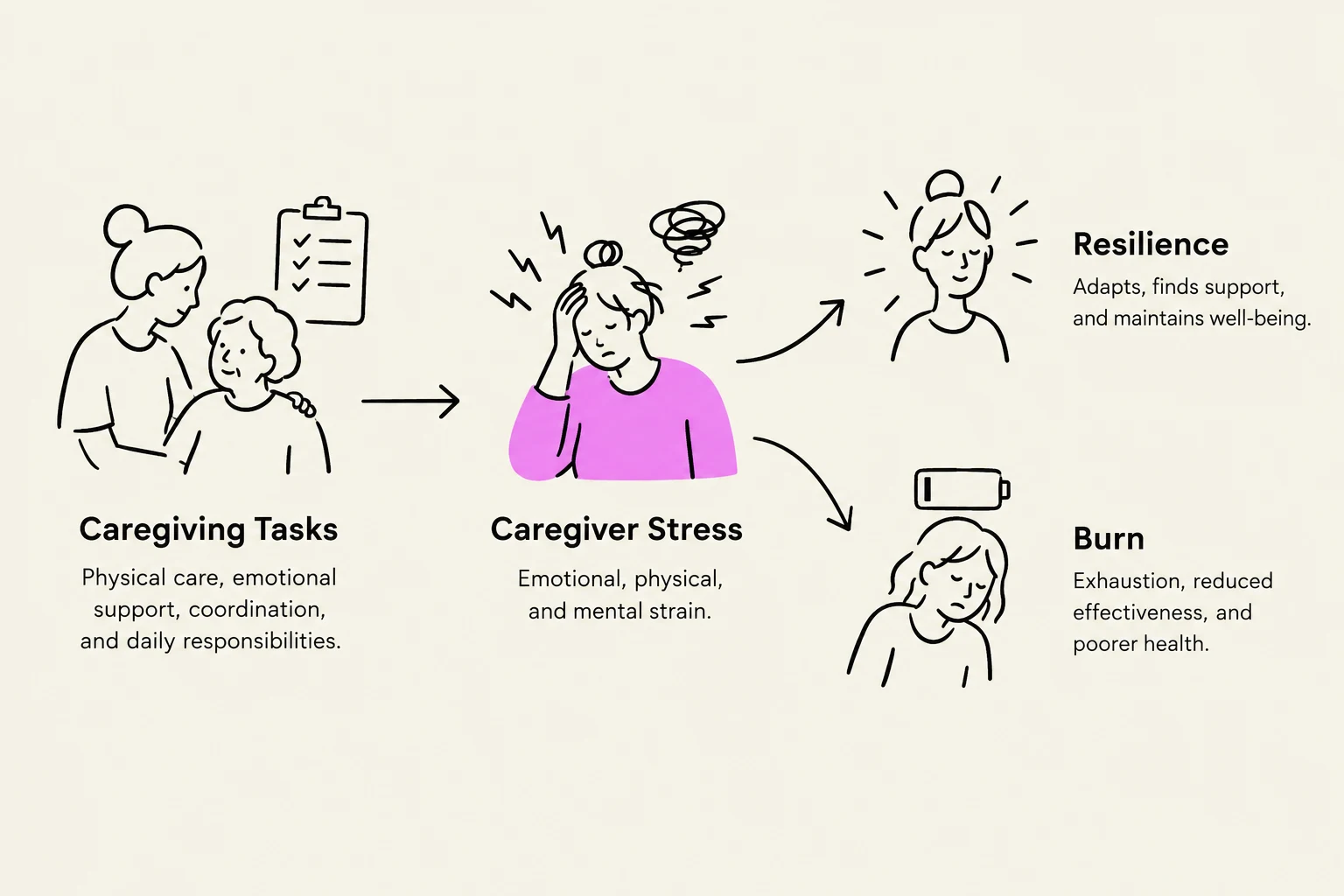
This diagram illustrates the progression from caregiving tasks to caregiver stress, which can lead to either resilience or burnout, with descriptions of each stage.
Assessing Support Capabilities and Resources
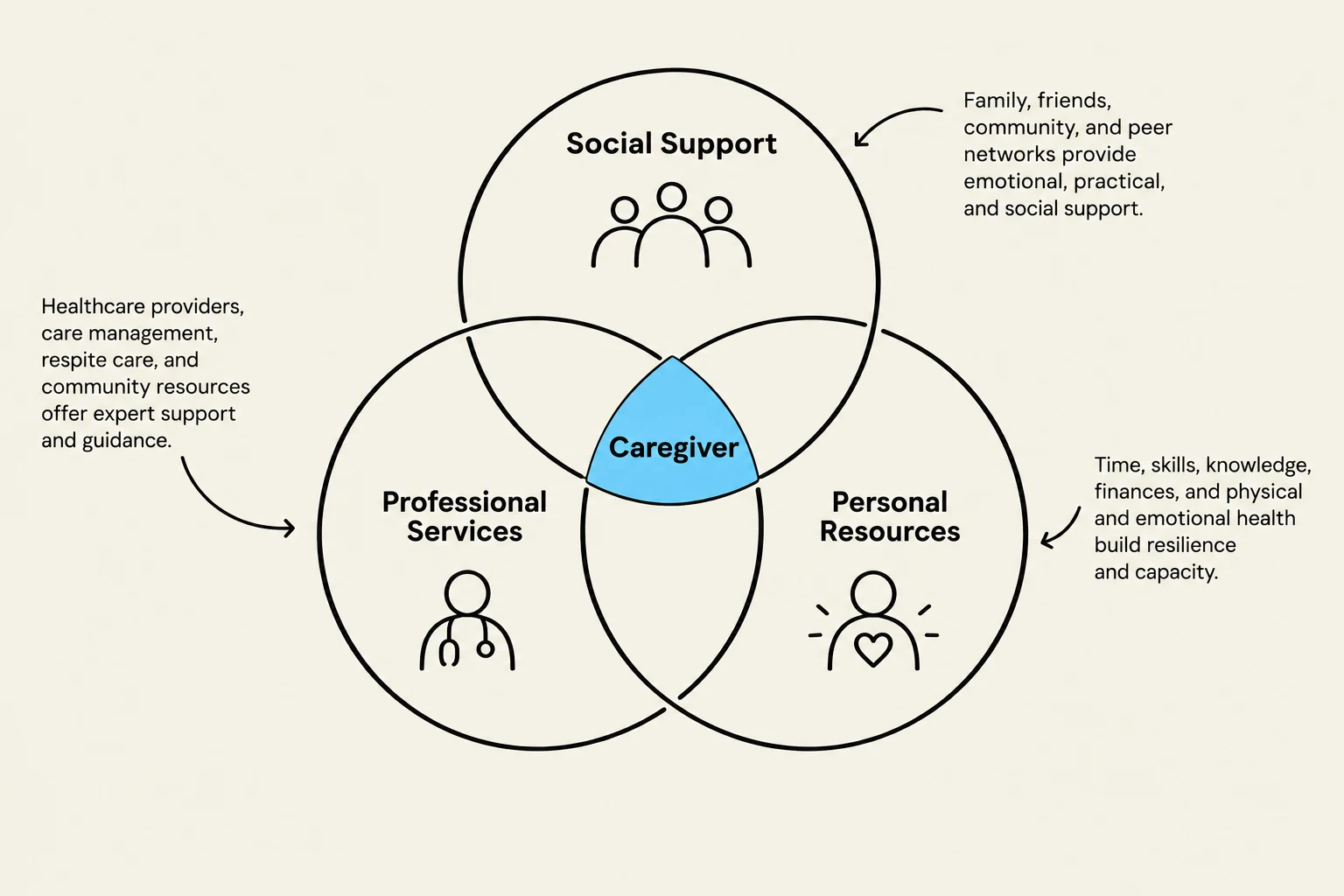
Once the roles and stress levels are identified, the assessment must pivot to Support Capabilities. This involves evaluating what the caregiver has versus what they need. Support can be broken down into three primary categories:
1. Internal Support (Family and Social Networks)
Does the caregiver have siblings, spouses, or close friends who can step in for a few hours a week? A caregiver with a strong social network is significantly more resilient than an isolated one.
2. External Support (Professional and Community Services)
This includes formal services such as home health aides, respite care, meal delivery services (like Meals on Wheels), or community support groups. Assessing the caregiver's knowledge of and access to these services is a critical component of the evaluation.
3. Personal Resources (Financial and Physical)
The caregiver's own ability to provide care is limited by their physical health and financial stability. A caregiver working a full-time job while managing a patient's complex medication schedule faces a different set of challenges than a retired spouse.
This diagram illustrates the multifaceted support system for a caregiver, encompassing social support, professional services, and personal resources.
Integrating Assessment into Care Planning
A caregiver assessment is only useful if it informs the care plan. If an assessment reveals high stress and low social support, the intervention might not be "teaching the caregiver how to change a bandage," but rather "referring the family to a respite care program."
When documenting your findings, aim for specificity. Instead of writing "Caregiver is stressed," write "Caregiver reports sleeping <4 hours per night and expresses concern regarding the cost of medications." This allows the interdisciplinary team to target the specific stressors identified during the assessment.
Exam Note: In many clinical scenarios, the "correct" intervention for a caregiver showing signs of burnout is Respite Care. This provides the caregiver with a temporary break, allowing them to recharge and maintain their own health.
By treating the caregiver as a vital component of the patient's healthcare team, providers can prevent the collapse of the home-care environment and ensure better long-term outcomes for the patient.
Keep reading for free.
Create an account to finish this reading and make it part of your study routine.