


In the clinical setting of anesthesia, the primary objective is to maintain homeostasis by ensuring that every cell in the body receives sufficient oxygen to support aerobic metabolism. This physiological requirement is met through a complex, integrated system involving the lungs, the heart, and the vasculature. To understand how a patient might experience hypoxia or ischemia, one must master the relationship between oxygen content, the speed of circulation, and the metabolic demands of the tissues.
The Fundamentals of Oxygen Delivery ()
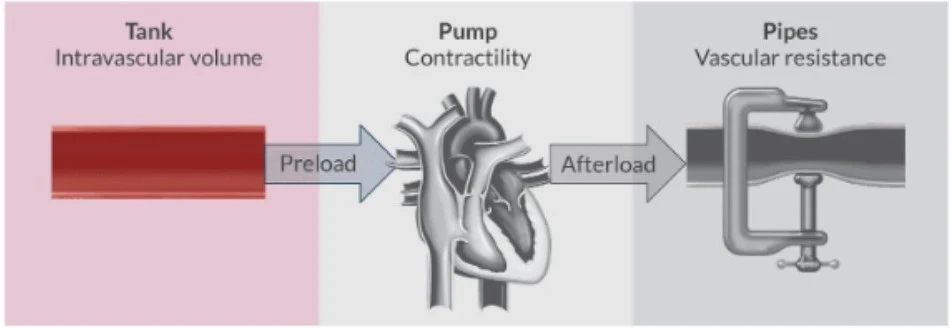
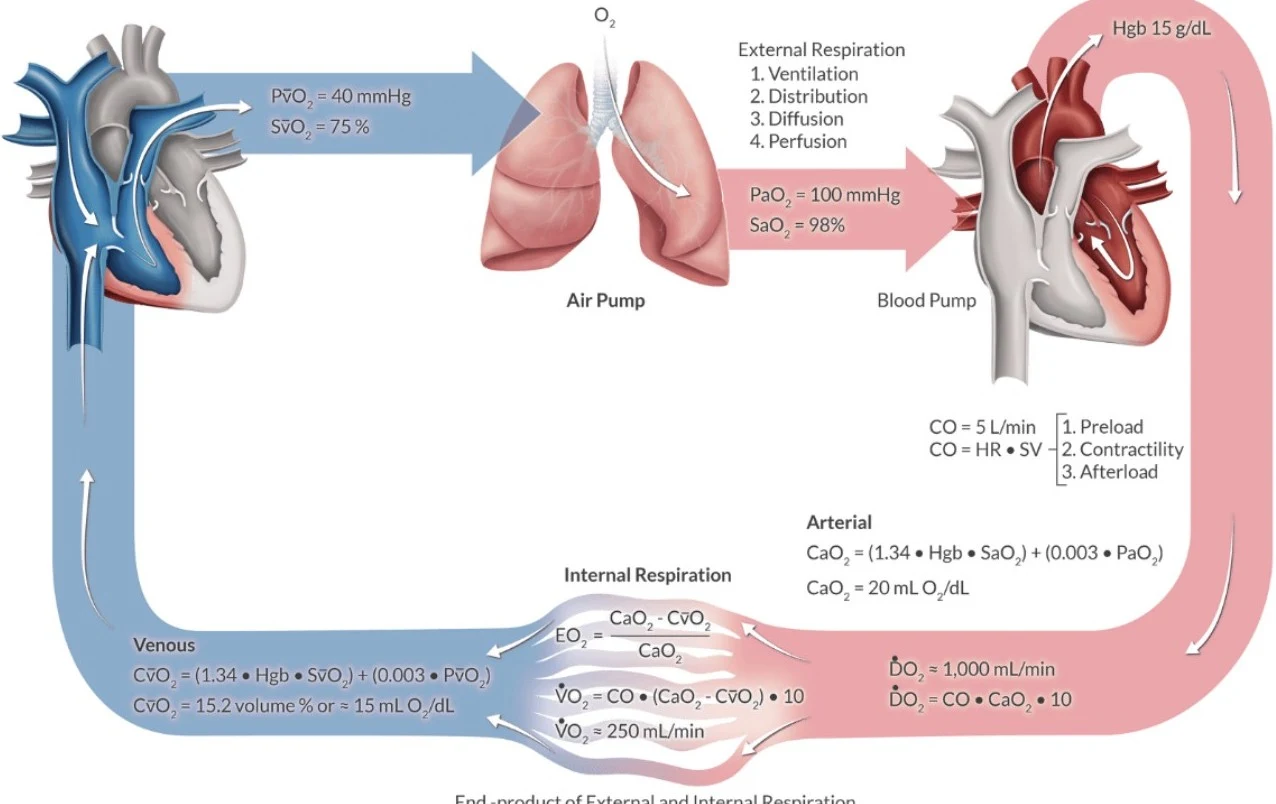
Oxygen delivery () is the total amount of oxygen transported to the tissues per minute. It is not a single variable but rather the product of two distinct components: how much oxygen is available in the blood and how quickly that blood is being moved by the heart.
The relationship is expressed by the following equation:
In this formula, represents Cardiac Output, and represents Arterial Oxygen Content. The factor of 10 is a mathematical conversion used to align the units of hemoglobin () and cardiac output () to result in a final value of .
Oxygen Carrying Capacity ()
To determine how much oxygen is actually in the blood, we must look at the Arterial Oxygen Content (). Oxygen is transported in the blood in two ways: bound to hemoglobin () and dissolved directly in the plasma.
Hemoglobin and Saturation
Hemoglobin acts as the "boxcars" of the blood, carrying the vast majority of the oxygen load. The amount of oxygen bound depends on the concentration of hemoglobin, the oxygen saturation ()—which is the percentage of those "boxcars" that are full—and a constant (1.34) representing the maximum oxygen-carrying capacity of hemoglobin.
Keep reading for free.
Create an account to finish this reading and make it part of your study routine.
Continue reading freeAlready have an account? Log in
Updated