Cardiology: Coronary Artery Disease and Acute Coronary Syndromes
An overview of cardiology, focusing on atherosclerosis, coronary artery disease (CAD), myocardial ischemia, and acute coronary syndromes (ACS) including unstable angina, NSTEMI, and STEMI. It also covers risk factors, lipid management, and clinical consequences like shock and heart failure.
Cardiology is the branch of medicine dedicated to the study and treatment of the heart and its associated blood vessels. Among the most critical conditions studied in this field are those involving the coronary arteries—the vessels responsible for supplying oxygenated blood to the heart muscle itself. When these vessels become compromised, it can lead to a spectrum of life-threatening conditions ranging from predictable chest pain to sudden cardiac death.
From Arteriosclerosis to Atherosclerosis
To understand heart disease, one must first distinguish between two related terms: arteriosclerosis and atherosclerosis. Arteriosclerosis is a general term referring to the thickening and hardening of the blood vessel walls. Atherosclerosis is a specific, highly significant form of arteriosclerosis.
In atherosclerosis, lipids (fats) accumulate within the arterial walls. This process involves the buildup of foam cells, which are macrophages that have become engorged with lipids. This accumulation of foam cells forms a structure known as a plaque.
Diagram illustrating the progression of atherosclerosis, from a healthy blood vessel to an advanced lesion with a lipid-rich core and fibrous cap, detailing cellular interactions including monocytes, macrophages, foam cells, and T cells.
As plaque progresses, it can lead to Coronary Artery Disease (CAD), which is the narrowing of the coronary arteries due to this atherosclerotic buildup.
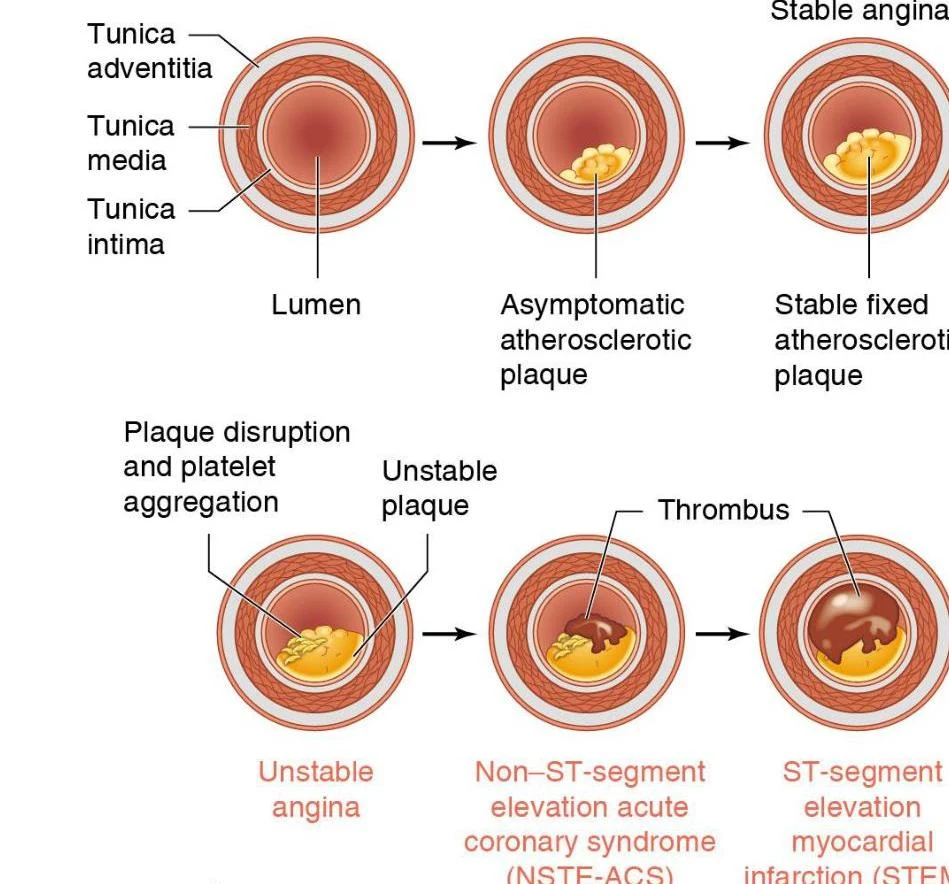
Diagram illustrating the progression of atherosclerosis from a normal artery lumen to the development of stable and unstable plaques, leading to conditions like unstable angina, NSTE-ACS, and ST-segment elevation myocardial infarction.
Risk Factors and Lipid Management
The development of atherosclerosis is influenced by both non-modifiable and modifiable risk factors.
Non-Modifiable: Age, gender (males generally have a higher risk), and family history.
Modifiable: Smoking, hypertension (HTN), diabetes mellitus (DM), sedentary lifestyle, obesity, chronic inflammation, and dyslipidemia (high LDL or low HDL).
Lipid profiles are central to managing these risks. Total cholesterol can be calculated using the following formula:
Total Cholesterol=LDL+HDL+5Triglycerides
Low-Density Lipoprotein (LDL) is often called "bad cholesterol" because it transports cholesterol to tissues, contributing to plaque. High-Density Lipoprotein (HDL) is "good cholesterol" because it removes excess cholesterol from the body and returns it to the liver for recycling.
Myocardial Ischemia and the Ischemic Cascade
The primary danger of CAD is the imbalance between myocardial oxygen supply and demand. Myocardial ischemia occurs when the oxygen demand of the heart muscle exceeds the supply provided by the coronary arteries.
Common causes of increased oxygen demand include exercise, hypertension, and tachycardia. When the lumen of a coronary artery is narrowed by plaque, it cannot deliver sufficient blood to meet these demands.
The Pathophysiology of Ischemia
When oxygen supply fails, the heart muscle is forced to switch to anaerobic metabolism. This process is highly inefficient:
Within 8–10 seconds, anaerobic metabolism begins, producing only about 65% of the ATP required for optimal heart function.
Within 30–60 seconds, EKG changes typically appear.
If ischemia is not reversed within 20 minutes, myocardial necrosis (cell death) begins, leading to a Myocardial Infarction (MI).
Exam Tip: Ischemia is a reversible state of oxygen deprivation, whereas Myocardial Infarction represents irreversible tissue death (necrosis).
Acute Coronary Syndromes (ACS)
Acute Coronary Syndrome is an umbrella term used to describe various clinical presentations of acutely reduced blood flow to the heart. The specific diagnosis depends on the degree of coronary artery occlusion and the presence of cardiac biomarkers.
1. Stable Angina
Stable angina is characterized by predictable chest pain caused by reversible myocardial ischemia. It typically occurs when a "stable plaque" causes >50% occlusion, and symptoms arise during increased oxygen demand (like physical exertion). The pain usually lasts less than 20 minutes and may be relieved by rest or nitroglycerine.
2. Unstable Angina
Unstable angina occurs when a plaque becomes damaged or ruptured, leading to more unpredictable and severe symptoms.
3. Myocardial Infarction (MI)
If the occlusion is severe enough to cause cell death, a myocardial infarction occurs. ACS is further categorized into two types based on EKG findings and cardiac markers:
NSTEMI (Non-ST Segment Elevation Myocardial Infarction): Characterized by EKG changes (such as ST depression) and the presence of cardiac biomarkers, but without the specific ST-segment elevation seen in more severe cases.
STEMI (ST-Segment Elevation Myocardial Infarction): A more severe form of MI where the EKG shows ST-segment elevation, indicating significant, often transmural, damage.
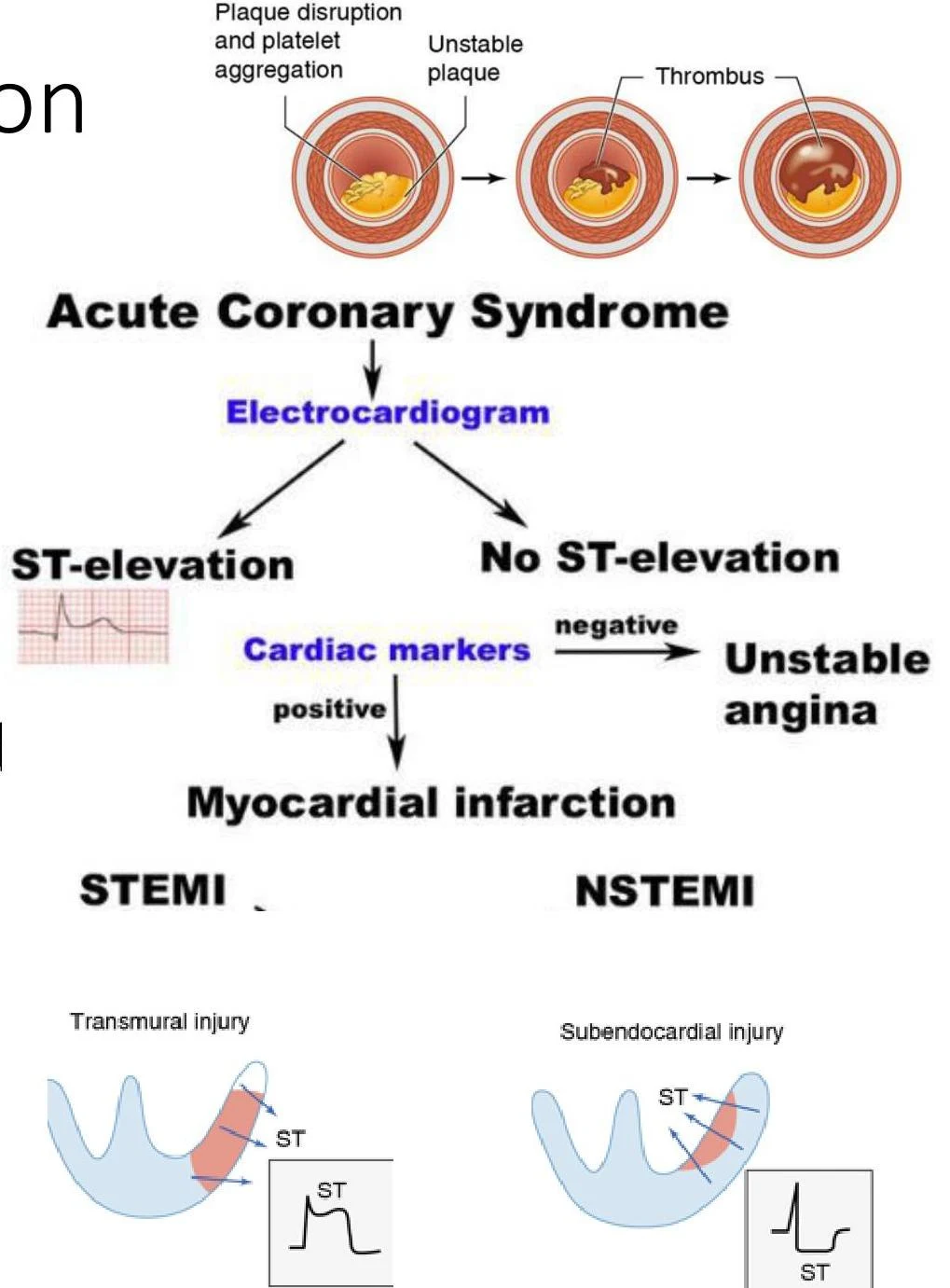
Diagram illustrating the diagnosis of Acute Coronary Syndrome, differentiating between STEMI and NSTEMI based on electrocardiogram and cardiac marker results, and showing the underlying pathology of plaque disruption and thrombus formation.
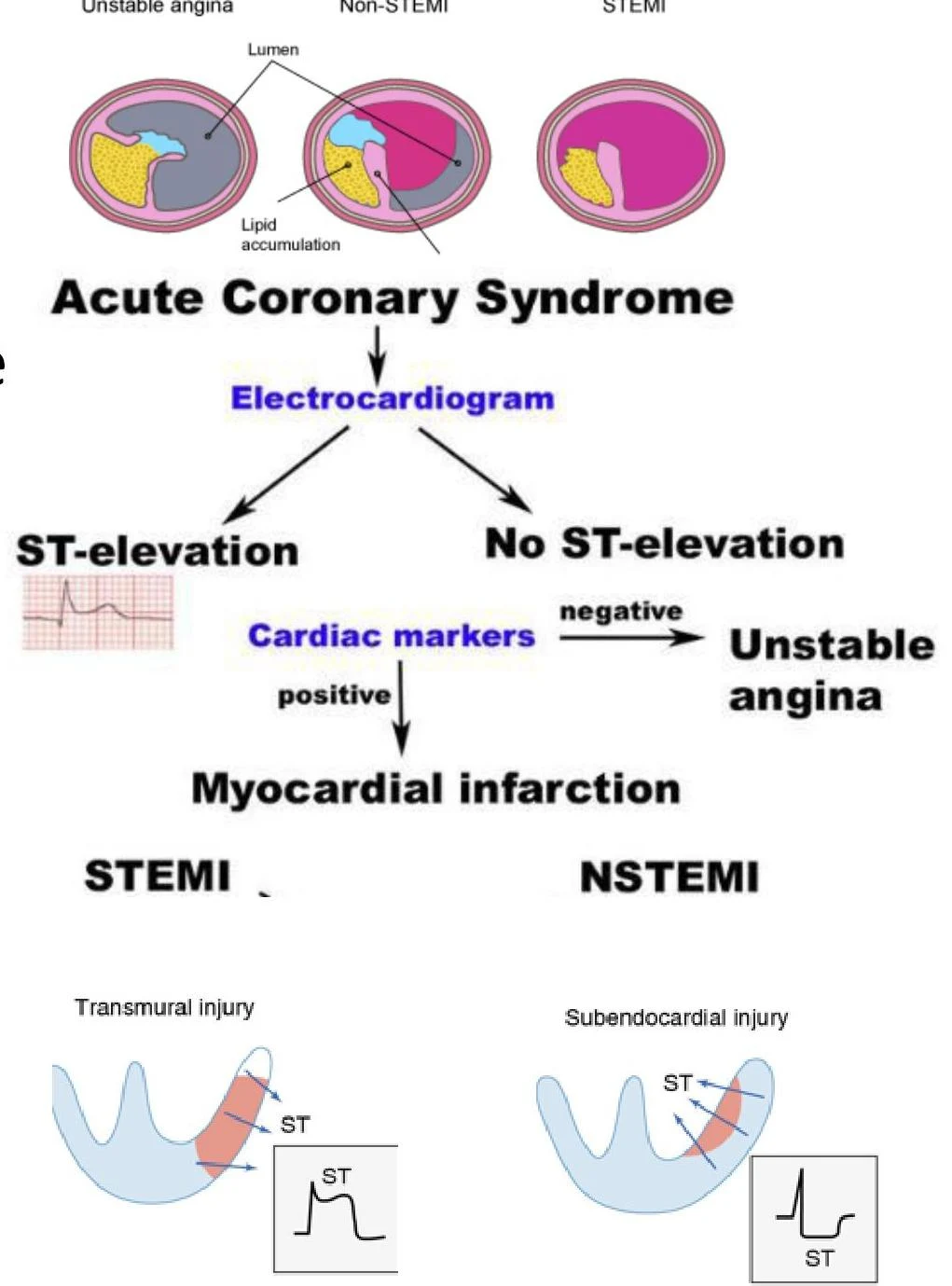
Diagram illustrating the classification of Acute Coronary Syndrome based on electrocardiogram findings and cardiac markers, differentiating between STEMI and NSTEMI, and showing corresponding myocardial injury patterns.
Clinical Consequences: Shock and Heart Failure
Severe coronary artery disease can lead to systemic failures.
Circulatory Shock is a life-threatening state where cardiac output is insufficient to meet the body's metabolic needs, resulting in tissue hypoxia. In the context of cardiology, Cardiogenic Shock occurs when the heart's pumping ability is so impaired that it cannot maintain adequate circulation.
Furthermore, chronic ischemia or infarction can lead to Congestive Heart Failure (CHF), where the heart's pumping ability is decreased. This can manifest as:
Left-sided CHF: Causes fluid to back up into the lungs (Pulmonary Edema).
Right-sided CHF: Causes fluid to back up in the periphery (Pitting Edema).
Cor Pulmonale: Right-sided heart failure specifically caused by a respiratory disorder.
Clinical Note: When assessing heart failure, clinicians look at the Ejection Fraction (EF). A low EF is a hallmark of Systolic Dysfunction (impaired contractility), while a normal EF with impaired filling indicates Diastolic Dysfunction (impaired relaxation).
Keep reading for free.
Create an account to finish this reading and make it part of your study routine.