Explains the three mechanisms of carbon dioxide transport in the blood (dissolved, carbaminohemoglobin, bicarbonate ions) and how the carbonic acid-bicarbonate buffer system and respiratory system regulate blood pH homeostasis, including conditions like respiratory acidosis and alkalosis. Also touches on carbon monoxid
In the complex dance of human metabolism, every cell produces carbon dioxide (CO2) as a waste product of cellular respiration. For the body to function correctly, this gas must be efficiently removed from the tissues and transported to the lungs for exhalation. This process is not merely about waste removal; it is a sophisticated physiological mechanism that plays a central role in maintaining the delicate acid-base balance of our blood.
Mechanisms of Carbon Dioxide Transport
Carbon dioxide does not travel through the bloodstream in a single form. Instead, it utilizes three distinct transport mechanisms to move from the peripheral tissues to the pulmonary capillaries:
Dissolved in Plasma: A small portion, approximately 7–10%, of CO2 is dissolved directly into the blood plasma.
Carbaminohemoglobin: About 20% of the CO2 binds to the polypeptide chains of hemoglobin (Hb) within red blood cells (erythrocytes).
Bicarbonate Ions (HCO3−): The vast majority, roughly 70%, is transported as bicarbonate ions. This method is the most significant for regulating blood pH.
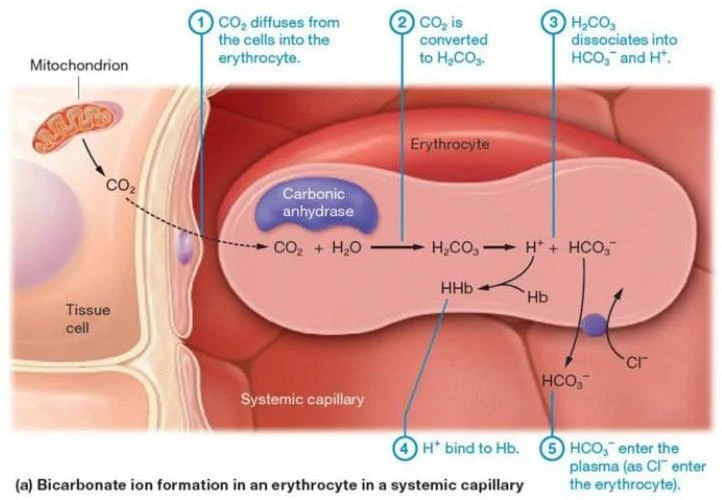
This diagram illustrates the process of bicarbonate ion formation within an erythrocyte in a systemic capillary, a key mechanism for carbon dioxide transport in the blood.
The Role of Carbonic Anhydrase and the Chloride Shift
The conversion of CO2 into bicarbonate is a rapid and highly efficient process facilitated by a specialized enzyme located inside erythrocytes called carbonic anhydrase (CA). When CO2 diffuses into a red blood cell, carbonic anhydrase catalyzes its reaction with water to form carbonic acid (H2CO3), which then spontaneously dissociates into bicarbonate and hydrogen ions:
CO2+H2O↔H2CO3↔HCO3−+H+
As bicarbonate ions (HCO3−) accumulate within the erythrocyte, they begin to diffuse out of the cell and into the plasma along their concentration gradient. To prevent a buildup of negative charge and maintain electrical neutrality, a process known as the chloride shift occurs: chloride ions (Cl−) move from the plasma into the erythrocyte to balance the loss of bicarbonate.
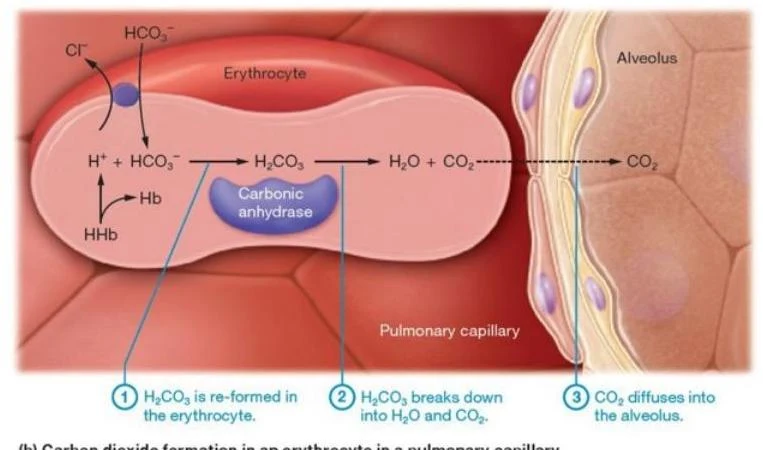
When the blood reaches the pulmonary capillaries surrounding the alveoli, the entire process reverses. The high concentration of oxygen in the lungs encourages the release of CO2 from hemoglobin, and the bicarbonate in the plasma moves back into the red blood cells. There, the reaction runs backward to reform CO2, which then diffuses across the respiratory membrane into the alveoli to be exhaled.
Diagram illustrating the formation of carbon dioxide in an erythrocyte within a pulmonary capillary and its diffusion into the alveolus.
Blood pH Homeostasis and the Buffer System
The human body must maintain blood pH within a very narrow, slightly alkaline range of 7.35 to 7.45. Even minor deviations from this range can disrupt enzyme function and cellular metabolism.
The carbonic acid-bicarbonate buffer system acts as the primary chemical defense against pH fluctuations. This system works by shifting the chemical equilibrium described above based on the concentration of hydrogen ions (H+) in the blood:
If pH decreases (Acidosis): There is an excess of H+ ions. The bicarbonate ions (HCO3−) in the blood act as a buffer by binding with these excess ions to form carbonic acid, thereby reducing the acidity.
If pH increases (Alkalosis): There is a deficit of H+ ions. Carbonic acid (H2CO3) dissociates to release more H+ ions, bringing the pH back down toward the normal range.
Exam Tip: Remember that the buffer system is a "seesaw." If you add acid (H+), the reaction shifts to the left to consume it. If you remove acid, the reaction shifts to the right to replace it.
Respiratory Regulation of pH
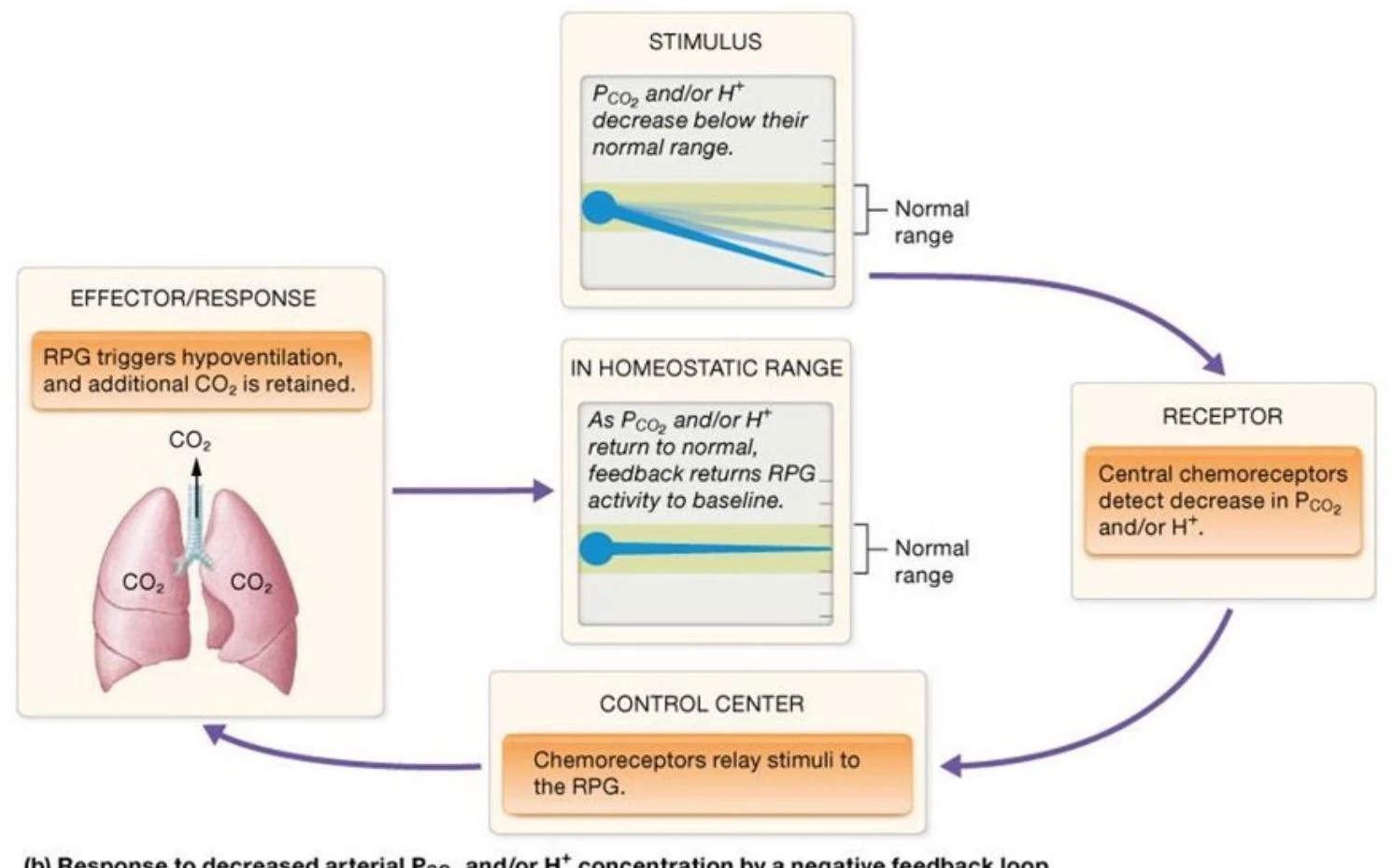
While chemical buffers provide immediate protection, the respiratory system provides a more powerful, long-term regulatory mechanism by controlling the partial pressure of carbon dioxide (PCO2) through ventilation. This is managed by central chemoreceptors in the brainstem (medulla oblongata) that monitor H+ levels in the cerebrospinal fluid.
Hyperventilation and Respiratory Alkalosis
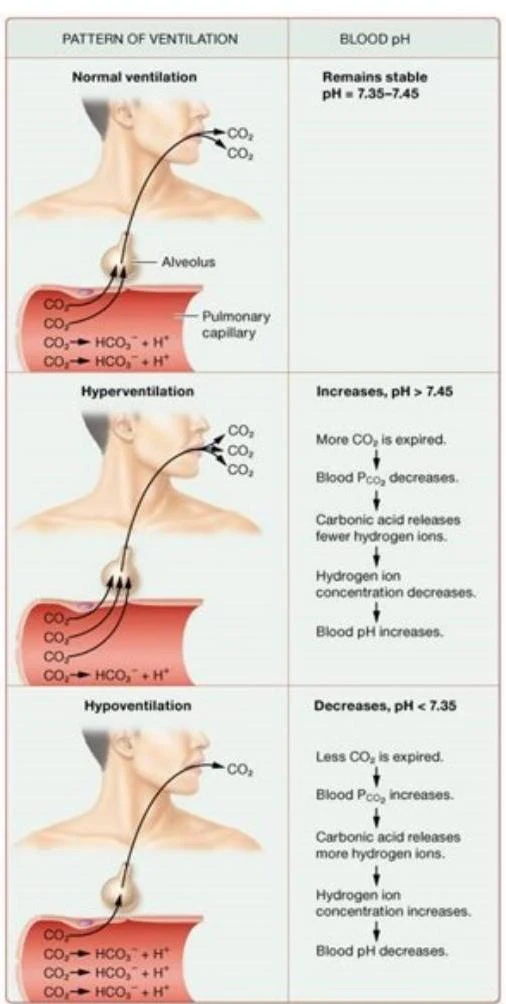
When a person breathes faster or deeper than necessary (hyperventilation), they "blow off" excessive amounts of CO2. This reduction in PCO2 leads to a decrease in the formation of carbonic acid, which in turn lowers the concentration of H+ ions. The result is an increase in blood pH, a condition known as respiratory alkalosis (often associated with hypocapnia, or low CO2 levels).
This diagram illustrates the relationship between ventilation patterns (normal, hyperventilation, and hypoventilation) and blood pH, explaining the physiological mechanisms involved in maintaining or altering blood pH through CO2 regulation.
Hypoventilation and Respiratory Acidosis
Conversely, if breathing is too slow or too shallow (hypoventilation), CO2 is retained in the body. This rise in PCO2 (known as hypercapnia) drives the formation of more carbonic acid, which increases the concentration of H+ ions. This lowers the blood pH, leading to respiratory acidosis.
This diagram illustrates a negative feedback loop regulating CO2 concentration in the blood. When CO2 levels decrease below the normal range, central chemoreceptors detect this change and signal the control center. The control center then relays this stimulus to the RPG, which triggers hypoventilation, leading to increased CO2 retention and a return to the homeostatic range.
Clinical Correlation: Carbon Monoxide Poisoning
While the body is highly efficient at transporting CO2, it can be dangerously compromised by other gases. In the case of carbon monoxide (CO) poisoning, the carbon monoxide molecule binds to hemoglobin with an affinity much higher than that of oxygen. This prevents hemoglobin from transporting oxygen to the tissues, leading to cellular hypoxia and death, even if the patient is breathing normally. This highlights how critical the specific binding sites on hemoglobin are for maintaining systemic homeostasis.
Keep reading for free.
Create an account to finish this reading and make it part of your study routine.