


Organic chemistry is defined as the study of carbon. While many elements form molecules, carbon is uniquely versatile, possessing the ability to form long chains, branched chains, and even complex rings of atoms. This versatility is the foundation of life and the basis for countless synthetic materials, from the fuels in our cars to the plastics in our homes.
The Uniqueness of Carbon
The secret to carbon's versatility lies in its position in the periodic table. As a Group 4 element, a single carbon atom has four electrons in its outer shell. To achieve a stable, full outer shell, carbon must form four covalent bonds. A covalent bond is formed when atoms share electrons rather than transferring them.
Because carbon needs four bonds, it can connect to other non-metal elements—such as hydrogen, oxygen, nitrogen, or chlorine—or to other carbon atoms. When carbon forms four single bonds, these bonds are not arranged in a flat, two-dimensional plane. Instead, they push away from each other to minimize repulsion, resulting in a three-dimensional tetrahedral shape.
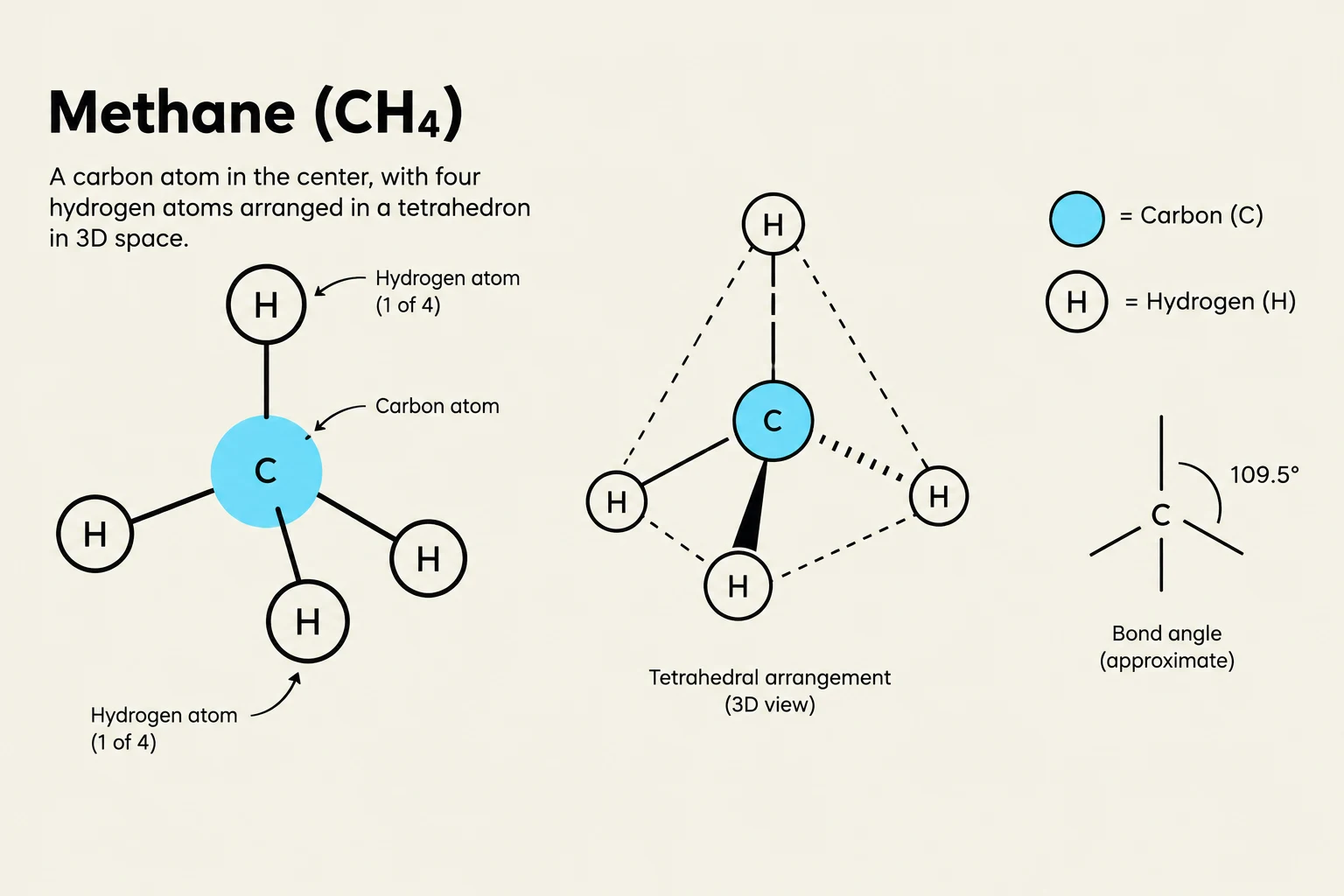
Exam Tip: When drawing structural formulas, remember that while 2D drawings often show bonds at 90° angles, the actual 3D shape of a saturated carbon molecule is tetrahedral.
Hydrocarbons: Alkanes and Alkenes
A hydrocarbon is a compound consisting of hydrogen and carbon atoms only. These are categorized into different "families" known as homologous series. A homologous series is a group of compounds that share the same functional group and similar chemical properties, but differ by a specific amount of atoms.
Keep reading for free.
Create an account to finish this reading and make it part of your study routine.
Continue reading freeAlready have an account? Log in
Updated