Carbohydrate Structure and Function: From Monomers to Complex Polymers
Explores the structure and function of carbohydrates, from simple monosaccharides like glucose to complex polysaccharides like starch and cellulose. Covers classification, isomerism, glycosidic bonds, dehydration synthesis, and hydrolysis.
Carbohydrates are essential organic macromolecules composed primarily of carbon, hydrogen, and oxygen. These molecules serve two fundamental roles in living systems: they act as a primary source of immediate fuel and provide the structural components necessary for cellular integrity. While we often associate carbohydrates with simple sugars, they exist in a vast spectrum of complexity, ranging from single sugar units to massive, highly branched polymers.
Monosaccharides: The Building Blocks
The simplest form of a carbohydrate is a monosaccharide, often referred to as a "single sugar". These serve as the monomers (building blocks) for all larger carbohydrates. Monosaccharides are classified based on two main criteria: the number of carbon atoms they contain and the position of their carbonyl group (C=O).
Carbon Count: Sugars can be trioses (3 carbons), pentoses (5 carbons, such as ribose), or hexoses (6 carbons, such as glucose).
Carbonyl Position: If the carbonyl group is at the end of the carbon chain, the sugar is an aldose; if it is within the chain, it is a ketose.
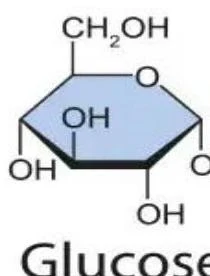
Glucose molecule structure
Glucose (C6H12O6) is perhaps the most critical monosaccharide in biology, serving as immediate fuel for cells throughout living systems. Because monosaccharides contain many hydroxyl groups (–OH), they are highly polar and hydrophilic, meaning they interact readily with water.
Isomers and Ring Formation
Even when molecules share the same chemical formula, they can have different structures, known as isomers. For example, glucose and fructose are structural isomers because their carbonyl groups are placed differently. Glucose and galactose are stereoisomers, differing only in the spatial orientation of a single hydroxyl group.
In aqueous (water-based) environments, these linear sugar chains typically fold into ring structures. A critical distinction occurs at the anomeric carbon (Carbon 1 in glucose):
Alpha (α) glucose: The hydroxyl group on carbon 1 points below the ring.
Beta (β) glucose: The hydroxyl group on carbon 1 points above the ring.
Exam Tip: The orientation of this single hydroxyl group is the "master switch" for biology. It determines whether the resulting polymer will be used for energy storage (like starch) or for rigid structural support (like cellulose).
Disaccharides: Joining Sugars
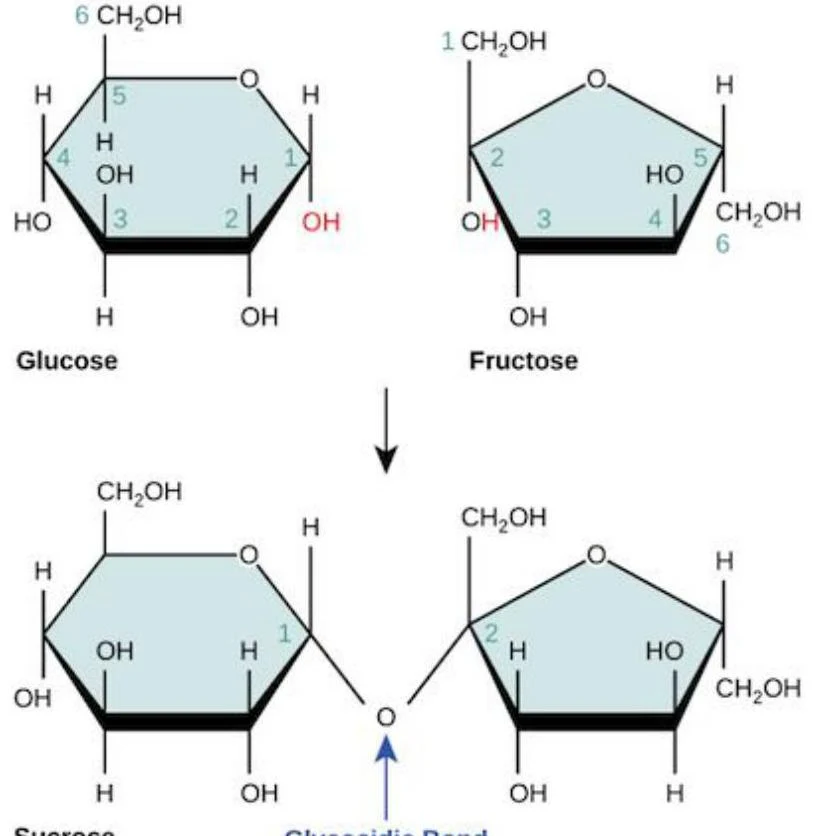
When two monosaccharides join together, they form a disaccharide. This connection is a covalent bond known as a glycosidic bond (or linkage).
Dehydration Synthesis vs. Hydrolysis
The formation and breakdown of these bonds are governed by two opposing chemical reactions:
Dehydration Synthesis: This is the process of building a larger molecule. Two sugars join, and in the process, a molecule of water (H2O) is released.
Glucose+Fructose→Sucrose+H2O
Hydrolysis: This is the process of breaking a bond. To break a glycosidic linkage, a water molecule is added back into the reaction, splitting the disaccharide into its original monomers.
Diagram showing the formation of sucrose from glucose and fructose through a glycosidic bond.
Common disaccharides include:
Maltose: Two glucose monomers joined together; often formed during the digestion of starch.
Lactose: Composed of glucose and galactose; the sugar naturally found in milk.
Sucrose: Composed of glucose and fructose; commonly known as table sugar.
Polysaccharides: Complex Carbohydrates
Polysaccharides are long chains of monosaccharides joined by glycosidic bonds. These "complex carbohydrates" can be used for either energy storage or structural support, depending on their specific molecular geometry.
Molecule
Subunits / Bonds
Primary Role
Organism/Location
Starch
α-glucose (1-4 and 1-6 bonds)
Energy storage
Plant roots and seeds
Glycogen
Highly branched α-glucose
Rapid energy mobilization
Animal liver and muscle
Cellulose
β-glucose (1-4 bonds)
Structural support
Plant cell walls
Chitin
Modified glucose with nitrogen
Structural support
Fungi and arthropods
Energy Storage: Starch and Glycogen
Plants use starch to store glucose. Because starch uses α-glucose linkages, it can form helical shapes that are easy for enzymes to access. Animals use glycogen, which is even more highly branched than starch. This high degree of branching is a functional advantage: it creates many "ends" on the molecule, allowing enzymes to work on many points simultaneously to release glucose rapidly when the body needs energy.
Structural Support: Cellulose and Chitin
In contrast, cellulose is used for strength. It is composed of β-glucose, which results in straight, unbranched chains. These straight chains can align parallel to one another and form many hydrogen bonds, creating incredibly strong fibers called microfibrils. Because of these β-linkages, most animals (including humans) lack the enzymes necessary to hydrolyze cellulose, meaning it passes through our systems as dietary fiber.
Chitin is similar to cellulose in its use of β-linkages but contains a nitrogen-modified sugar, providing the toughness required for fungal cell walls and the exoskeletons of arthropods like insects and crabs.
Summary of Structure-Function Relationships
Understanding carbohydrates requires looking past the chemical formula to the physical shape of the molecule.
Key Takeaway:
Branching→ Increases surface area for enzymes → Supports rapid energy mobilization (e.g., Glycogen).
While carbohydrates are often discussed alongside lipids (fats) as energy sources, they serve distinct roles: carbohydrates provide immediate and short-term energy, while lipids are primarily used for long-term energy storage and cell membrane structure.
Keep reading for free.
Create an account to finish this reading and make it part of your study routine.