This article provides a comprehensive guide to the Canine Breeding Soundness Examination (BSE), semen collection methods, and semen evaluation parameters necessary for assessing male fertility in dogs.
In canine reproduction, ensuring the fertility of the male is just as critical as timing the estrus of the female. A Breeding Soundness Examination (BSE) serves as a comprehensive assessment to determine if a male is physically and physiologically capable of producing high-quality semen for successful conception. This article outlines the essential components of the BSE, the nuances of semen collection, and the parameters required for a "fertile male."
Breeding Soundness Examination (BSE)
The BSE is a multi-faceted clinical evaluation. It is not merely a check of the reproductive organs but a holistic assessment of the dog's ability to perform the breeding act and produce viable gametes.
Physical and Reproductive Assessment
A thorough examination must include:
General Health: Assessing for arthritis or other musculoskeletal issues that might cause pain during the mounting and tying process.
Testicular Evaluation: The clinician must assess the testes for size, symmetry, and consistency. It is vital to check for testicular pathology, such as tumors, atrophy, or inflammation, which can significantly impact sperm production.
Scrotal Measurements: While specific standardized tables vary, assessing scrotal width and overall size provides a baseline for testicular health.
Prostate Exam: The prostate should be evaluated for enlargement or abnormalities. Prostatic issues can lead to discomfort during ejaculation, which may result in the dog being uncooperative or unable to complete the breeding act.
Exam Tip: Always check for behavioral or psychological barriers. A dog may be physically capable but may suffer from "psychological" refusal to breed due to previous negative experiences or lack of social stimulation.
Disease Screening
One of the most critical steps in the BSE is screening for infectious diseases. Specifically, the male must be tested and confirmed negative for Brucella canis. Brucella is a significant reproductive pathogen that can cause infertility and poses a zoonotic risk to humans.
Semen Collection Methods
Once a male is deemed sound, semen must be collected for evaluation or use in artificial insemination (AI). There are several primary methods used in veterinary practice:
Manual Stimulation and Ejaculation
This is the most common method, often involving a handler or a trained technician providing manual stimulation to the penis to induce ejaculation. This method is preferred for its ability to mimic natural processes and is generally the first line of approach for healthy, cooperative dogs.
Drug-Enhanced Ejaculation
In cases where a dog is uncooperative or has difficulty with manual stimulation, pharmacological aids may be used to facilitate the process. These drugs can increase libido or assist in the muscular contractions required for ejaculation.
Electroejaculation
Electroejaculation is a more invasive technique used primarily when manual collection is impossible. It involves the use of an electroejaculator probe inserted into the rectum to stimulate the reproductive nerves and muscles. While effective, it requires careful technique to avoid tissue damage.
Semen Evaluation and Parameters
After collection, the semen is analyzed to determine its quality. A "fertile male" is expected to produce a significant volume of high-quality spermatozoa.
Spermatozoa Numbers and Concentration
The total number of spermatozoa in an ejaculate is a key indicator of fertility. A high-quality ejaculate typically contains between 300 million and 2 billion spermatozoa.
The concentration is measured in millions of cells per milliliter (106/mL). A normal concentration ranges from 4 to 400 million/mL. To calculate the total sperm per ejaculate, use the following formula:
Total Sperm=Volume (mL)⋅Concentration (cells/mL)
Ejaculate Fractions
A canine ejaculate is not a uniform mixture; it is composed of different fractions that must be understood during evaluation:
Pre-sperm fraction: The initial portion of the ejaculate, often lower in sperm concentration.
Sperm-rich fraction: The most critical portion, containing the highest concentration of spermatozoa. This is the fraction targeted for breeding doses.
Prostatic portion: The final fraction, which is largely composed of prostatic fluid and contains very few sperm.
Motility and Morphology
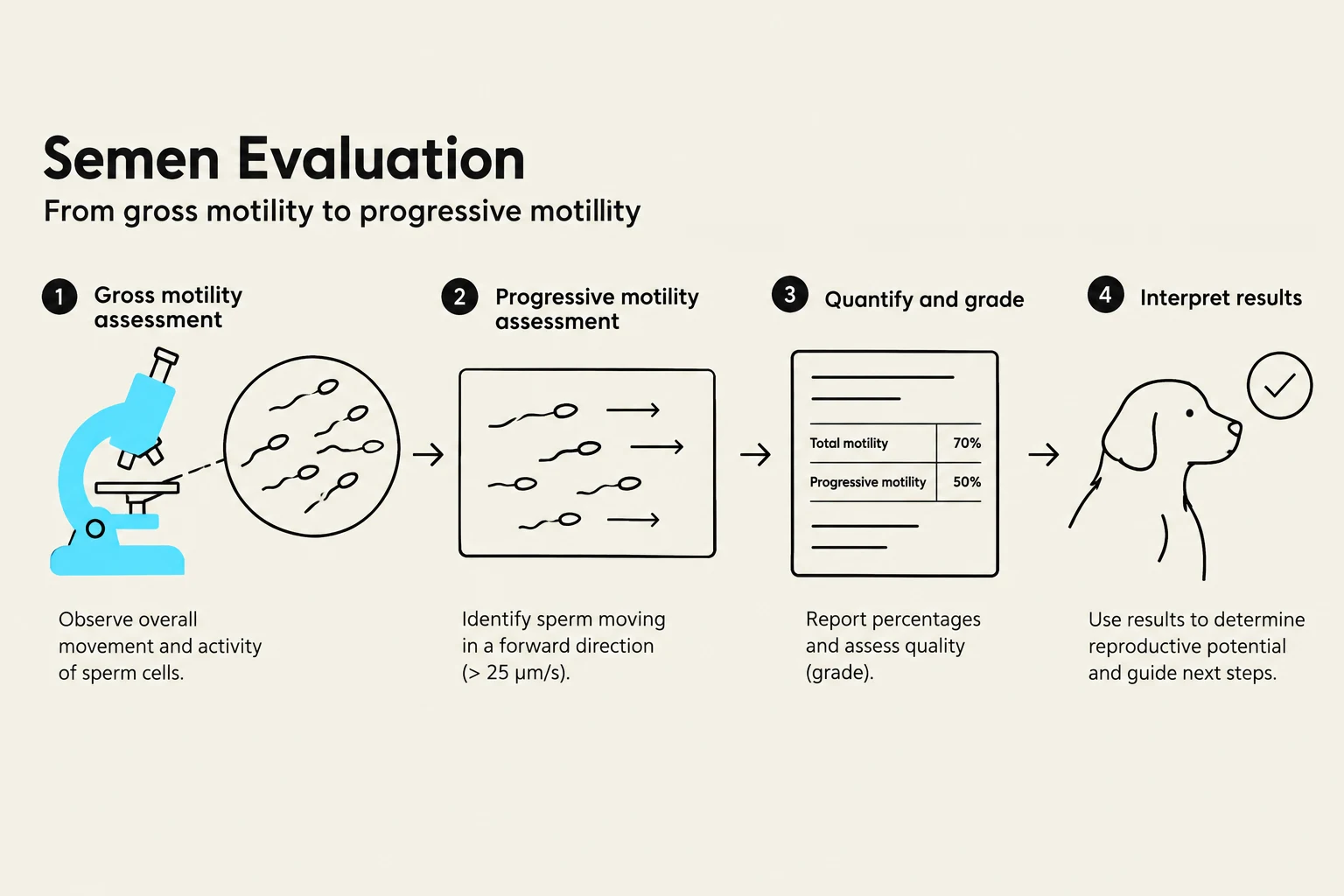
Motility: We distinguish between "gross motility" (all moving cells) and "progressive motility" (cells moving forward in a straight line or large circles). A normal dog should have >80% progressive motility.
Morphology: This involves assessing the physical structure of the sperm cells using stains like Eosin Nigrosin. A fertile male should have >80% morphologically normal spermatozoa.
This diagram illustrates the process of semen evaluation, from assessing gross motility to progressive motility, quantifying results, and interpreting them to determine reproductive potential.
Summary of Target Breeding Values
For successful artificial insemination, clinicians aim for a specific "breeding dose":
Target Dose:200×106 progressively motile, morphologically normal spermatozoa.
Motility Threshold:>70–80% progressive motility.
Morphology Threshold:>80% normal morphology.
Clinical Note: When working with frozen semen, the longevity is significantly reduced. While fresh semen can last 48–72 hours, frozen semen may only remain viable for 8–12 hours. Always perform longevity testing before shipping commercial frozen doses.
Keep reading for free.
Create an account to finish this reading and make it part of your study routine.