Calculus often requires us to "undo" operations or evaluate limits that appear impossible at first glance. This article explores the mathematical mechanics of inverse functions, the specific behavior of inverse trigonometric functions, and the powerful utility of L’Hospital’s Rule for resolving indeterminate limits.
Understanding Inverse Functions
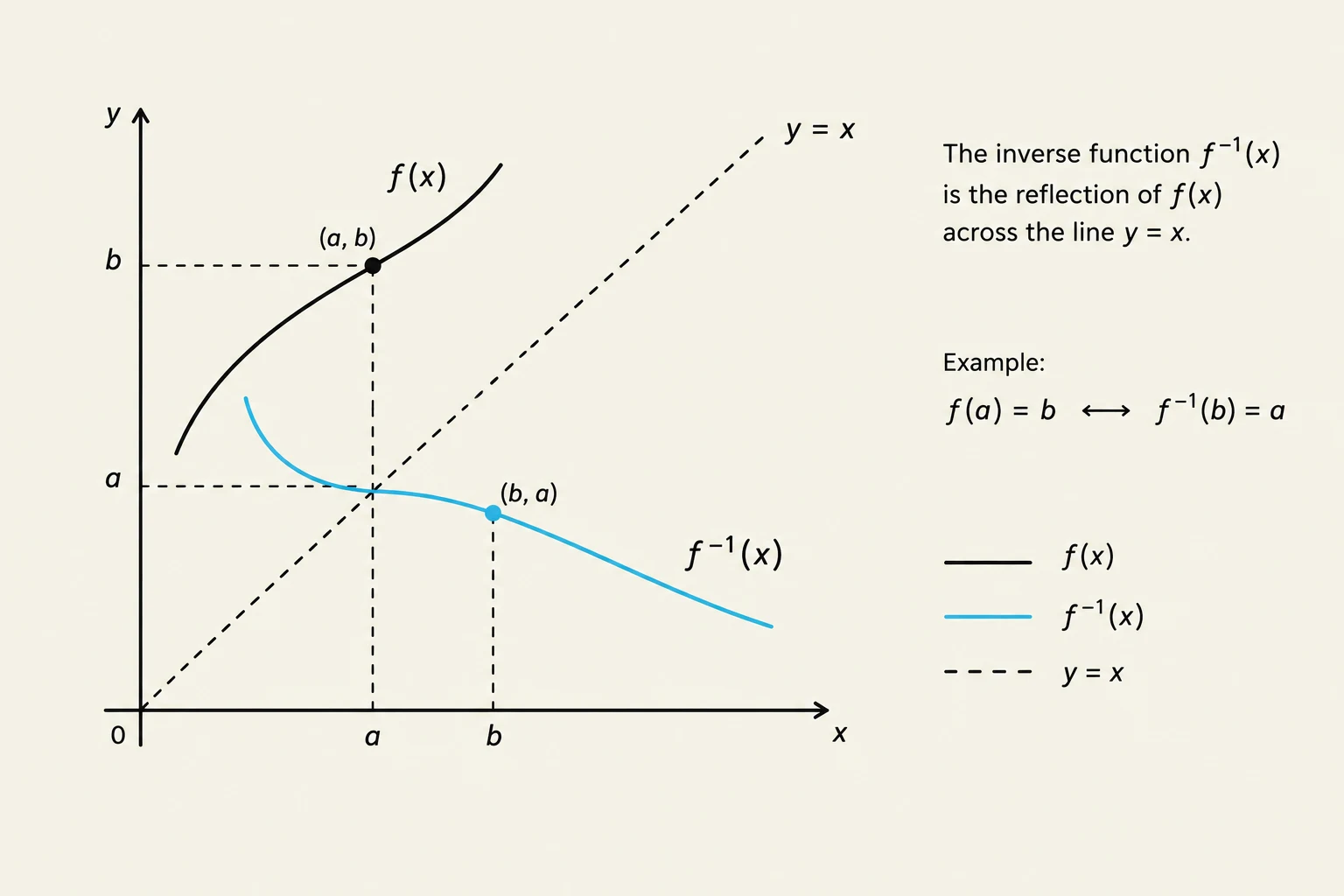
An inverse function essentially reverses the action of a given function. If we have a function f with a domain D=Dom(f) and a range R=Ran(f), its inverse F (often written as f−1) is defined such that it maps the range of f back to the domain of f.
Formally, for F to be the inverse of f:
Dom(F)=Ran(f)
Ran(F)=Dom(f)
(F∘f)(x)=x for every x in Dom(f).
To find an inverse algebraically, you can write y=f(x), solve the equation for x in terms of y, and then swap the variables to express the result as y=f−1(x).
Note: Do not confuse the inverse function f−1(x) with the reciprocal function f(x)1. The former undoes the operation, while the latter is simply division by the function's value.
A graph illustrating the concept of an inverse function, showing a function f(x) and its inverse f-1(x) as reflections across the line y=x.
Derivatives of Inverse Functions
One of the most useful properties in calculus is the ability to find the derivative of an inverse function without necessarily finding the algebraic expression for the inverse itself. The derivative of an inverse function F is given by the formula:
dxdF(x)=f′(f−1(x))1=f′(F(x))1
. This relationship tells us that the slope of the inverse function at a certain point is the reciprocal of the slope of the original function at the corresponding point.
Inverse Trigonometric Functions
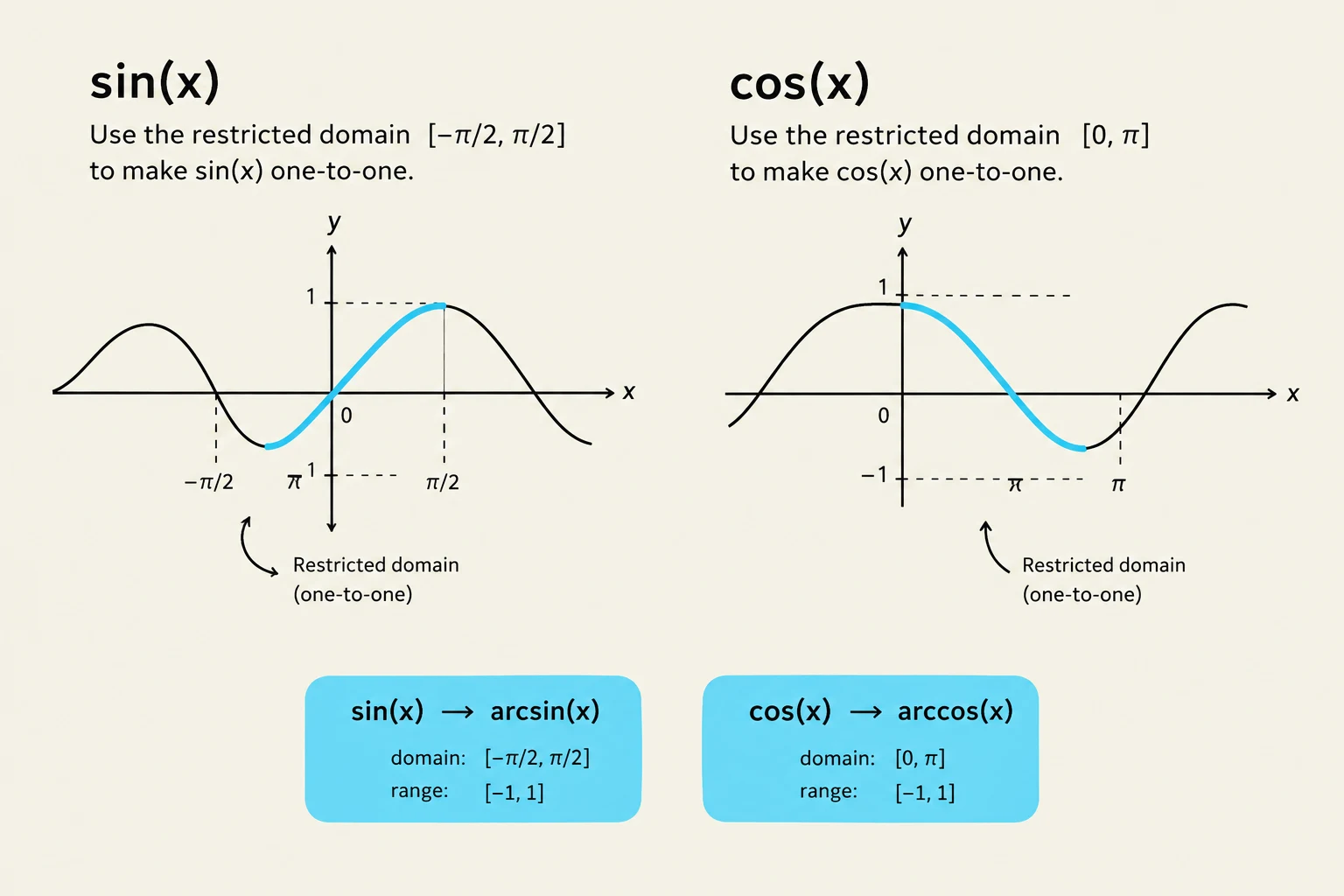
Standard trigonometric functions like sin(x) are periodic, meaning they repeat values. To create an inverse, we must restrict their domains so they become "one-to-one". These are known as inverse trigonometric functions.
Common Inverse Trig Functions
The following table summarizes the primary inverse trigonometric functions, their domains, and their ranges:
Function
Domain
Range (Principal Value)
y=Arcsin(x)
−1≤x≤1
−2π≤y≤2π
y=Arccos(x)
−1≤x≤1
0≤y≤π
y=Arctan(x)
−∞<x<∞
−2π<y<2π
y=Arccot(x)
−∞<x<∞
0<y<π
Derivatives of Inverse Trig Functions
When differentiating these functions, we often use the chain rule. If u is a function of x, the derivatives are:
dxdArcsin(u)=1−u21⋅dxdu
dxdArccos(u)=−1−u21⋅dxdu
dxdArctan(u)=1+u21⋅dxdu
dxdArccot(u)=−1+u21⋅dxdu
Graphs of sin(x) and cos(x) with restricted domains to illustrate one-to-one functions and their corresponding inverse functions, arcsin(x) and arccos(x), along with their domains and ranges.
L’Hospital’s Rule and Indeterminate Forms
In many limit problems, direct substitution results in an indeterminate form, such as 00 or ∞∞. These forms do not provide a definitive value for the limit and require further investigation.
L’Hospital’s Rule provides a method to resolve these limits by using derivatives.
The Rule
Let f and g be two functions defined and differentiable in a punctured neighborhood of a (where a is finite). If g′(x)=0 in that neighborhood, and the limit limx→ag(x)f(x) results in the indeterminate forms 00 or ∞∞, then:
x→alimg(x)f(x)=x→alimg′(x)f′(x)
.
Pro Tip: This rule is not limited to finite values of a. It also holds if a is replaced by ±∞ or if you are evaluating one-sided limits.
Example Application
Consider the limit:
limx→0xsin(x)
Direct substitution gives 0sin(0)=00, which is indeterminate. Applying L’Hospital’s Rule:
limx→0dxdxdxdsin(x)=limx→01cos(x)=cos(0)=1
By differentiating the numerator and denominator separately, we successfully found the limit.
Keep reading for free.
Create an account to finish this reading and make it part of your study routine.