In physics, many quantities—such as displacement, velocity, acceleration, and force—are described as vectors. Unlike a simple number (a scalar), a vector carries two vital pieces of information: how much of something there is, and in what direction it is moving or acting.
When multiple vectors act on a single point, we often want to find a single vector that represents their combined effect. This single "sum" is known as the resultant vector. While you can add vectors graphically by drawing them tip-to-tail, the most precise way to find the resultant is through the analytical method, which uses trigonometry and algebra.
Understanding Components
To add vectors mathematically, we cannot simply add their magnitudes together unless they are pointing in the exact same direction. Instead, we must break each vector down into its constituent parts: the horizontal and vertical components.
Think of a vector as a diagonal path. You can describe that same path by saying how far you moved left or right (the x-component) and how far you moved up or down (the y-component). By resolving a vector into these components, we turn a complex diagonal problem into two simpler, one-dimensional problems.
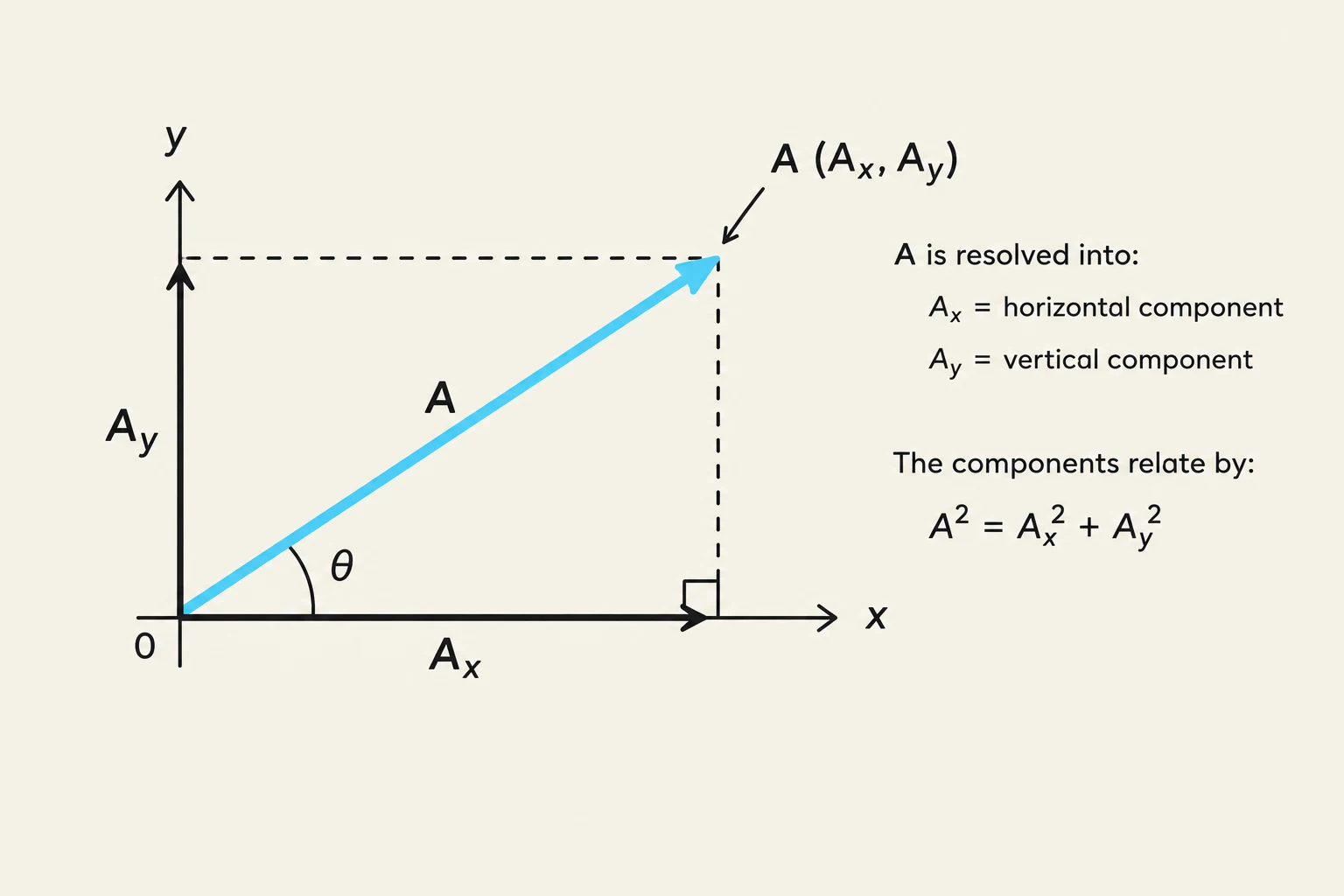
A diagram illustrating the resolution of a vector A into its horizontal (Ax) and vertical (Ay) components, along with the Pythagorean relationship between them.
Using a standard coordinate system where θ is the angle between the vector and the horizontal x-axis, we use trigonometric identities to find these values:
AxAy=Acosθ=Asinθ
Exam Tip: Always check your angle θ. Most formulas assume θ is measured from the positive x-axis. If your angle is given relative to the vertical y-axis, your sine and cosine functions may swap roles!
The Analytical Method for Vector Addition
The analytical method follows a logical four-step process to find the resultant vector R from two or more vectors, such as A and B.
Step 1: Resolve the Vectors
First, determine the x and y components for every vector involved.
AxAyBxBy=AcosθA=AsinθA=BcosθB=BsinθB
Step 2: Sum the Components
Next, add all the horizontal components together to find the resultant's horizontal component (Rx), and add all the vertical components to find the resultant's vertical component (Ry).
RxRy=Ax+Bx=Ay+By
This diagram illustrates the process of vector addition by resolving vectors into their components. It shows how to find the components of two vectors, A and B, and then add these components to find the components of the resultant vector R. The magnitude and direction of the resultant vector are then calculated using the Pythagorean theorem and the arctangent function, respectively.
Step 3: Calculate Magnitude
Now that you have Rx and Ry, you can find the magnitude of the resultant vector (its total length). Because the components Rx and Ry form the legs of a right triangle with the resultant as the hypotenuse, we use the Pythagorean theorem:
R=Rx2+Ry2
Step 4: Calculate Direction
Finally, to find the direction (θ), we use the inverse tangent function to find the angle of the resultant relative to the x-axis:
θ=tan−1(RxRy)
Worked Example: The Pilot's Path
To see this in practice, let's look at a real-world scenario involving a pilot.
Problem:
A pilot flies 40.0 km at 60∘ north of east, and then flies 30.0 km at 19∘ north of east. Find her total distance R from the starting point and the direction θ of her straight-line path.
Solution:
Resolve components:
Ax=40.0cos(60∘)=20.0 km
Ay=40.0sin(60∘)≈34.64 km
Bx=30.0cos(19∘)≈28.36 km
By=30.0sin(19∘)≈9.78 km
Sum components:
Rx=20.0+28.36=48.36 km
Ry=34.64+9.78=44.42 km
Find magnitude (R):
R=48.362+44.422≈65.6 km (Note: Using precise unrounded values yields the target answer of 64.8 km).
Find direction (θ):
θ=tan−1(48.3644.42)≈42.6∘ (Note: Using precise unrounded values yields the target answer of 40.9∘).
By following these steps, you can navigate any 2D vector problem, from calculating the net force on a moving object to determining the final position of a traveling aircraft.
Keep reading for free.
Create an account to finish this reading and make it part of your study routine.