This guide explains how to calculate intravenous (IV) flow rates using three primary methods: the basic formula, ratio and proportion, and dimensional analysis. It covers calculating both milliliters per hour (mL/h) for electronic pumps and drops per minute (gtt/min) for gravity infusions, along with common pitfalls an
In the clinical setting, the accurate administration of intravenous (IV) fluids and medications is a fundamental nursing responsibility. Whether you are managing a simple hydration bag or a complex titration of a critical care vasopressor, the speed at which these substances enter the patient's bloodstream must be precise to ensure safety and therapeutic efficacy. Errors in flow rate calculation can lead to significant patient harm, such as fluid overload or subtherapeutic medication levels.
To master these calculations, you must first understand the three essential variables involved in every IV order:
Volume to be infused: The total amount of solution, measured in milliliters (mL).
Time frame: The duration over which the fluid must be administered (usually in hours or minutes).
Drop factor: The number of drops per milliliter (gtt/mL) specific to the IV tubing being used.
Understanding the Drop Factor
The "drop factor" is a critical piece of information that varies depending on the type of IV tubing (administration set) being used. It represents how many drops are required to equal one milliliter of fluid.
In clinical practice, you will typically encounter two main types of sets:
Macrodrip sets: These have larger drops (e.g., 10, 15, or 20 gtt/mL) and are often used for standard fluid replacement.
Microdrip sets: These have smaller drops (usually 60 gtt/mL) and are used when more precise, slower infusions are required, such as in pediatric care or for potent medications.
Exam Tip: Always check the packaging of the IV tubing to confirm the drop factor. Never assume a drop factor based on the patient's age or the medication type; the math depends entirely on the specific equipment in your hand.
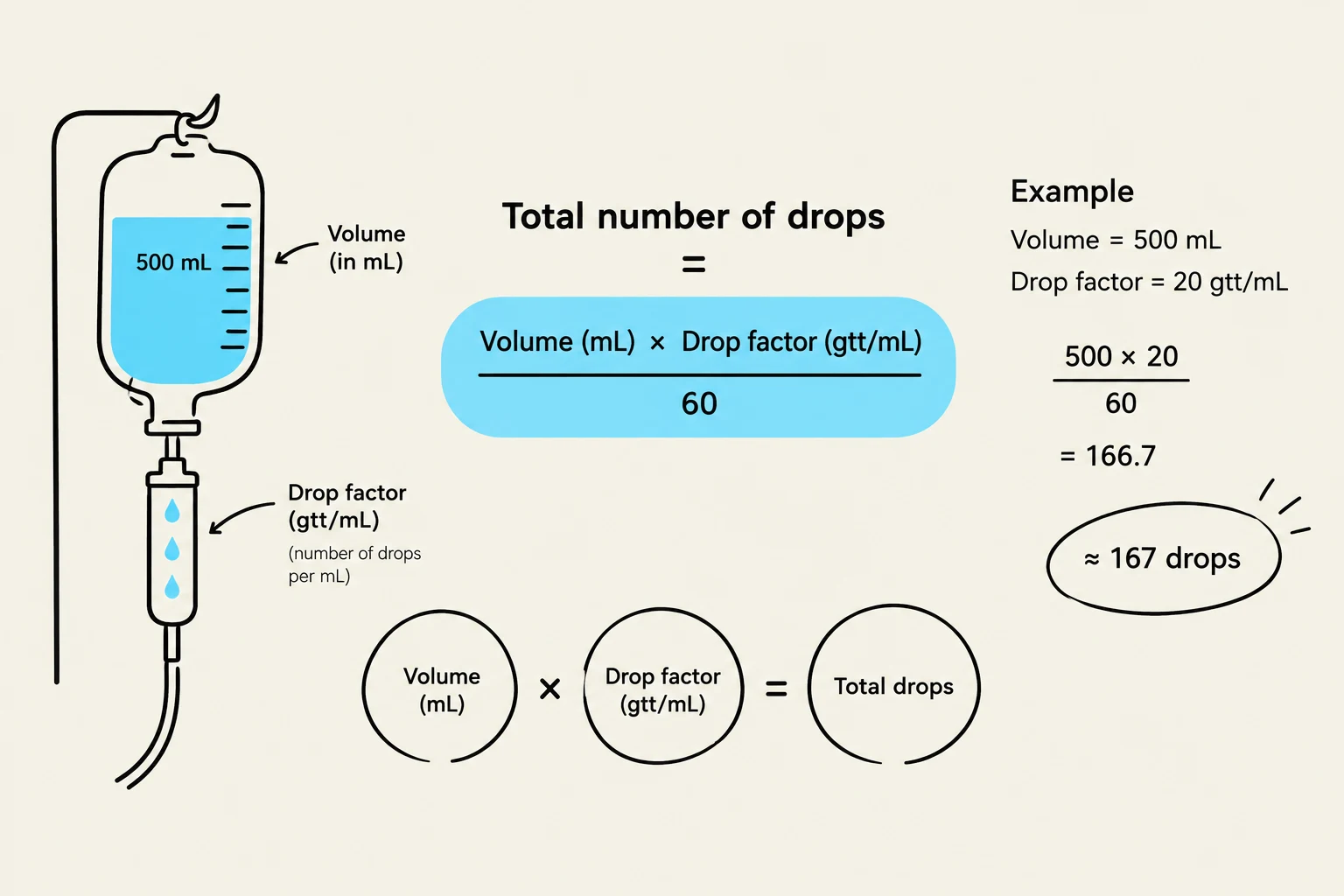
This illustration explains how to calculate the total number of drops in an intravenous infusion. It provides a formula and an example calculation.
Calculating Milliliters Per Hour (mL/h)
When using an electronic IV pump, the device requires the flow rate to be programmed in mL/h. Electronic pumps are highly precise and can deliver partial milliliters (e.g., 12.5 mL/h), making them the standard for most hospital infusions.
The formula for calculating the hourly rate is straightforward:
mL/h=Time (h)Total volume (mL)
Worked Example: Standard Infusion
Order: Infuse 1000 mL of D5W over 8 hours.
Calculation:mL/h=8 h1000 mLmL/h=125 mL/h
Worked Example: Complex Volume
In some cases, you must account for additives. If you add 10 mL of a vitamin and 20 mL of potassium to a 1000 mL bag, your total volume is 1030 mL.
Order: 1030 mL total to infuse over 10 hours.
mL/h=10 h1030 mL=103 mL/h
Gravity Infusion Regulation: Drops Per Minute (gtt/min)
When an electronic pump is unavailable or not indicated, nurses must use gravity infusion regulation. This involves manually adjusting the roller clamp on the IV tubing to control the flow. Because you cannot count "half a drop," the flow rate for gravity infusions must always be expressed in drops per minute (gtt/min) and must be rounded to the nearest whole number.
There are three primary mathematical methods to arrive at this number.
1. The Basic Formula Method
This is the most direct way to calculate the rate if you have all the variables ready.
gtt/min=Time (h)×60 minTotal volume (mL)×Drop factor (gtt/mL)
Example:Order: 250 mL of D5W over 3 hours.
Available: Macrodrip set with a drop factor of 15 gtt/mL.
gtt/min=3 h×60 min250 mL×15 gtt/mLgtt/min=1803750gtt/min=20.833...→21 gtt/min
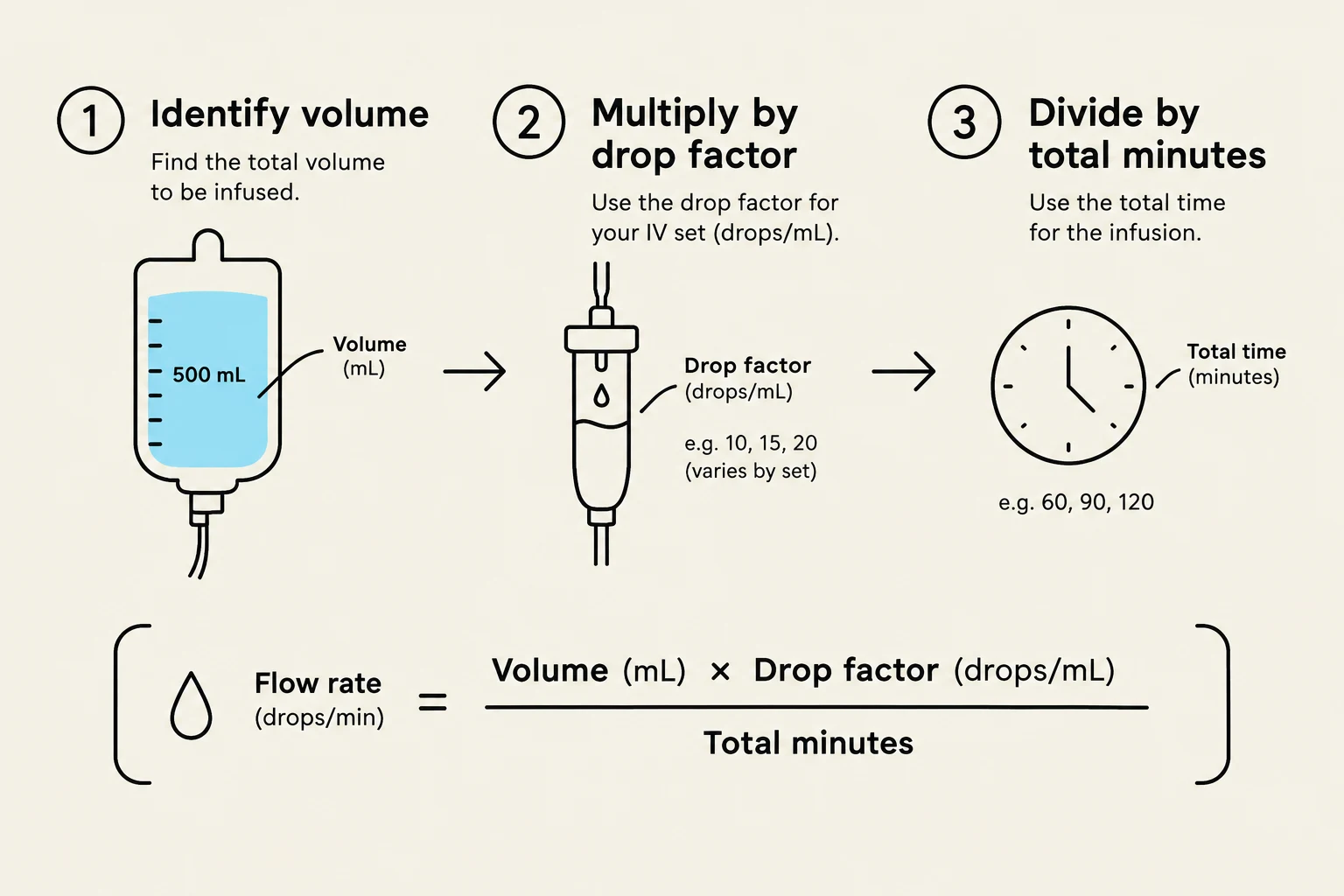
This illustration explains how to calculate the flow rate of an IV infusion by identifying the total volume, multiplying by the drop factor, and dividing by the total infusion time.
2. The Ratio and Proportion Method
This method is helpful for students who prefer a two-step logical progression. First, you find the mL/h, and then you set up a proportion to find the drops per minute.
Step 1: Find mL/h3 h250 mL=83.33 mL/h
Step 2: Set up the proportionhmL=mingtt60 min83.33 mL=1 minx gtt60x=83.33x=1.38 (This specific example is for a very slow rate; in practice, use the volume/time/drop factor method for accuracy)
Note: While ratio and proportion is a valid mathematical tool, in nursing, the basic formula or dimensional analysis is often more efficient for avoiding rounding errors mid-calculation.
3. Dimensional Analysis (DA)
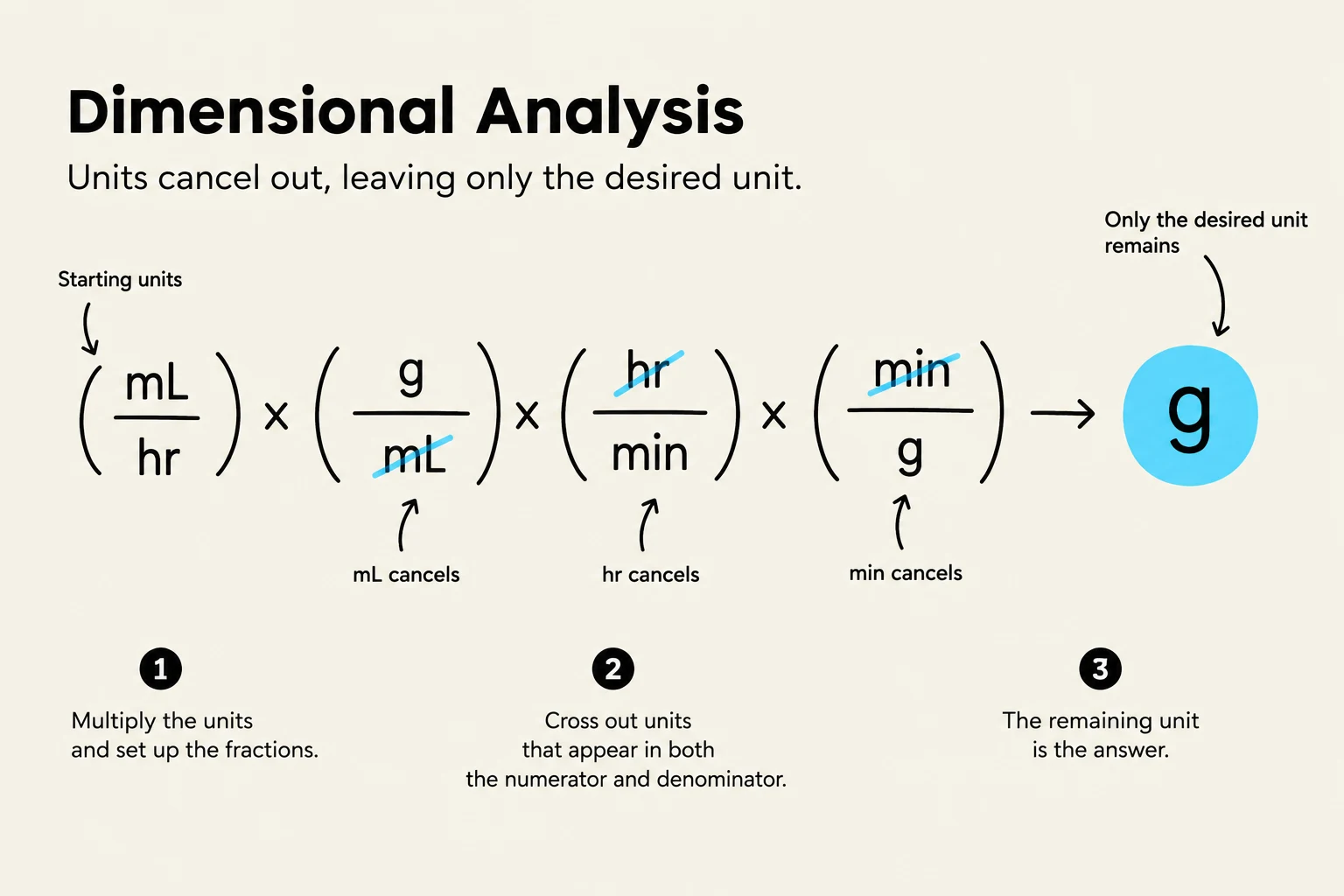
Dimensional analysis is widely considered the "gold standard" for complex calculations, especially in critical care. It involves setting up a single equation where all units cancel out except for the desired unit (gtt/min).
Example: Calculating gtt/min using DAOrder: 1000 mL over 12 hours. Drop factor: 60 gtt/mL.
gtt/min=12 h1000 mL×60 min1 h×1 mL60 gtt
By canceling out mL, h, and min, you are left with gtt/min.
gtt/min=12×60×11000×1×60=72060,000=83.33→83 gtt/min
Dimensional Analysis: A method to convert units by canceling out intermediate units to arrive at the desired unit.
Edge Cases and Common Pitfalls
The "Total Volume" Trap
A common mistake occurs when a nurse forgets to include the volume of medications added to the primary IV bag. If a physician orders 1000 mL of Normal Saline with 10 mL of a medication, the total volume is 1010 mL, not 1000 mL. Always sum all components before starting your calculation.
Time Unit Mismatches
Always ensure your time units are consistent. If your formula requires minutes in the denominator, you must convert hours to minutes by multiplying by 60. If you use "3" instead of "180" (3 hours × 60) in the denominator of a gtt/min formula, your result will be dangerously incorrect.
Critical Care Titrations
In critical care, drugs like dopamine or dobutamine are often ordered based on weight (e.g., mcg/kg/min). These require multiple conversion steps (pounds to kilograms, then micrograms to milligrams, then mL to hours). For these high-stakes calculations, Dimensional Analysis is the most effective method because it allows you to track every conversion factor in a single, organized equation, reducing the chance of a "lost" conversion.
Clinical Alert: When calculating critical care drugs, always double-check your weight conversion (1 kg=2.2 lb) before proceeding. A mistake here scales through every subsequent step of the calculation.
Summary Table of Methods
Method
Best Used For...
Key Advantage
Basic Formula
Standard gravity infusions
Quick and direct
Ratio & Proportion
Understanding the relationship between mL and drops
Logical two-step process
Dimensional Analysis
Complex, multi-step, or critical care calculations
Minimizes errors by canceling units
By mastering these three approaches, you ensure that you can provide safe, accurate, and efficient fluid and medication administration regardless of the equipment available.
Keep reading for free.
Create an account to finish this reading and make it part of your study routine.