An exploration of business-level strategies, including cost leadership and differentiation, and the value chain tool used to map out how competitive advantage is created through primary and support activities.
In the world of strategic management, a company's success is not determined solely by having a great idea, but by how effectively that idea is executed. As the saying goes, "strategy is only as good as its implementation". To move from a high-level vision to actual market success, firms must engage in strategic formulation—the process of deciding how to position themselves against competitors to achieve a sustainable competitive advantage.
This article explores the two primary ways businesses position themselves and introduces the value chain, a vital tool used to map out exactly where that advantage is created.
Business Level Strategies: Cost vs. Differentiation
A business-level strategy is the specific plan an organization uses to gain an edge over its rivals. Generally, companies pursue one of two fundamental paths to develop a competitive advantage: cost leadership or differentiation.
Cost Leadership: The goal here is to become the lowest-cost producer in the industry. This is achieved by reducing overall costs across the entire value chain, allowing the firm to either underprice competitors or enjoy higher profit margins at market prices.
Differentiation: Instead of competing on price, the firm focuses on creating unique value that customers are willing to pay a premium for. This could be through superior quality, unique features, or exceptional service.
Exam Tip: Remember that these are often seen as opposing forces. A firm attempting to be "everything to everyone" by being both the cheapest and the most unique often ends up stuck in the middle, lacking a clear competitive advantage.
The Value Chain Tool
To decide whether to pursue cost leadership or differentiation, managers use the value chain. The value chain is a conceptual framework that charts the path by which products and services are created and sold to customers. By breaking the firm into discrete activities, managers can identify which specific steps add the most value and which steps are driving up costs.
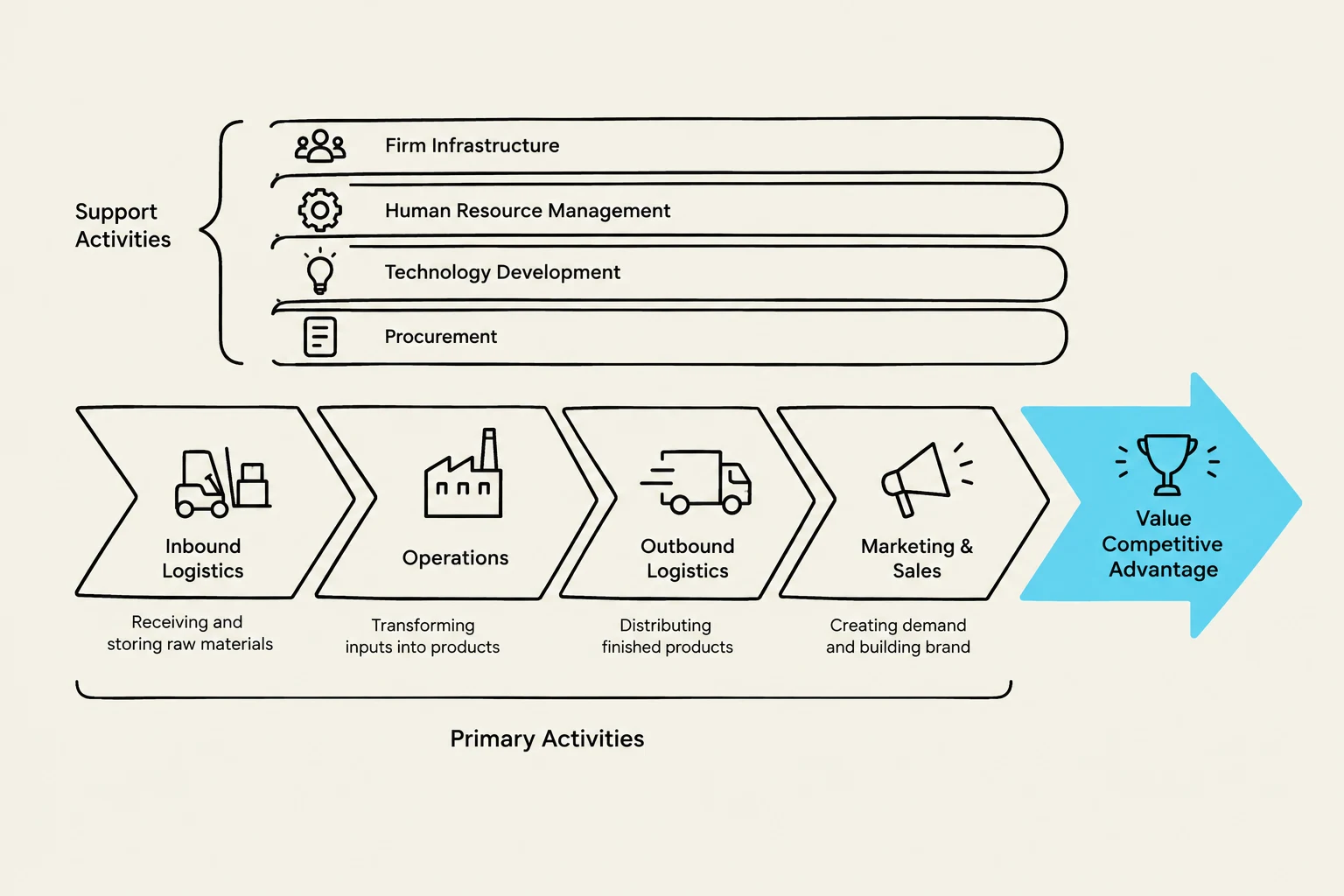
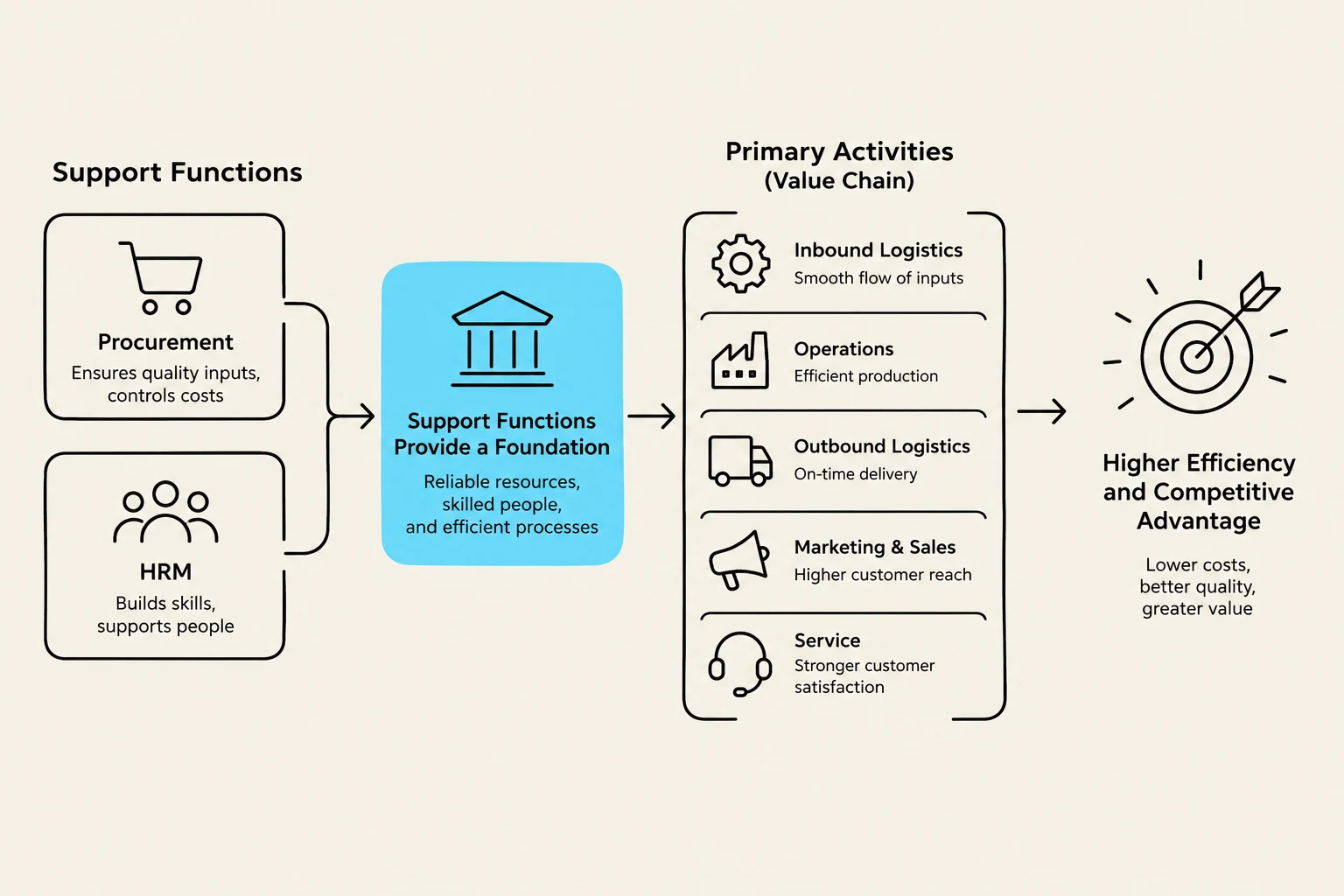
The value chain is divided into two categories: Primary Activities, which are directly involved in the creation and sale of the product, and Support Functions, which provide the necessary infrastructure for the primary activities to operate efficiently.
This diagram illustrates Porter's Value Chain model, categorizing business activities into primary and support functions that contribute to competitive advantage.
Primary Activities: The Direct Flow of Value
Primary activities represent the physical and logical movement of a product from raw materials to the hands of the end consumer. At each step, the company must add value to justify the cost of that step.
Inbound Logistics: This involves the receiving, storing, and distributing of inputs (raw materials). A key way to gain a cost advantage here is through just-in-time (JIT) inventory techniques, which reduce holding costs by ensuring materials arrive only when they are needed for production.
Operations: This is the transformation stage where inputs are converted into finished goods. Efficiency here is often driven by optimized processes and advanced technology.
Outbound Logistics: Once the product is finished, it must be collected, stored, and distributed to buyers. Success in this area depends on efficient shipping and streamlined order processing.
Marketing and Sales: These activities are designed to induce customers to purchase the product. This includes advertising, managing the sales force, selecting distribution channels, and setting prices.
Service: Value creation does not end at the point of sale. After-sales activities—such as installation, repairs, training, and warranties—are essential for maintaining the product's value and ensuring customer loyalty.
Support Functions: Enabling Efficiency
While support functions do not directly touch the product in the same way primary activities do, they are the "glue" that makes the primary activities possible and efficient.
Procurement: This is the process of purchasing the raw materials and inputs needed for the chain. Effective procurement focuses on optimizing quality, speed, and cost, while also diversifying supplier sources to reduce the risk of dependency on a single vendor.
Human Resource Management (HRM): A company is only as good as its people. HRM involves recruiting, training, and compensating the personnel required to staff every link in the value chain.
Technology Development: This involves Research and Development (R&D). Technology development can be used to create better, more differentiated products or to find more efficient ways to run the operations (process efficiency).
General Administration: These are the high-level organizational functions, such as planning, finance, and legal, that provide the overarching support required for the entire organization to function.
This diagram illustrates the relationship between support functions and primary activities in a value chain, leading to higher efficiency and competitive advantage.
Connecting Strategy to the Value Chain
The relationship between business-level strategy and the value chain can be summarized by how a firm chooses to optimize its activities.
If a firm chooses cost leadership, it will look at the value chain to find "waste" to eliminate. For example, it might implement JIT inventory in inbound logistics or automate operations to reduce labor costs.
If a firm chooses differentiation, it will look at the value chain to find "value-add" opportunities. For example, it might invest heavily in technology development to create a unique feature or enhance its service department to provide industry-leading warranties.
Key Takeaway: The value chain is not just a map; it is a diagnostic tool. By analyzing each activity, a firm can decide exactly where to invest its resources to achieve its chosen strategic goal.
This diagram illustrates two business strategies: Cost Leadership and Differentiation, showing how they relate to different stages of the value chain to achieve distinct business outcomes.
Keep reading for free.
Create an account to finish this reading and make it part of your study routine.