Business-Level Strategies and Competitive Dynamics
An overview of business-level strategies, including cost leadership, differentiation, and focus strategies, and how they relate to the industry life cycle and competitive dynamics. Explains drivers of competitive behavior and tactical vs. strategic actions.
In the realm of strategic management, a firm's success depends not just on having a vision, but on how effectively it implements its strategy to achieve a competitive advantage. To compete effectively, a company must decide how it will position itself against rivals and how it will respond to the shifting tides of its industry. This involves choosing a specific business-level strategy and understanding where the industry sits within its life cycle.
Business-Level Strategies and Competitive Scope
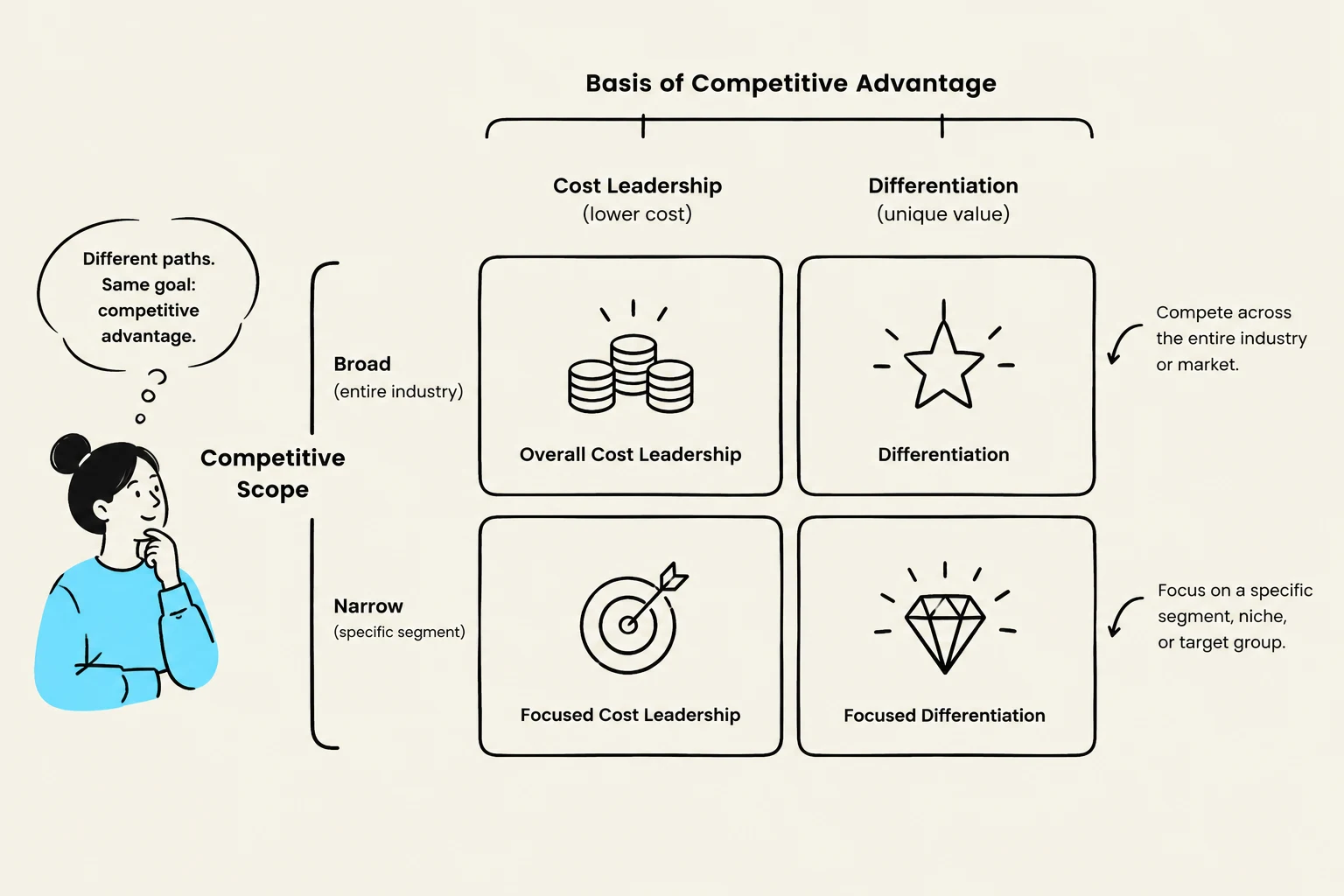
Business-level strategies are the specific actions a firm takes to gain an advantage within a particular market. These strategies are generally categorized by two dimensions: competitive scope (whether the firm targets a broad market or a narrow niche) and the basis of advantage (cost or differentiation).
Broad Market Strategies
When a firm targets a wide range of customers, it typically chooses one of the following:
Cost Leadership: The goal is to become the lowest-cost producer in the industry. By minimizing costs through scale, efficient processes, or proprietary technology, the firm can either underprice competitors to gain market share or maintain industry-average prices to earn higher profits.
Differentiation: Instead of competing on price, the firm offers unique features, superior quality, or exceptional service that customers perceive as valuable. This uniqueness allows the firm to command a premium price, offsetting the higher costs of innovation or high-quality inputs.
Integrated Cost Leadership/Differentiation: This is a hybrid approach where a firm attempts to provide unique value while maintaining a competitive cost structure. While difficult to execute, successful integrated firms provide "more for less".
Focus Strategies
Focus strategies apply the cost or differentiation approach to a narrow, specific market segment or niche.
Focused Cost Leadership: Aiming to be the low-cost provider within a very specific niche (e.g., a budget airline that only flies between two specific regional airports).
Focused Differentiation: Offering highly specialized, unique products to a narrow segment (e.g., a luxury brand that only caters to professional athletes).
This diagram illustrates Porter's Generic Strategies, which outline how a company can achieve a competitive advantage through cost leadership or differentiation, combined with a broad or narrow competitive scope.
Exam Tip: When analyzing a case study, always identify the "scope" first. Ask: Is this company trying to serve everyone (Broad), or are they specialists (Focus)? Once the scope is clear, determine if their primary weapon is price (Cost) or uniqueness (Differentiation).
The Industry Life Cycle and Competitive Dynamics
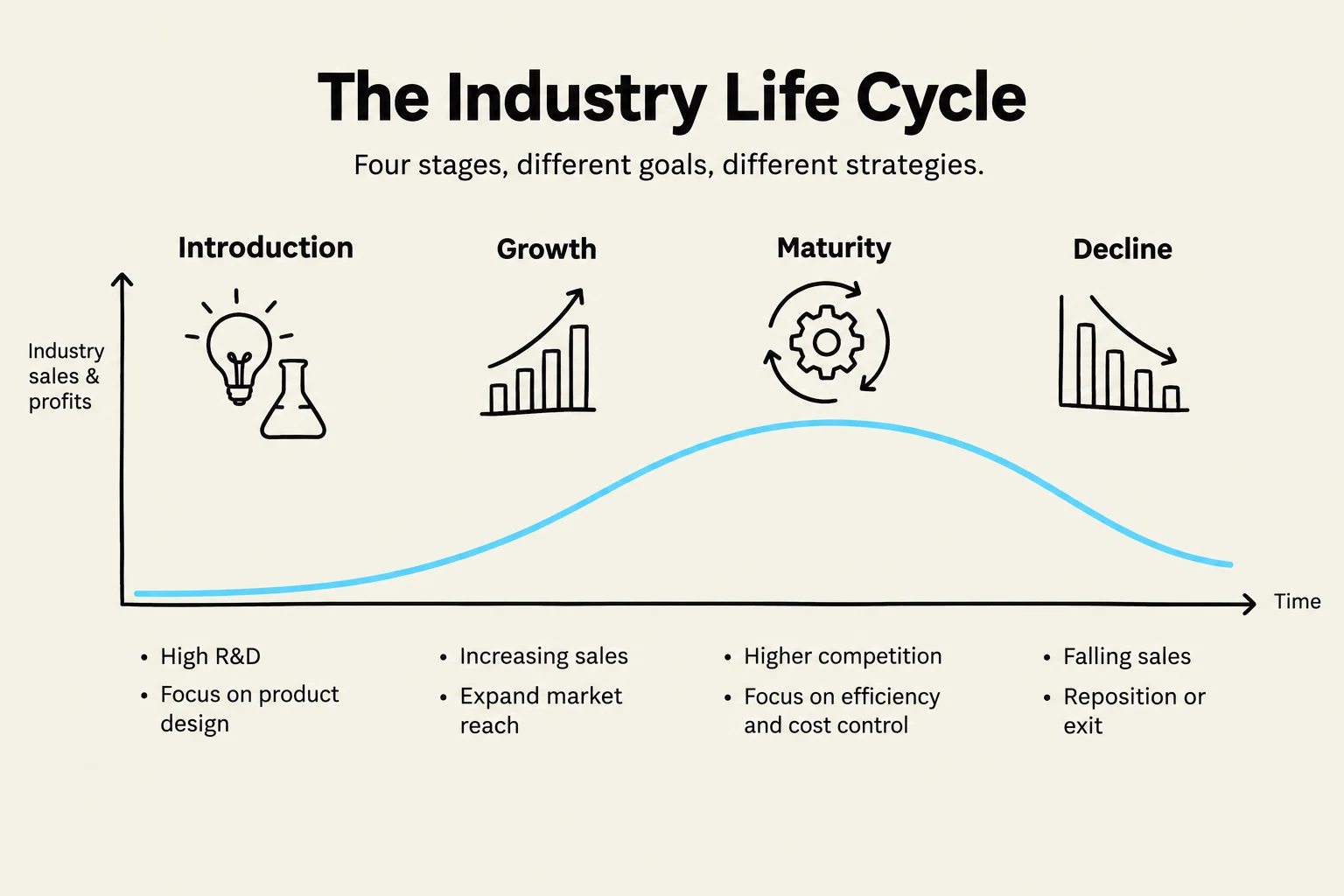
A firm's strategy cannot exist in a vacuum; it must adapt to the stage of the industry life cycle. As an industry evolves, the nature of competition and the primary drivers of success change.
1. Introduction Phase
In the introduction stage, sales are typically low, and costs are high due to heavy R&D and startup requirements. Competition is minimal, and firms often seek first-mover advantages. These advantages can include establishing technological standards, locking up valuable resources, or creating switching costs—barriers that make it difficult for customers to move to a competitor (for example, Microsoft's dominance in operating systems). However, firms must be wary of "first-mover disadvantages" if they fail to set the industry standard and instead bear the brunt of early R&D costs without long-term protection. During this phase, the strategic emphasis is heavily placed on product design.
2. Growth Phase
As the industry enters the growth phase, sales explode. This attracts new entrants eager to capture market share. The competitive focus remains on product design and aggressive marketing to build brand preference and customer loyalty.
3. Maturity Phase
Maturity is reached when the market hits market saturation. Growth slows, and the industry becomes crowded. Competition often intensifies into price wars as products become standardized and well-defined. Because product design is no longer a major differentiator, the strategic focus shifts from product design to process design. Firms compete by maximizing efficiency, improving service, or innovating their manufacturing processes to lower costs and protect margins.
4. Decline Phase
In the decline phase, industry growth turns negative due to technological shifts or changing consumer tastes. Competition can become zero-sum, a situation where one firm's gain is directly another's loss, leading to desperate fights for a shrinking pool of customers. Firms facing decline have several strategic options:
Consolidate: Merge with competitors to reduce rivalry and gain scale.
Niche: Retreat to a small, profitable segment of the market.
Harvest: Minimize all investments to extract as much remaining profit as possible before exiting.
Exit: Leave the industry entirely.
The Industry Life Cycle illustrates four stages: Introduction, Growth, Maturity, and Decline, each with distinct goals and strategies.
Competitive Dynamics: Attack and Response
Understanding how competitors behave requires looking at competitive dynamics—the interplay of actions and responses between firms.
Drivers of Competitive Behavior
Three main drivers influence whether a firm will attack or respond:
Awareness: This involves understanding the "mutual interdependence" of firms. If firms realize that an attack on a rival will likely trigger a retaliatory response that hurts everyone (similar to the concept of "mutually assured destruction" in nuclear politics), they are less likely to initiate an attack.
Motivation: A firm will only act if there is a tangible incentive. If the potential gain in market position is low, the motivation to attack or respond is minimal.
Capabilities: This refers to the resources and competencies of the competitors. High resource similarity means competitors have similar capabilities, making them more likely to respond aggressively to an attack.
Tactical vs. Strategic Actions
Competitors engage in two types of actions:
Tactical Actions: These are refinements or extensions of existing strategies, such as price cuts, minor product enhancements, or changing distribution channels. Because they use existing resources, they are easy to implement but also easy for competitors to copy.
Strategic Actions: These involve major changes to the firm's overall direction, such as entering new markets, introducing entirely new product lines, or engaging in mergers and acquisitions. These require massive resource commitments and are much harder to undo.
Critical Concept: Tacit Collusion vs. Explicit Collusion
While explicit collusion (illegal price-fixing agreements) is strictly forbidden, firms often engage in tacit collusion. This is the legal practice of sending subtle signals—such as not responding to a competitor's minor attack in a specific market—to create a state of "mutual forbearance," where everyone agrees to leave each other's core markets alone to maintain industry stability.
Keep reading for free.
Create an account to finish this reading and make it part of your study routine.