Business Growth and Organizational Design in Fitness Operations
This guide explains how fitness facilities can manage complexity during growth by implementing intentional organizational design, including understanding vertical and horizontal business aspects, utilizing organizational charts, and developing effective job descriptions.
As a fitness facility grows from a small local studio to a large-scale operation, the complexity of managing people, processes, and profits increases significantly. To prevent chaos, managers must implement intentional organizational design. This process involves structuring the company to manage this complexity while maintaining clear communication, accountability, and a rewarding work environment for both part-time and full-time employees.
Dimensions of Business Complexity
The complexity of any business is determined by two primary dimensions: vertical and horizontal aspects. Understanding these is crucial for deciding when to restructure or hire new management.
Vertical Aspects: The Hierarchy
Vertical aspects refer to the various levels of management or hierarchy within the business. Vertical growth occurs when a business adds new layers of management to oversee staff as the organization expands.
For example, in a small gym, the General Manager might oversee everyone directly. However, as the club grows, the General Manager may become overwhelmed. To solve this, the business might introduce a Sales Manager or an Assistant Manager to oversee specific departments. This adds a new "level" to the organization.
This is an organizational chart illustrating vertical growth within a company, showing the hierarchy from Sales Representatives to a General Manager.
Horizontal Aspects: The Roles
Horizontal aspects refer to the various positions or roles within the organization. Horizontal growth occurs when the scope of a specific department expands, leading to increased responsibilities for the manager of that area. While vertical growth adds "steps" to the ladder, horizontal growth adds "width" to the departments.
The Organizational Chart
To visualize these dimensions, organizations utilize an organizational chart. This tool is much more than a simple list of names; it serves several critical functions in a fitness facility:
Rank and Relationship: It outlines the relative ranks of positions and defines the relationships between individuals.
Career Mapping: It provides employees with a visual map of potential career paths and promotion opportunities, which can serve as a powerful motivational tool.
Communication Flow: A well-designed chart facilitates effective communication by ensuring employees know exactly who is responsible for specific areas.
Exam Tip: If a front-desk employee receives a complaint about a salesperson, they should be able to use the organizational chart to identify exactly which manager is responsible for the sales department to ensure the information reaches the right person.
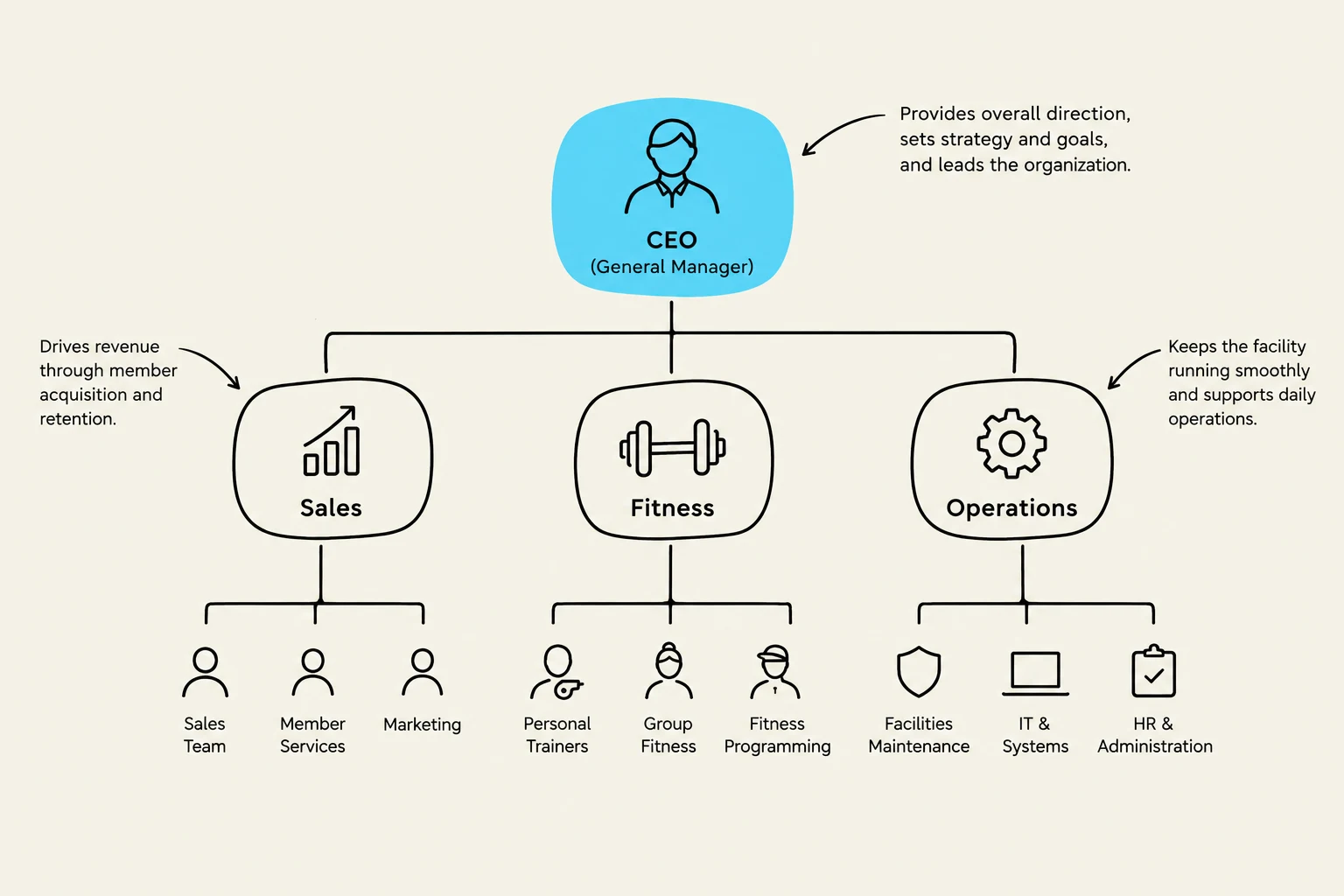
This is an organizational chart showing the structure of a company, with a CEO at the top, followed by departments like Sales, Fitness, and Operations, and then specific roles within those departments.
Defining Success: Job Descriptions and Task Prioritization
While the organizational chart shows who is in the company, job descriptions define what they actually do. Without formal job descriptions, facilities often face significant operational issues, such as:
Prospective hires lacking a clear understanding of their duties, leading to a poor first impression.
Vague or subjective employee evaluations, as there is no written standard to measure performance against.
Internal animosity, where staff members feel others are not "carrying their weight" because roles are poorly defined.
Employee demotivation and "complacency," where staff perform meaningless tasks just to look busy.
Developing Effective Descriptions
To create a functional job description, managers should brainstorm tasks across different timeframes—daily, weekly, monthly, and yearly. It is often helpful to consult experienced staff members to ensure no critical tasks are overlooked.
Once tasks are listed, they must undergo rank ordering to prevent "role creep"—a situation where employees spend too much time on minor tasks while neglecting their primary duties. Tasks should be categorized into three levels:
Essential Tasks: Fundamental duties that are core to the position.
Important Tasks: Duties that support the role but are not the primary focus.
Non-priority Tasks: Secondary duties that are not central to the mission.
Worked Example: Imagine a Membership Coordinator who is constantly interrupted by non-sales phone calls and customer complaints. If these tasks are categorized as "non-priority" for their specific role, the manager should reassign them to the front-desk staff. This allows the Coordinator to focus on "essential" tasks, such as making outgoing sales calls and conducting tours.
Comparing Fitness Facility Models
Organizational design is influenced by the ultimate goal of the facility. While all fitness organizations share common themes, they differ in their structure and focus.
For-Profit (Commercial) Facilities
These facilities focus heavily on membership, retention, and revenue. Success is measured by metrics such as revenue per member and net membership growth. Key roles typically include General Managers, Membership Directors, and Personal Trainers.
Not-for-Profit Community Facilities
Organizations like the YMCA or JCCs focus on providing affordable wellness programs to the community. They are governed by a Board of Directors and often rely on donations and scholarships to serve families regardless of financial status. Their goal is broad, offering everything from childcare to senior programming.
Corporate-Based Fitness
These organizations provide on-site wellness programs to employees of a company. The goal is to reduce healthcare costs and increase productivity by addressing physical, mental, and social well-being.
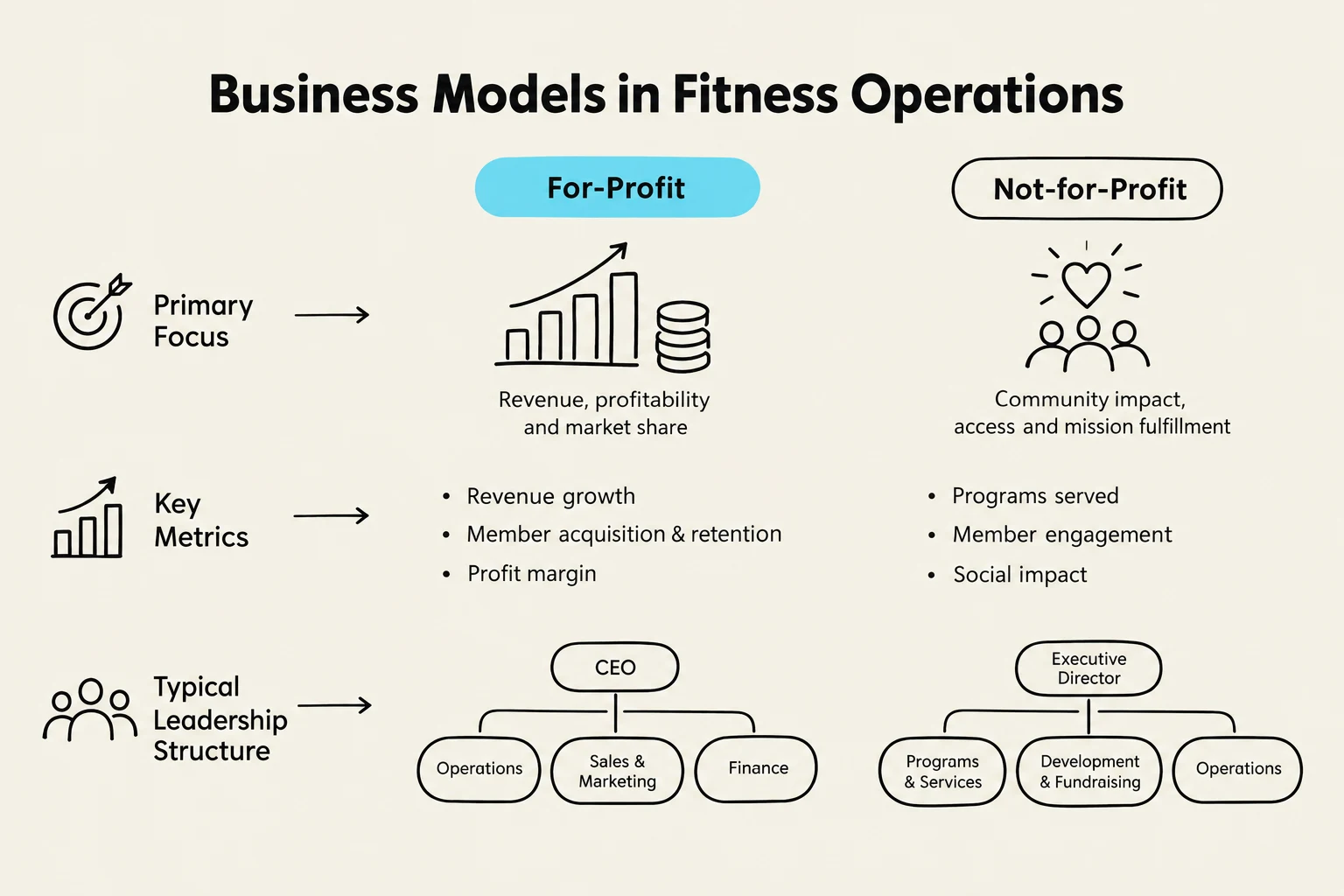
This diagram illustrates the key differences between for-profit and not-for-profit business models in fitness operations, covering primary focus, key metrics, and typical leadership structures.
By aligning organizational design with these specific business goals, fitness leaders can create structures that support both business growth and employee success.
Keep reading for free.
Create an account to finish this reading and make it part of your study routine.