In the law of negligence, establishing that a defendant was "careless" is not enough; a plaintiff must prove that the defendant's conduct fell below a specific legal benchmark. This benchmark is known as the standard of care. While the "duty" element of a negligence claim asks whether a legal obligation to protect a person existed, the breach of duty element asks whether the defendant actually failed to meet that obligation. Determining whether a breach occurred requires a nuanced analysis of what a reasonable person would have done under the specific circumstances at hand.
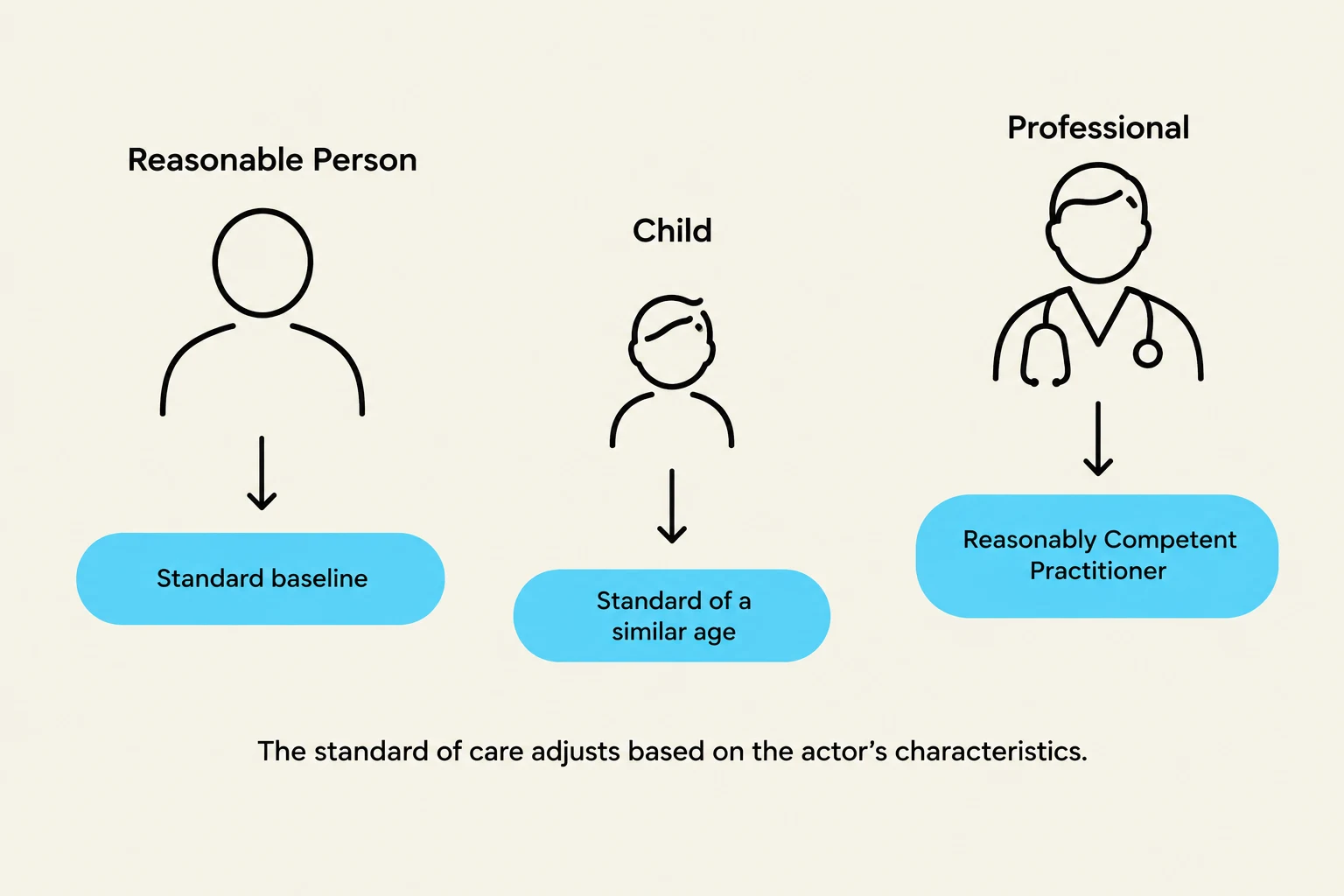
This diagram illustrates how the standard of care is adjusted based on the characteristics of the actor, such as being a reasonable person, a child, or a professional.
The Reasonable Person Standard
The baseline for assessing conduct is the "reasonable person" standard. This is an objective test: the law does not ask what the specific defendant was thinking, but rather how a person of ordinary prudence would have acted in the same situation. However, this standard is not a rigid, one-size-fits-all rule; it is adjusted to account for certain characteristics of the actor:
Children: Children are generally held to the standard of a reasonable child of similar age, intelligence, and experience.
Physical Disability: A person with a physical disability is held to the standard of a reasonable person possessing that same disability.
Special Expertise: When a person possesses professional skills, they are held to a higher standard—that of a reasonably competent practitioner in their specific field.
Medical Malpractice and Informed Consent
In the context of medical professionals, modern law has largely moved away from "locality rules" (which judged doctors by the standards of their specific town) in favor of a national standard. An expert witness used to support a claim does not need to be in the exact same specialty as the defendant, but they must possess relevant knowledge, skill, or training.
Furthermore, the duty of a physician extends to informed consent. A doctor must disclose medically reasonable alternatives—including both invasive and non-invasive options—as well as the associated risks and potential outcomes. This is measured by the reasonable patient standard, which prioritizes the patient's right to autonomy by focusing on what information a reasonable person would find material to their decision-making.
Exam Tip: When analyzing a professional negligence case, always check if the standard is being applied to the individual's personal training (incorrect) or to the objective standard of a competent professional in that field (correct).
Assessing Breach: Key Reasonableness Factors
Courts use several factors to determine if a defendant's conduct was unreasonable. These factors are often used disjunctively or in combination to reach a conclusion.
Foreseeability
A central component of breach is whether the defendant could have anticipated the risk of harm. The focus is generally on whether a reasonable person would have foreseen the type of harm that occurred, rather than the exact specific manner in which it happened. For example, in Palsgraf, the court emphasized that the "risk reasonably to be perceived defines the duty to be obeyed".
Custom and Statutory Violations
Following industry custom is often used as evidence of reasonableness, but it is not a "get out of jail free" card. If a widely accepted industry custom is inherently unsafe, a court can still find that the custom constitutes a breach of duty. Conversely, violating a statute that was designed to protect a specific class of people from a specific harm can serve as evidence of negligence, often referred to as negligence per se.
The Hand Formula: Costs and Benefits
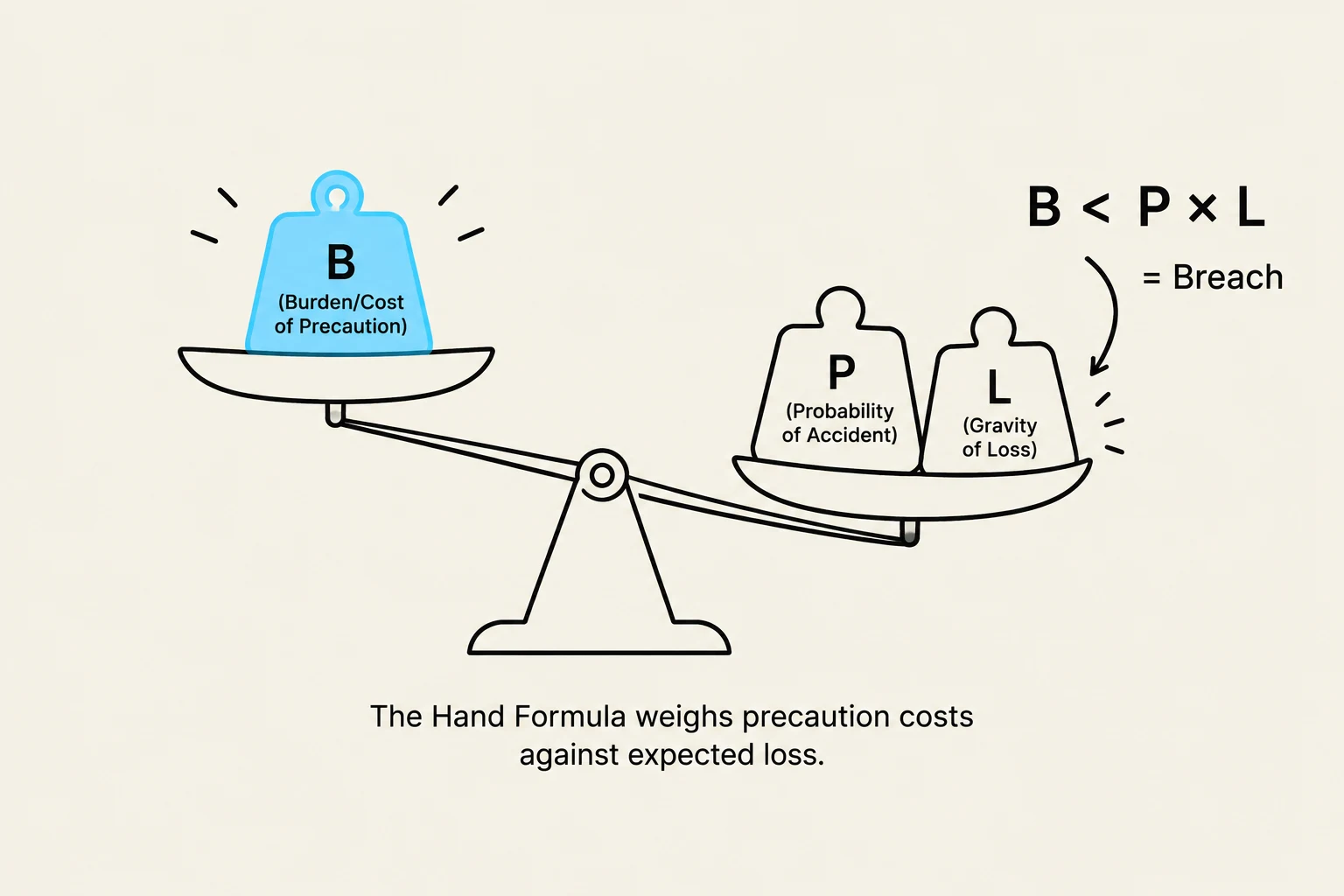
The Hand Formula illustrates that the cost of precaution (B) should be less than the probability of an accident (P) multiplied by the gravity of the loss (L) to avoid a breach.
From an economic efficiency perspective, courts often weigh the burden of preventing a harm against the probability and gravity of the harm itself. This is famously expressed through the Hand Formula, derived from United States v. Carroll Towing Co.:
B<P×L
Where:
B is the burden (the cost or difficulty of taking the precaution).
P is the probability of the accident occurring without the precaution.
L is the gravity of loss (the expected average cost of the injury).
If the cost of prevention (B) is less than the expected loss (P×L), the failure to take that precaution constitutes a breach of duty.
Specialized Doctrines
Res Ipsa Loquitur
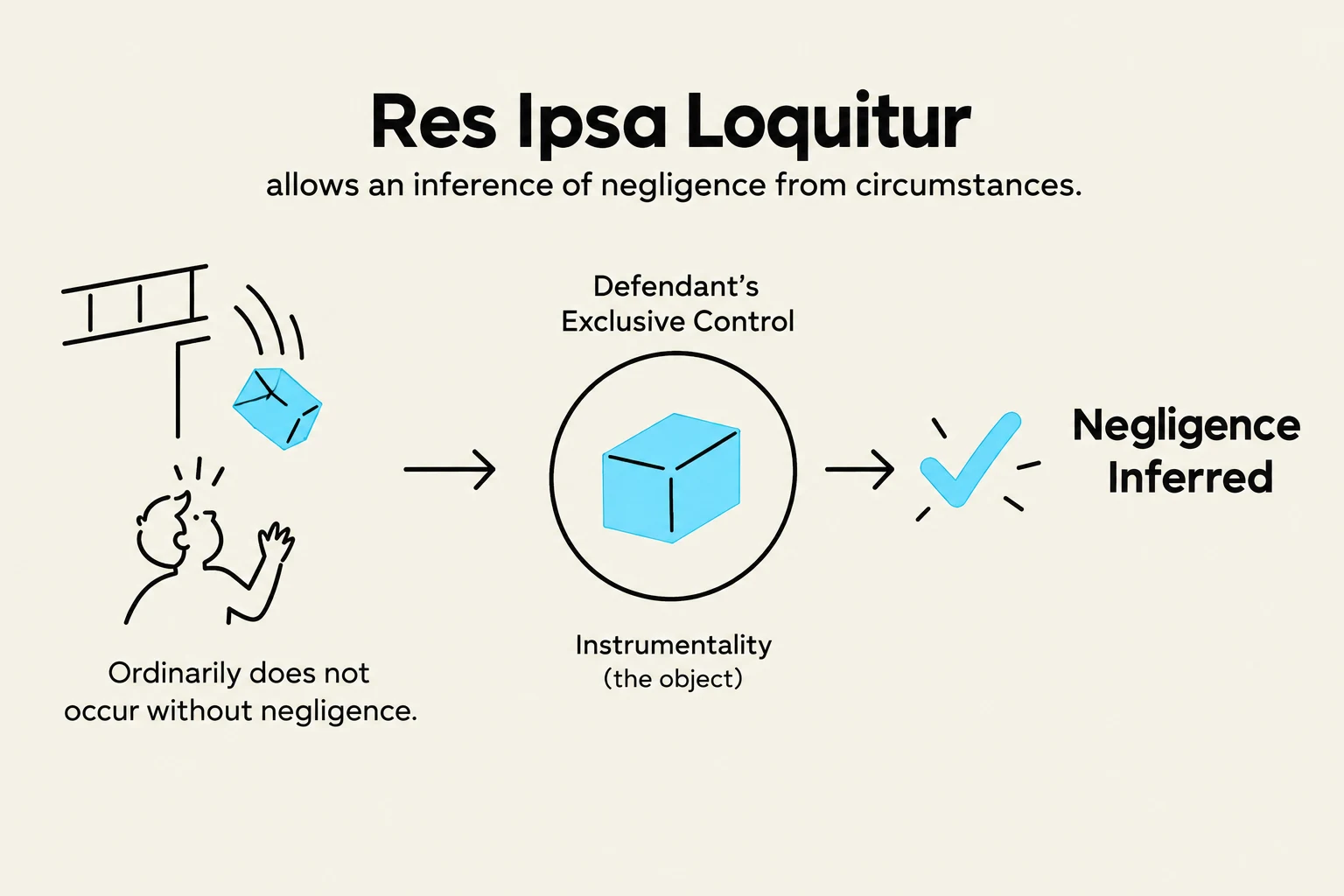
The legal doctrine of Res Ipsa Loquitur, meaning "the thing speaks for itself," allows for an inference of negligence when an accident occurs that would not ordinarily happen without negligence, and the instrumentality causing the accident was under the defendant's exclusive control.
Sometimes, a plaintiff cannot point to a specific act of negligence, but the accident is of a type that "speaks for itself". Under the doctrine of res ipsa loquitur, a court may infer negligence if:
The event is of a kind that ordinarily does not occur in the absence of negligence; and
The instrumentality causing the harm was under the defendant's exclusive control.
For example, a barrel falling from a warehouse window is a classic illustration where the mere occurrence suggests negligence.
Summary of Breach Analysis
To determine if a breach has occurred, a student should follow this logical flow:
Identify the Standard: Is this a reasonable person, a child, or a professional?
Evaluate Foreseeability: Was the risk of harm a foreseeable consequence of the defendant's conduct?
Apply Economic Logic: Was the cost of preventing the harm significantly lower than the risk of the harm occurring?
Check for Evidence: Does custom support the defendant, or does a statutory violation suggest they were negligent?
Note on Causation: Remember that "Breach" is only one part of the puzzle. Even if you prove a breach, the plaintiff must still prove that the breach was the factual cause (the "but-for" cause) and the proximate cause (the legal cause) of the actual damages.
Keep reading for free.
Create an account to finish this reading and make it part of your study routine.