In the critical care setting, distinguishing between a deep coma and brain death is a vital clinical responsibility. Brain death represents the irreversible cessation of all functions of the entire brain, including the brain stem. Understanding the physiological progression of brain death, the rigorous clinical tests required for confirmation, and the legalities surrounding organ donation is essential for healthcare providers to ensure both medical accuracy and ethical respect for grieving families.
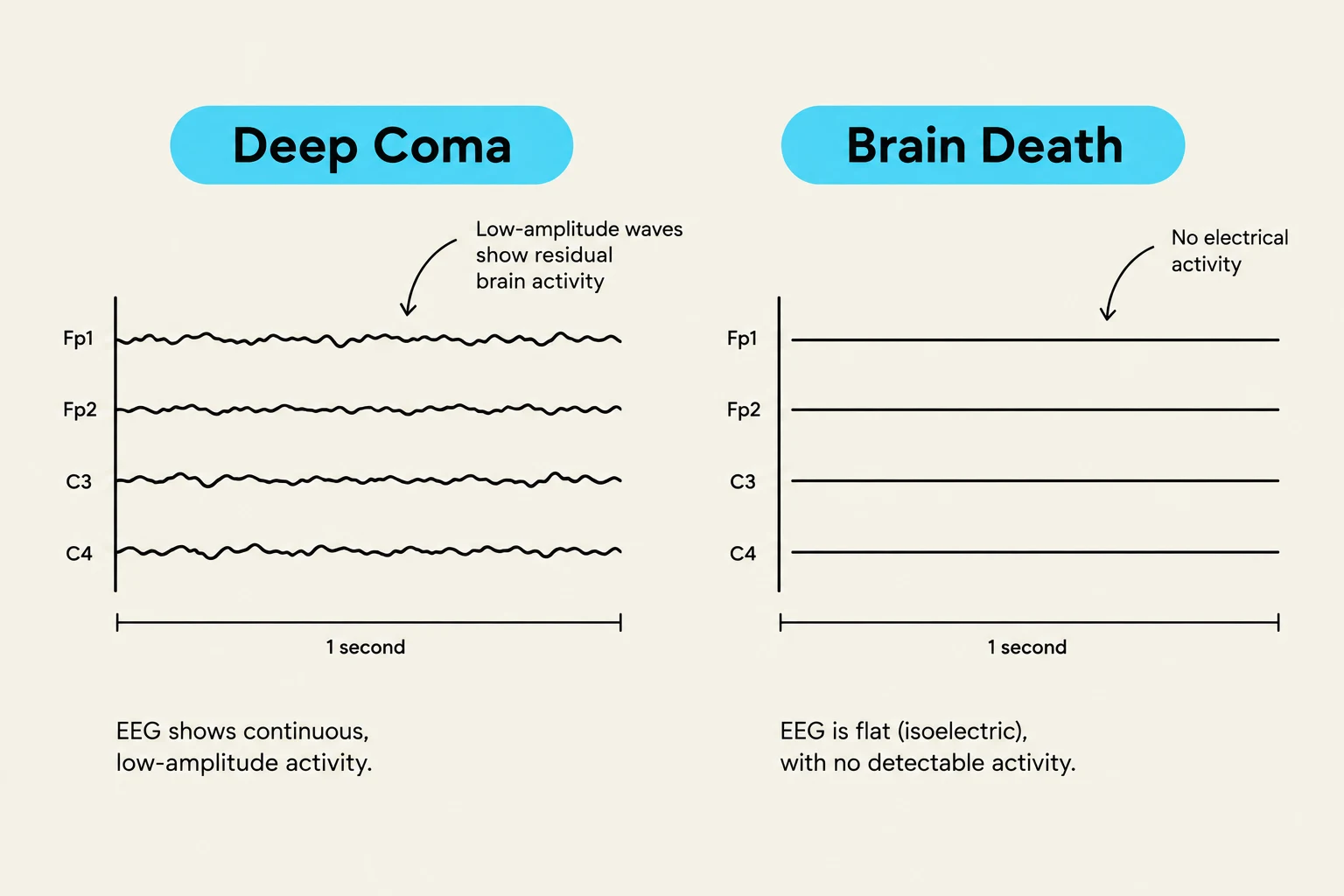
Comparison of EEG readings in deep coma and brain death, illustrating residual brain activity versus no electrical activity.
Pathophysiology of Brain Death
The progression of brain death is often characterized by a cascade of physiological failures. As intracranial pressure (ICP) rises and brain tissue begins to herniate, the body undergoes significant autonomic shifts.
In the pre-herniation stage, clinicians may observe changes in heart rate, blood pressure, and temperature as the brain stem begins to struggle. However, once post-herniation occurs, the autonomic control centers are lost. This leads to profound instability in blood pressure, heart rate, and temperature, as well as a loss of regulated urine output. Because the brain is no longer capable of regulating the body, the focus shifts from managing intracranial pressure to maintaining systemic perfusion to keep donor organs viable.
Clinical Signs and Brain Stem Reflexes
Diagrams illustrating the clinical testing of brain stem reflexes, including the oculocephalic, corneal, supra-orbital, and gag reflexes, with indications of absence of response.
A diagnosis of brain death is primarily clinical and requires the demonstration of a complete lack of response to stimuli. A patient must be in a flaccid state with unreactive (fixed) pupils and an absence of spontaneous respiration.
To confirm the absence of brain stem function, clinicians must systematically test several specific reflexes:
Oculocephalic Reflex: The absence of eye movement when the head is moved (often referred to as the "doll's eye" maneuver).
Corneal Reflex: The absence of blinking when the cornea is touched.
Supra-orbital Reflex: The absence of response to stimulation above the eye.
Ocular Vestibular Reflex: The absence of eye movement in response to caloric stimulation of the ear.
Gag Reflex: The absence of a gag response when the posterior pharynx is stimulated.
Clinical Note: The patient must also show no response to commands and must have a Glasgow Coma Scale (GCS) score of less than 5 to be considered for referral in vented patients.
Ancillary Testing for Confirmation
In cases where clinical exams are difficult to perform, ancillary testing can provide objective evidence of brain death:
Electroencephalogram (EEG): This test measures brain voltage in microvolts. While a patient in a deep coma will still show electrical activity, a brain-dead patient will show no electrical activity at all.
Cerebral Blood Flow (CBF) Study: This involves injecting a mild radioactive isotope into the bloodstream and using a radioactive counter over the head to measure blood flow. A negative study—showing no blood flow to the brain—is considered indisputable evidence of brain death.
Organ Donation: Decision Making and Law
The transition from declaring death to the recovery of organs is a highly regulated process involving the Organ Procurement Organization (OPO).
The Hierarchy of Consent
Decision-making follows a specific hierarchy of self-determination:
Self-Determination: If the patient made a legal decision while competent (e.g., via a donor card), that decision is paramount.
Next-of-Kin: If no prior decision was made, authority moves to the legal next-of-kin, such as a spouse, children, or parents.
Legal Frameworks (UAGA and Texas Law)
Under the Uniform Anatomical Gift Act (UAGA), which has been codified into laws like the Texas Anatomical Gift Act, the rights of the deceased are protected. In Texas, if a competent individual (18+ years old) makes a postmortem anatomical gift via a donor card or legal document, that gift must be honored without requiring additional consent from the next-of-kin.
Referral and Donor Management
The 'Rule of 100s' for donor physiological management illustrates key vital signs including PaO2, systolic blood pressure, urine output, and temperature.
When to Refer
Referrals to the OPO are categorized based on the patient's respiratory status:
Vented Patients: Referred if they have a neurological insult, two or more absent brain stem reflexes, a GCS <5, or if death is imminent.
Non-vented Patients: Referred following cardiac death.
Donor Exclusion and Viability
Not every patient is a candidate for donation. Extensive testing is performed, and certain communicable diseases generally exclude a patient, including:
Human Immunodeficiency Virus (HIV)
Hepatitis B
Active Tuberculosis
To ensure organs remain viable for transplantation, clinicians follow the "Rule of 100s" to maintain homeostasis:
PaO2: Maintain at 100 mm Hg
Urine Output: Maintain at approximately 100 ml/hr (but less than 200 ml)
Systolic Blood Pressure: Maintain at 110 mm Hg
Temperature: Maintain at approximately 100∘F (97∘F to 102∘F)
Exam Tip: Up to 98% of donors may develop Diabetes Insipidus. This should be managed with Vasopressin (DDAVP) to preserve tissue perfusion and maintain blood pressure.
Respectful Communication
The role of the healthcare team is not just physiological management but also emotional support. When working with the OPO, clinicians must provide families with time to grieve, answer all questions clearly, and maintain a high level of respect throughout the process.
Keep reading for free.
Create an account to finish this reading and make it part of your study routine.