Brain Anatomy and Lobes: A Guide to Functional Neuroanatomy
Explore the major lobes of the cerebral cortex (frontal, parietal, temporal, occipital) and the limbic system, detailing their primary functions in cognition, sensation, emotion, and memory.
The human brain is arguably the most complex structure in the known universe. It serves as the command center for the entire body, processing sensory information, regulating vital functions, and giving rise to consciousness, memory, and emotion. To understand how the brain works, neuroscientists often divide it into distinct regions based on their anatomical location and the specific tasks they perform. This article explores the primary lobes of the cerebral cortex and the vital role of the limbic system.
The Cerebral Cortex and the Four Lobes
Lateral view of the cerebral cortex showing the four major lobes: frontal, parietal, temporal, and occipital.
The cerebral cortex is the outer layer of the brain, characterized by its folded appearance. This folding increases the surface area, allowing for more neurons to be packed into the limited space of the skull. The cortex is divided into two hemispheres, which are further subdivided into four major lobes: the frontal, parietal, temporal, and occipital lobes.
The Frontal Lobe: The Executive Center
Located at the front of the brain, the frontal lobe is often considered the "CEO" of the brain. It is responsible for higher-level cognitive functions that distinguish humans from many other species.
Executive Function: This includes decision-making, planning, problem-solving, and impulse control.
Motor Control: The posterior part of the frontal lobe contains the motor cortex, which manages voluntary muscle movements.
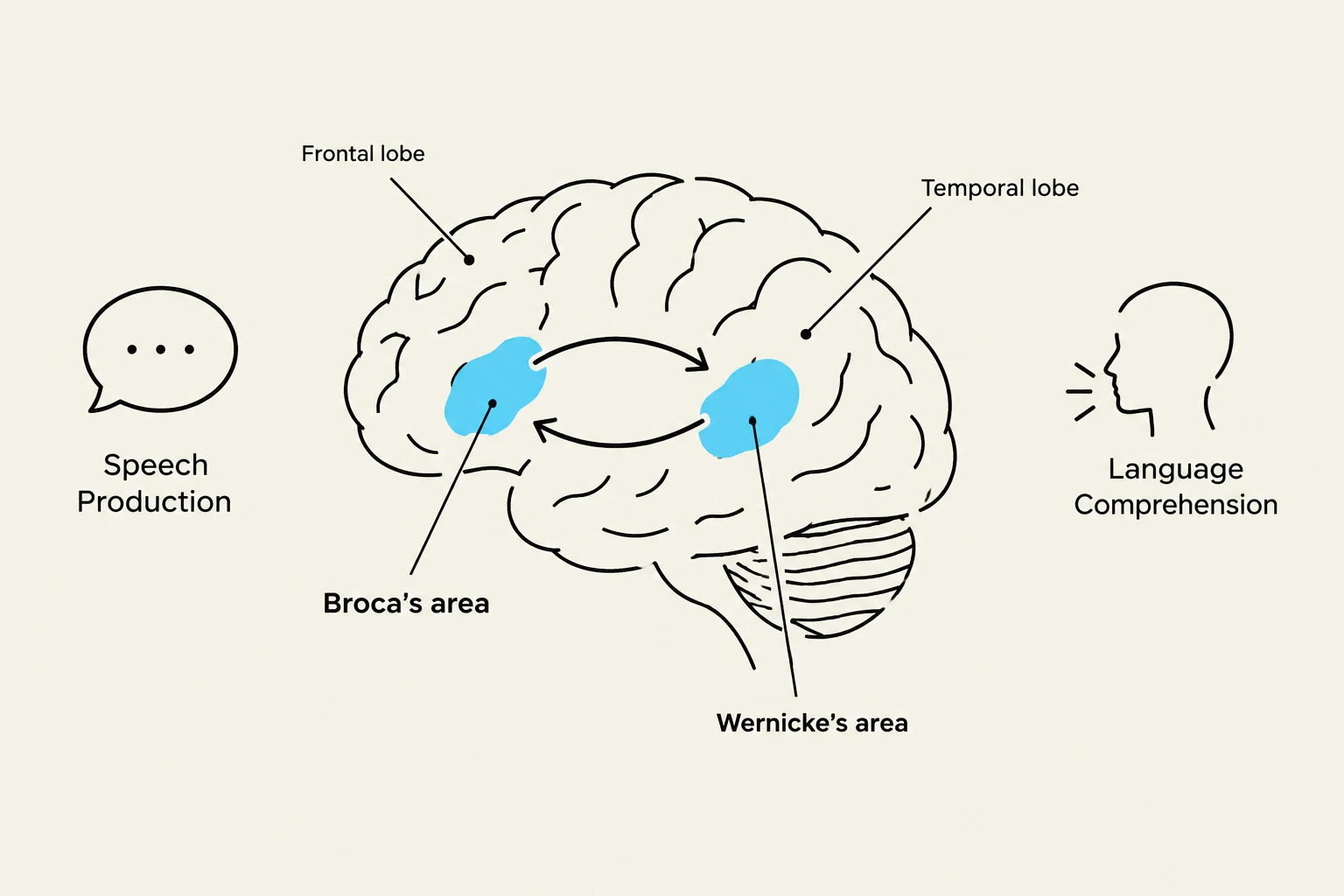
Language Production: A specific area within the frontal lobe, known as Broca's area, is critical for the physical production of speech.
Exam Tip: If a clinical case study describes a patient who has difficulty planning their day or exhibits sudden changes in personality and social behavior, look toward the frontal lobe as the likely site of injury.
The Parietal Lobe: The Sensory Integrator
Positioned behind the frontal lobe, the parietal lobe is primarily concerned with processing sensory information from the body.
Somatosensation: The parietal lobe contains the somatosensory cortex, which processes touch, pressure, temperature, and pain.
Spatial Awareness: It plays a crucial role in helping us understand where our body is in relation to our environment and navigating through space.
The Temporal Lobe: Hearing and Memory
Located near the temples (the sides of the head), the temporal lobe is essential for processing auditory information and managing much of our memory.
Auditory Processing: This lobe houses the primary auditory cortex, which allows us to perceive and interpret sounds.
Language Comprehension: While the frontal lobe helps us speak, the temporal lobe (specifically Wernicke's area) helps us understand spoken language.
Memory Formation: The temporal lobe is closely linked to the structures responsible for encoding new memories.
The Occipital Lobe: The Visual Processor
At the very back of the brain lies the occipital lobe. This region is almost exclusively dedicated to visual processing.
Visual Perception: It receives raw data from the eyes via the optic nerves and interprets it into recognizable shapes, colors, and movements.
Visual Mapping: Even if your eyes are functioning perfectly, damage to the occipital lobe can result in "cortical blindness," where the brain simply cannot make sense of the visual input it receives.
The Limbic System: The Emotional Core
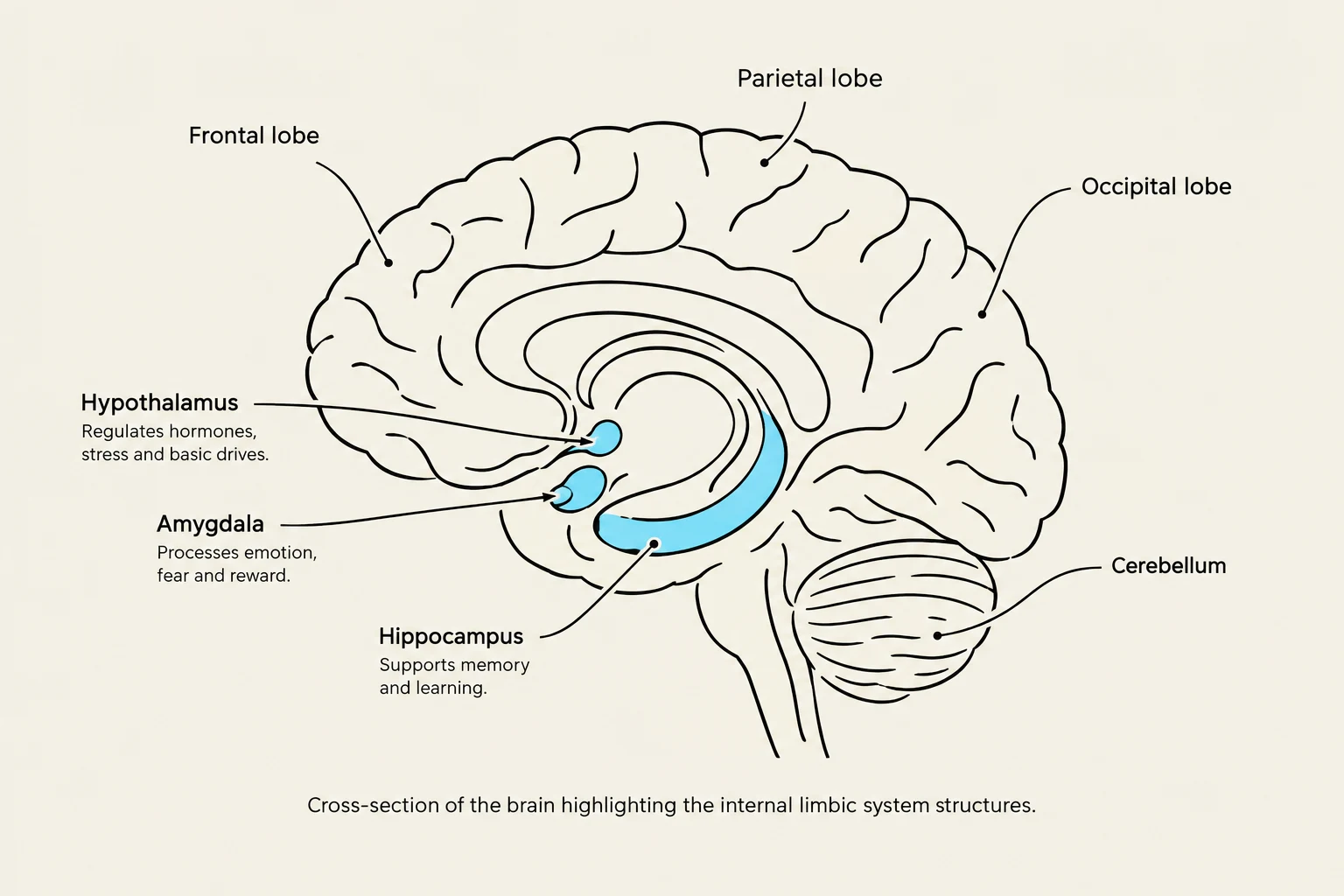
Cross-section of the brain highlighting the internal limbic system structures.
While the lobes of the cortex handle "thinking" and "sensing," the limbic system is a collection of deeper structures located beneath the cerebral cortex. It is often referred to as the "emotional brain" because it regulates our most primal drives and feelings.
Key components of the limbic system include:
The Amygdala: A small, almond-shaped structure that is central to processing emotions, particularly fear and aggression.
The Hippocampus: A curved structure essential for the formation of new long-term memories and spatial navigation.
The Hypothalamus: This acts as a bridge between the nervous system and the endocrine (hormonal) system. It regulates homeostasis, including hunger, thirst, body temperature, and sleep cycles.
Summary Table of Brain Functions
To help consolidate this information, refer to the table below:
Brain Region
Primary Function
Key Feature/Area
Frontal Lobe
Executive function, motor control, speech production
Broca's Area
Parietal Lobe
Sensory integration, spatial awareness
Somatosensory Cortex
Temporal Lobe
Auditory processing, memory, language comprehension
Wernicke's Area
Occipital Lobe
Visual processing
Visual Cortex
Limbic System
Emotion, motivation, memory, homeostasis
Amygdala & Hippocampus
Worked Example: A Clinical Scenario
This diagram illustrates the brain regions involved in speech production (Broca's area in the frontal lobe) and language comprehension (Wernicke's area in the temporal lobe), showing the connection between them.Scenario: A patient arrives at a clinic after a car accident. They can see objects clearly, but they struggle to understand what people are saying to them. Furthermore, they find it very difficult to control their temper and often react with sudden outbursts of anger.
Analysis:
Language Issue: Since the patient can see (occipital is likely fine) but cannot understand language, the issue is likely in the temporal lobe (specifically Wernicke's area).
Emotional Issue: The sudden inability to control anger suggests an impact on the limbic system, specifically the amygdala, which regulates emotional responses.
By breaking the brain down into these functional units, we can begin to understand how specific injuries or neurological conditions manifest as specific behavioral or sensory changes.
Keep reading for free.
Create an account to finish this reading and make it part of your study routine.