Explore the Brønsted-Lowry theory of acids and bases, focusing on proton transfer, conjugate acid-base pairs, and the quantification of acid and base strength using equilibrium constants. Includes practical examples and applications like ocean acidification.
In many chemical reactions, the movement of a single particle—a proton—defines the entire interaction. While older theories focused on the production of hydroxide ions or the absorption of protons, the Brønsted-Lowry theory provides a more versatile framework by defining acids and bases through the lens of proton transfer. This concept is fundamental to understanding everything from the pH of your blood to the complex buffering systems in our oceans.
The Mechanics of Proton Transfer
At the heart of this theory are two specific roles: the donor and the acceptor.
A Brønsted-Lowry acid is defined as a proton donor. To function as an acid, a molecule must possess a hydrogen atom that can be released as a hydrogen ion ($H^+$). Conversely, a Brønsted-Lowry base is a proton acceptor. For a species to act as a base, it must possess a lone pair of electrons available to facilitate the acceptance of the $H^+$ ion.
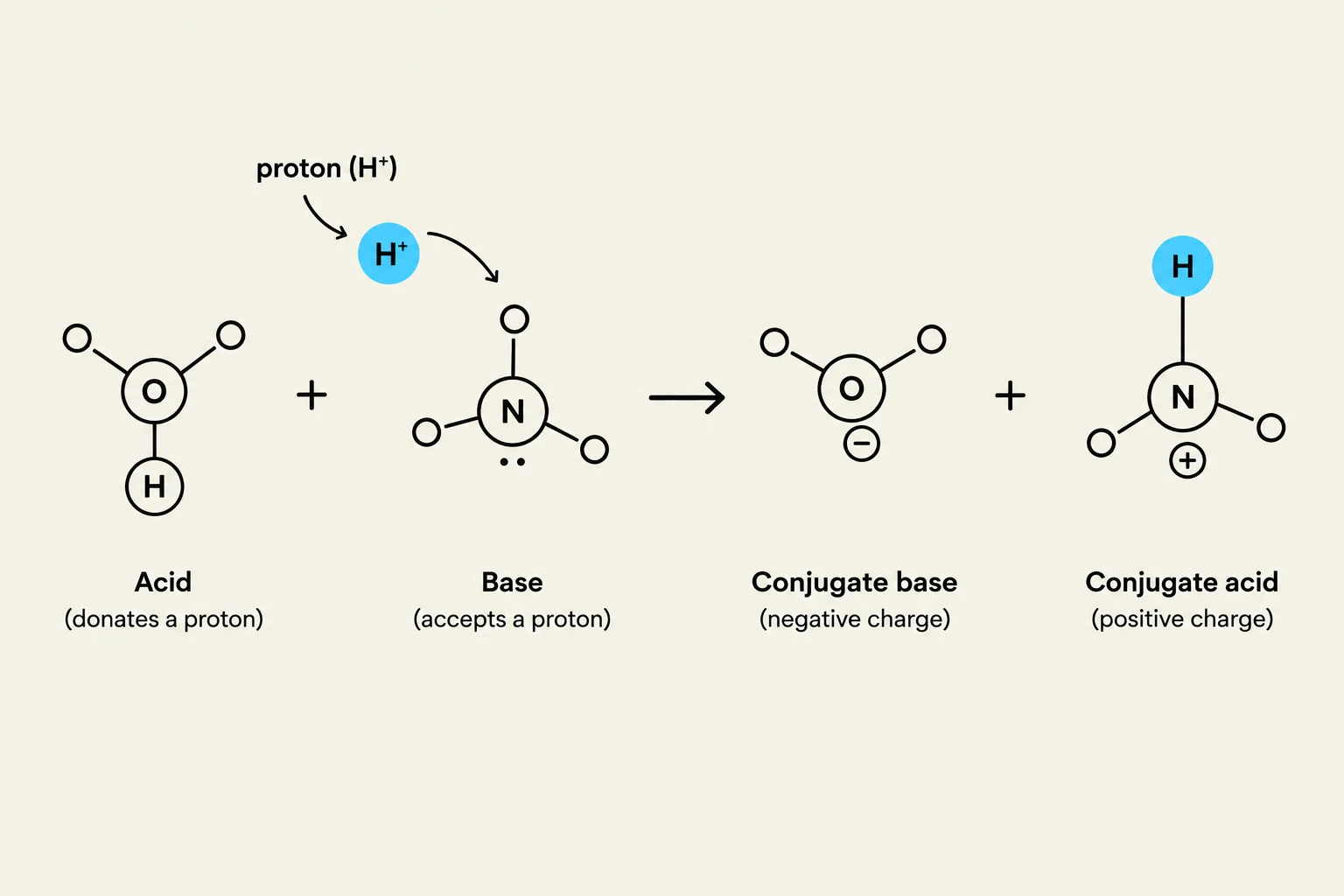
When an acid reacts with a base, they do not simply disappear; they transform into new species. This relationship creates what we call a conjugate acid-base pair. When an acid loses a proton, it becomes its conjugate base. When a base gains a proton, it becomes its conjugate acid.
The general form of such a reaction is:
acid1+base2⇌base1+acid2
This diagram illustrates the Brønsted-Lowry acid-base theory, showing an acid donating a proton (H+) to a base, forming a conjugate base and a conjugate acid.
Exam Tip: When identifying conjugate pairs, always look for the species that differ by exactly one $H^+$ ion. If you add an $H^+$, you are moving from a base to its conjugate acid.
Equilibrium and Reaction Direction
In a reversible reaction, the direction of the equilibrium is determined by the relative strengths of the participants. A fundamental rule of Brønsted-Lowry chemistry is that a reaction will always favor the formation of the weaker acid and the weaker base.
This leads to an inverse relationship: a stronger acid will always have a weaker conjugate base. If you are given a reaction and asked which way it will shift, compare the acid on the left to the acid on the right. The reaction will proceed toward the side with the weaker acid.
Quantifying Acid Strength
We measure the strength of an acid by how much it dissociates in water. This is quantified by the acid dissociation constant (Ka). For a weak acid HA in water, the equilibrium expression is:
Ka=[HA][H3O+][A−]
Strong vs. Weak Acids
Strong acids (such as HCl, HBr, HI, and certain oxoacids like H2SO4) dissociate completely in water.
Weak acids (such as HF, HCN, and carboxylic acids like CH3COOH) dissociate only partially, resulting in a small Ka value.
Predicting Oxoacid Strength
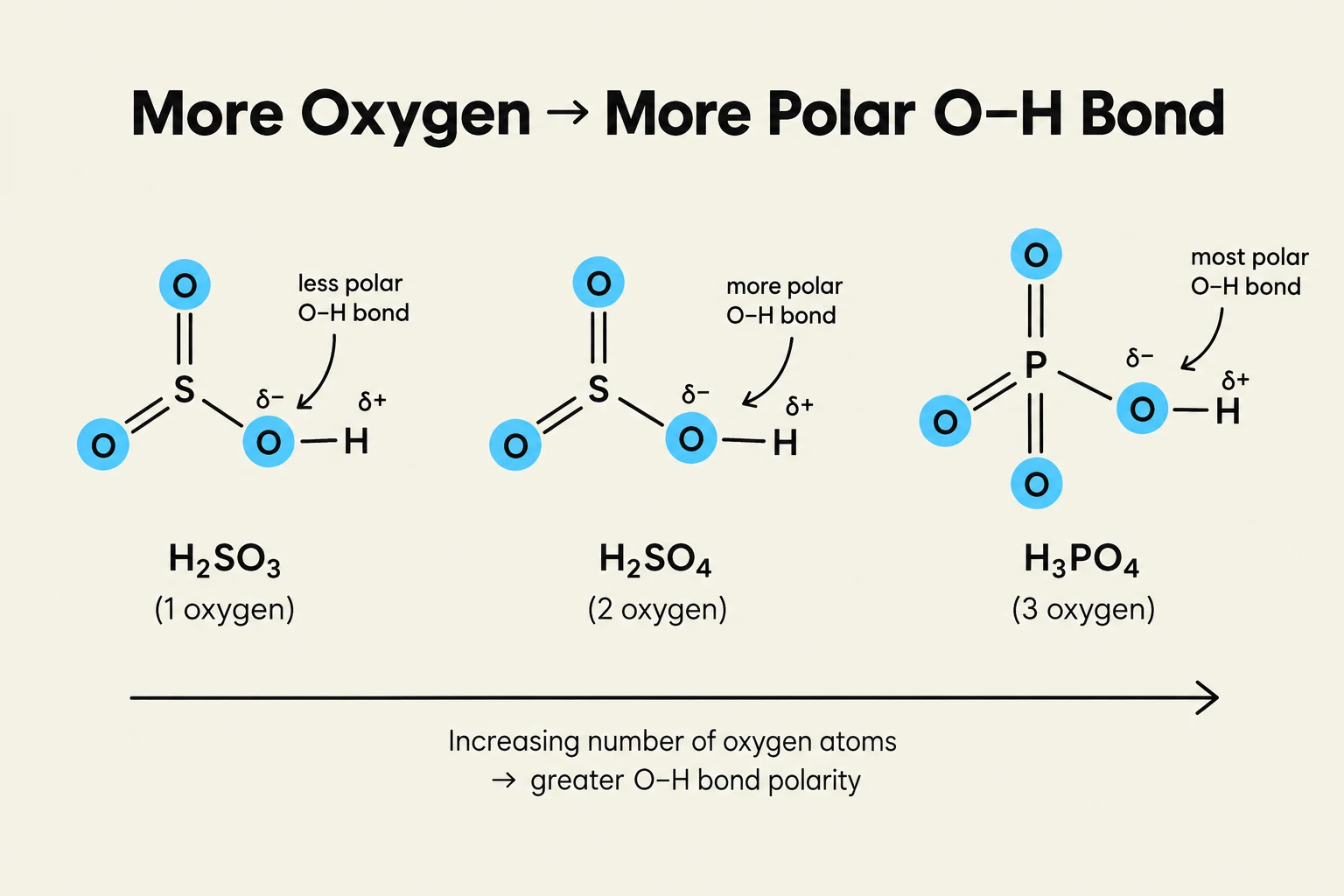
For oxoacids (acids containing oxygen), strength is heavily influenced by the number of oxygen atoms. Generally, as the number of oxygen atoms increases relative to the number of ionizable protons, the acid strength increases. You can often predict this by examining the Lewis dot structure of the molecule to see how much the oxygen atoms pull electron density away from the O−H bond.
This diagram illustrates the relationship between the number of oxygen atoms in a molecule and the polarity of its O-H bonds, showing that more oxygen atoms lead to a more polar O-H bond.
Quantifying Base Strength
Similarly, base strength is measured by the base hydrolysis constant (Kb). For a weak base B in water:
Kb=[B][BH+][OH−]
Strong vs. Weak Bases
Strong bases are typically water-soluble compounds containing $OH^-$ or O2− ions, often occurring as metal hydroxides like NaOH or $Ca(OH)_2$.
Weak bases (such as ammonia, NH3, and various amines) have a smaller Kb and a larger $pK_b$.
Mathematical Relationship: For any conjugate acid-base pair, the relationship between their constants is linked by the auto-ionization constant of water:
Ka×Kb=Kw
where Kw=1.0×10⁻¹⁴ at 25°C.
Worked Example: Solving for pH
A common challenge is calculating the pH of a weak acid solution. Because weak acids do not dissociate completely, we must use an ICE table (Initial, Change, Equilibrium).
Problem: Calculate the pH of a 0.10 M solution of nitrous acid (HNO2), given Ka=5.6×10⁻⁴.
Step 1: Set up the equilibrium equation.HNO2(aq)+H2O(l)⇌H3O+(aq)+NO2−(aq)
Step 2: Construct the ICE table.
Let x be the concentration of H_3O+ produced at equilibrium.
HNO2
H_3O+
NO2−
Initial
0.10 M
0
0
Change
−x
+x
+x
Equilibrium
0.10−x
x
x
Step 3: Substitute into the Ka expression.Ka=0.10−xx2=5.6×10⁻⁴
Step 4: Simplify and solve.
Since Ka is small, we can assume 0.10−x≈0.10. This assumption is valid if the error is ≤5%.
0.10x2≈5.6×10−4x2=5.6×10⁻⁵x=[H3O+]≈0.00748 M
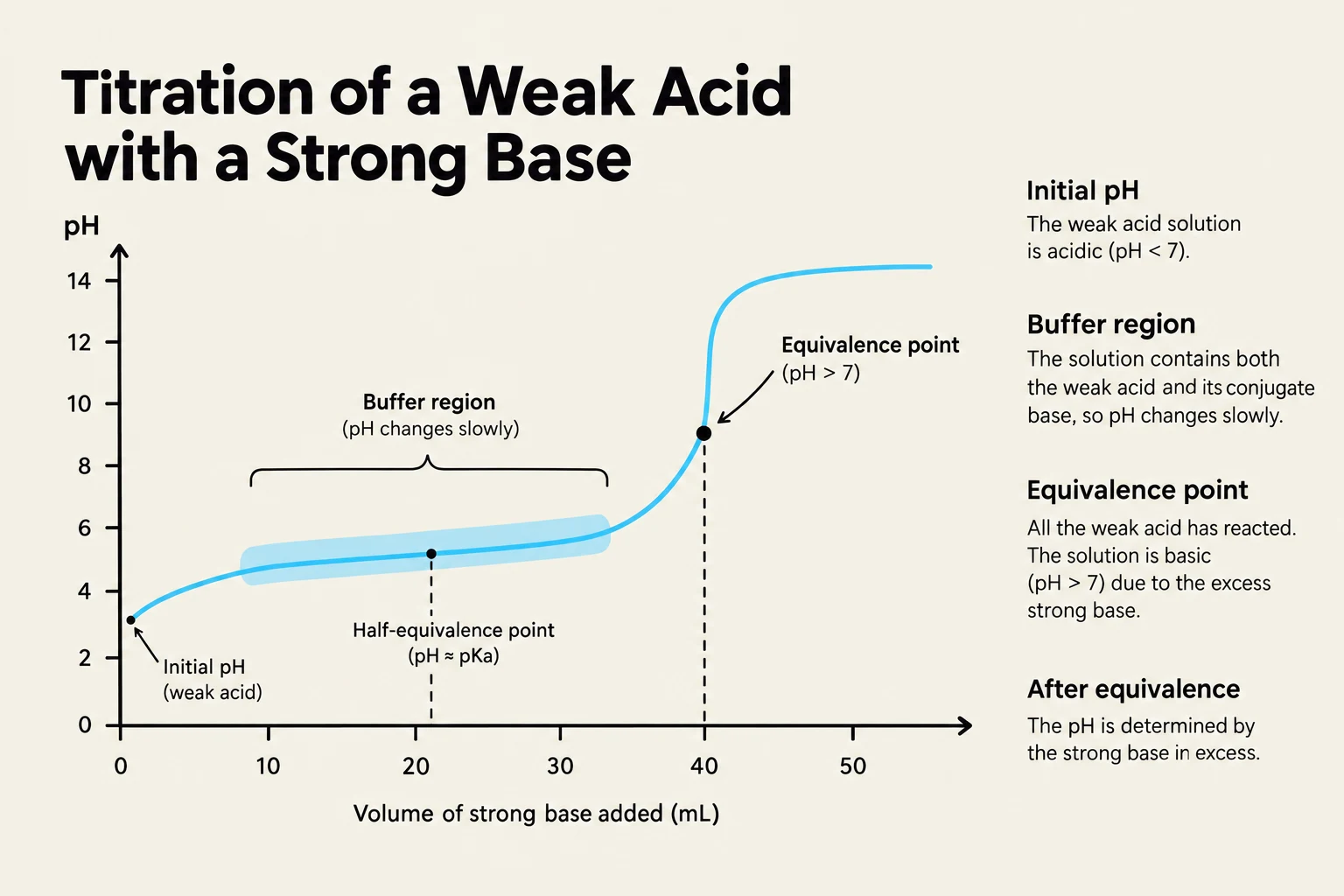
This graph illustrates the pH change during the titration of a weak acid with a strong base, highlighting key points like the initial pH, buffer region, half-equivalence point, and equivalence point.
Real-World Application: Ocean Acidification
The Brønsted-Lowry theory is not just a classroom exercise; it explains critical environmental shifts. As atmospheric CO2 increases, more gas dissolves in the ocean, undergoing a hydration reaction to form carbonic acid (H2CO3). This carbonic acid then dissociates, releasing H_3O+ ions and lowering the pH.
This acidification threatens marine life by shifting the equilibrium of other important reactions. For example, the dissolution of calcium carbonate (CaCO3)—the primary component of many seashells—is increased in acidic conditions. As H_3O+ concentration increases, it reacts with carbonate ions (CO32−), effectively removing them from the water and making it harder for organisms to maintain their shells.
Keep reading for free.
Create an account to finish this reading and make it part of your study routine.