Bona Fide Occupational Requirements and Justifications in Canadian Human Rights Law
This document explains Bona Fide Occupational Requirements (BFOR) and Bona Fide Justifications (BFJ) under the Canadian Human Rights Act, detailing the unified test, duty to accommodate, and implications for discrimination cases.
In the landscape of Canadian human rights law, employers and service providers often face a difficult tension: the need to maintain certain standards for safety, efficiency, or quality, and the legal obligation to prevent discrimination. Under the Canadian Human Rights Act (CHRA), certain standards that appear to discriminate against protected groups (such as those based on disability, sex, or religion) can only be legally defended if they meet specific criteria. These legal defenses are known as Bona Fide Occupational Requirements (BFOR) for employment and Bona Fide Justification (BFJ) for the provision of services.
Understanding the Types of Discrimination
To understand how a BFOR or BFJ is applied, one must first distinguish between the different ways discrimination manifests in a workplace or service environment. Historically, legal analysis treated "direct" and "indirect" discrimination differently, but modern jurisprudence has unified these approaches.
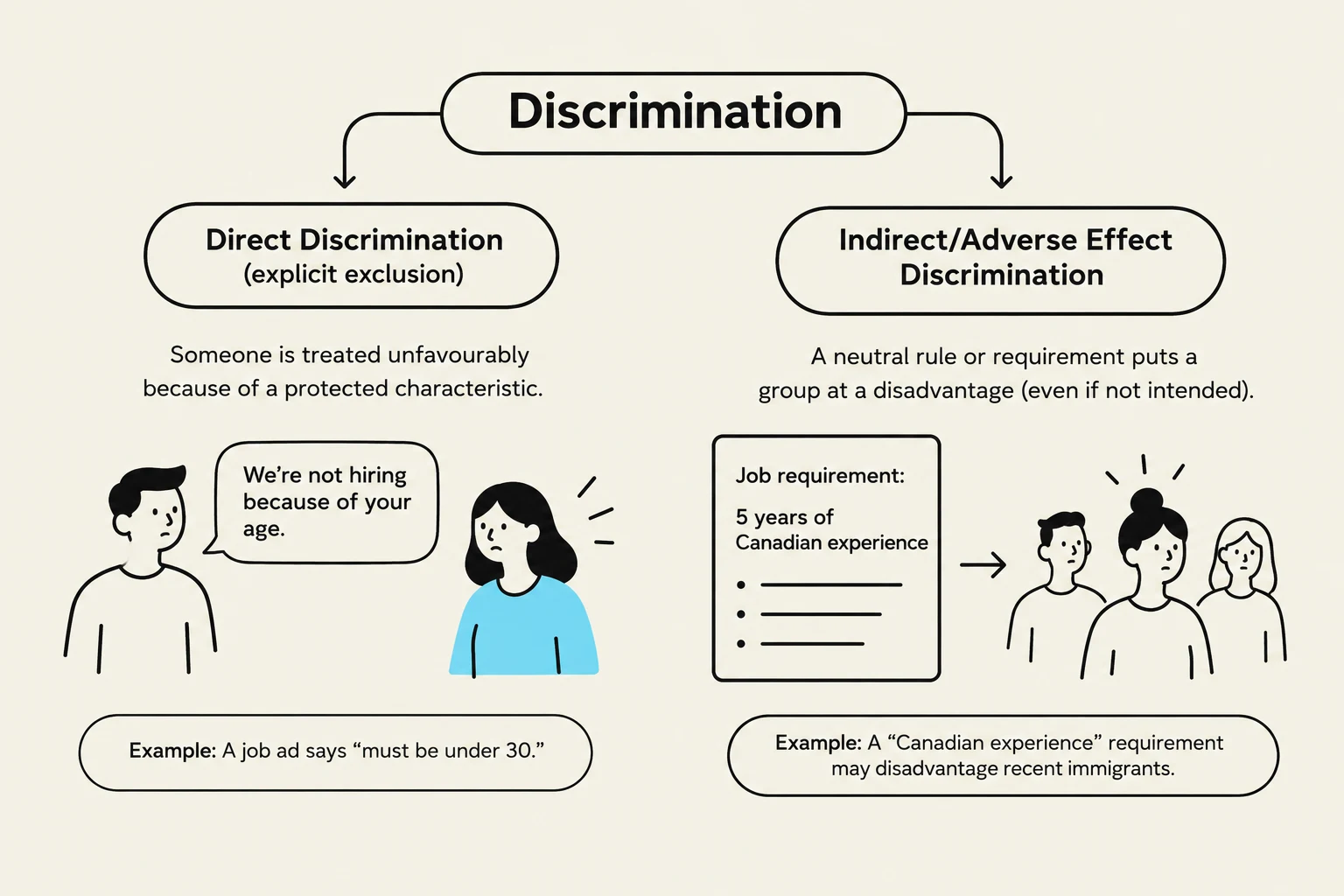
Direct Discrimination: This occurs when a policy explicitly excludes a group. For example, a job posting stating "only men may apply for this security position" is direct discrimination.
Indirect (Adverse Effect) Discrimination: This occurs when a policy appears neutral on the surface but disproportionately impacts a specific group. A classic example is a requirement for all employees to possess a driver's license; while it applies to everyone, it may unfairly exclude individuals with certain physical disabilities.
This diagram illustrates two types of discrimination: direct discrimination, which involves explicit exclusion based on protected characteristics, and indirect/adverse effect discrimination, where a neutral rule disadvantages a group. Examples are provided for each type.
Exam Tip: Remember that the distinction between direct and indirect discrimination has been largely eliminated in terms of legal testing. Whether the discrimination is obvious or hidden, the employer must still pass the same rigorous unified test to justify their standard.
The Duty to Accommodate and Undue Hardship
A central pillar of the CHRA is the duty to accommodate. This means that employers and service providers cannot simply apply a "one-size-fits-all" standard and ignore the needs of individuals who cannot meet it due to protected characteristics.
Instead of maintaining a rigid standard and offering "exceptions," the law requires that accommodation be built into the standard itself. The limit to this duty is undue hardship. An employer is only excused from accommodating an individual if they can prove that doing so would cause excessive difficulty or expense, specifically considering factors like health, safety, and cost.
The Unified Test: The Meiorin and Grismer Legacy
The most significant turning point in this area of law came in 1999 with two landmark Supreme Court of Canada decisions: the Meiorin case and the Grismer case.
In the Meiorin case, a female firefighter was dismissed for failing a new aerobic fitness test. The Court ruled that the standard was not a valid BFOR because it did not account for the biological differences between sexes and was not the least discriminatory way to ensure safety. In the Grismer case, which involved service provision (driver's licenses), the Court applied a similar logic, ruling that a rigid vision standard was not "reasonably necessary" if it failed to account for individuals who could compensate for their vision loss.
Together, these cases established a unified test that applies to both employment (BFOR) and service provision (BFJ).
The Four-Step Unified Test for Bona Fide Occupational Requirements outlines four criteria: Rational Connection, Good Faith, Reasonable Necessity, and Minimal Impact. If all four steps are met, the requirement can be justified.
The Four-Step Test for BFOR (Employment)
To successfully defend a standard as a BFOR, an employer must prove:
Rational Connection: The standard is connected to the performance of the job.
Good Faith: The employer adopted the standard in an honest belief that it was necessary.
Reasonable Necessity: The standard is reasonably necessary to fulfill the work purpose.
Least Discriminatory Alternative: The employer has demonstrated that it is impossible to accommodate the individual without experiencing undue hardship.
The Three-Step Test for BFJ (Services)
For service providers (like the government or utility companies), the test is slightly streamlined but follows the same logic:
Rational Connection: The purpose of the standard is connected to the service provider's function.
Good Faith: The standard was adopted in an honest and good faith belief.
Reasonable Necessity: The standard is reasonably necessary to achieve the goal.
Practical Implications for Investigations
When a complaint is filed with the Canadian Human Rights Commission, the investigation follows a specific evidentiary burden:
The Complainant's Burden: The person filing the complaint must first establish a prima facie case—showing that the policy or practice actually creates a distinction or exclusion based on a protected ground.
The Respondent's Burden: Once the distinction is shown, the "onus" shifts to the employer or service provider. They must then provide evidence to satisfy the unified test.
This diagram illustrates the concept of the burden of proof in legal contexts, differentiating between the complainant's role in showing a distinction and the respondent's role in providing a rational justification.
Study Note: When analyzing "Reasonable Necessity," always look for whether the employer considered alternatives. If an employer could have used individualized testing instead of a group-wide standard but chose not to, they will likely fail the fourth element of the Meiorin test.
Conclusion
The evolution of BFOR and BFJ under the CHRA reflects a shift from "equality of treatment" (treating everyone exactly the same) to "equality of opportunity" (adjusting standards so everyone can participate). By requiring that accommodation be integrated into workplace and service standards, the law ensures that individuals are judged on their personal abilities rather than on biased group characteristics.
Keep reading for free.
Create an account to finish this reading and make it part of your study routine.