An explanation of colloid oncotic pressure, crystalloid vs. colloid solutions, and the administration of various blood products including red blood cells, fresh frozen plasma, platelets, albumin, and erythropoietin.
In clinical practice, managing a patient's hemodynamic stability and oxygenation requires a deep understanding of fluid dynamics and the specific roles of various blood components. Whether treating acute hemorrhage, chronic kidney disease, or liver failure, healthcare providers must choose between different types of solutions and biological products to restore volume, clotting ability, or red cell mass.
The Physics of Fluid Therapy: Colloid Oncotic Pressure (COP)
A fundamental concept in fluid resuscitation is the movement of water between the intravascular space (the blood vessels) and the extravascular/interstitial space (the tissues). This movement is governed by the balance between hydrostatic pressure and Colloid Oncotic Pressure (COP).
COP is the osmotic pressure exerted by large molecules, primarily proteins, that are too big to easily pass through the capillary walls. Because these proteins remain trapped within the vessels, they exert a "pulling" force that attracts water into the capillary. When COP is high, it effectively expands the plasma volume by drawing fluid from the surrounding tissues into the bloodstream.
Diagram illustrating how high colloid oncotic pressure (COP) in capillaries pulls fluid into the blood, counteracting hydrostatic pressure that pushes fluid out.
Crystalloids vs. Colloids
When a patient requires volume expansion, clinicians select between two main categories of solutions: crystalloids and colloids.
Crystalloids
Crystalloids are water-based solutions that contain small molecules but lack large proteins. Common examples include Normal Saline, Lactated Ringers, and D5W.
Indications: Used for short-term volume expansion, such as in cases of burns or shock.
Advantages: They are inexpensive and carry no risk of viral transmission or anaphylaxis.
Limitations: They have a very short half-life, typically only 30–60 minutes, because they quickly leak out of the intravascular space into the tissues.
Colloids
Colloids contain large molecules, such as proteins (albumin) or carbohydrates (dextrans/starches), which increase the COP.
Indications: Used when volume expansion is needed without administering massive amounts of fluid.
Advantages: They stay in the intravascular space much longer than crystalloids, with a half-life ranging from hours to days.
Limitations: They are more expensive and carry a higher risk of adverse reactions compared to crystalloids.
Administration of Blood Products
Blood products are considered biological drugs because they are derived from living organisms. They are most commonly indicated when a patient has lost more than 25% of their total blood volume.
Red Blood Cells (RBCs)
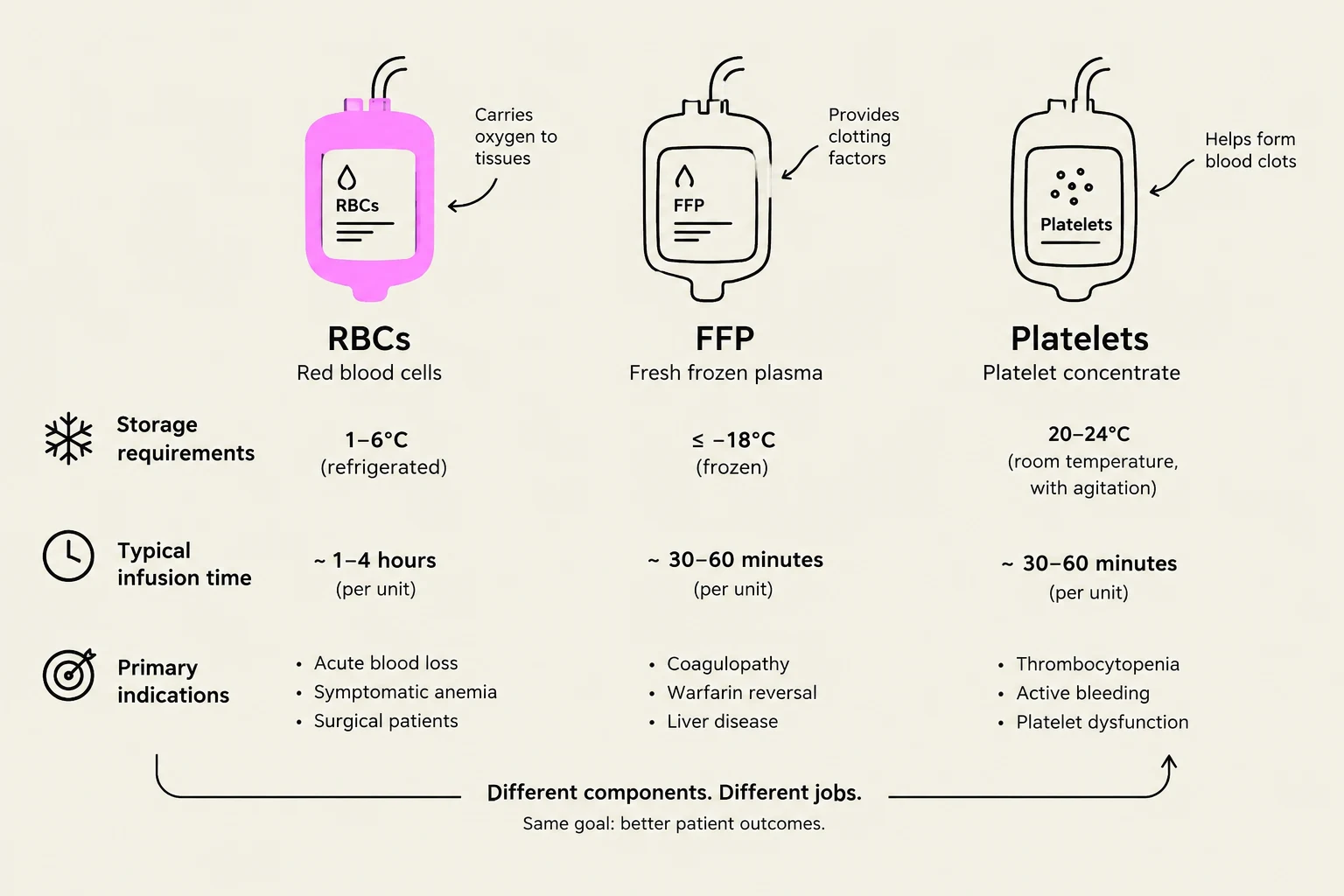
RBCs are primarily used to increase the oxygen-carrying capacity of the blood in patients experiencing symptomatic anemia or active bleeding. Symptoms of low RBC levels may include tachycardia, dizziness, and shortness of breath.
Administration: Must be administered using specific blood tubing equipped with a filter.
Safety: The transfusion must be completed within 4 hours to prevent bacterial proliferation that can occur as the blood reaches room temperature.
Fresh Frozen Plasma (FFP)
FFP contains clotting factors and is indicated for patients with liver disease or coagulation deficiencies. It is also used in plasma exchange procedures for conditions like Thrombotic thrombocytopenic purpura (TTP).
Storage: FFP is stored frozen for up to 1 year. Once thawed, it must be used within 5 days when stored at 1–6∘C.
Platelets
Platelets are essential for preventing or controlling bleeding in patients with thrombocytopenia (low platelet count) or platelet dysfunction (e.g., due to aspirin use).
Storage: Unlike other products, platelets must be stored at room temperature (20–24∘C) on an agitator to maintain viability.
Administration: They are typically infused rapidly, usually within 60 minutes.
This diagram illustrates the differences between Red Blood Cells (RBCs), Fresh Frozen Plasma (FFP), and Platelets, including their storage requirements, typical infusion times, and primary indications for use. It highlights that while these components have different functions, they share the common goal of improving patient outcomes.
Albumin and Specialized Protein Therapy
Albumin is a natural protein produced by the liver and is responsible for approximately 70% of the body's Colloid Oncotic Pressure. It plays a vital role in transporting substances like bilirubin, calcium, and various medications throughout the body.
Indications: Albumin is used for patients with severe burns, those with ascites requiring large-volume paracentesis (>5 L), and during plasma exchange.
Nursing Alert: Rapid infusion of albumin must be avoided, as it can lead to vascular overload and pulmonary edema.
Erythropoietin (EPO) and Chronic Kidney Disease
While blood products replace what is lost, medications like Erythropoietin (EPO/Epoetin) work by stimulating the body to produce its own cells.
The Pathophysiology of CKD
In Chronic Kidney Disease (CKD), the loss of functioning nephrons leads to several physiological failures:
Increased glomerular permeability leads to proteinuria.
Tubular inflammation and scarring occur.
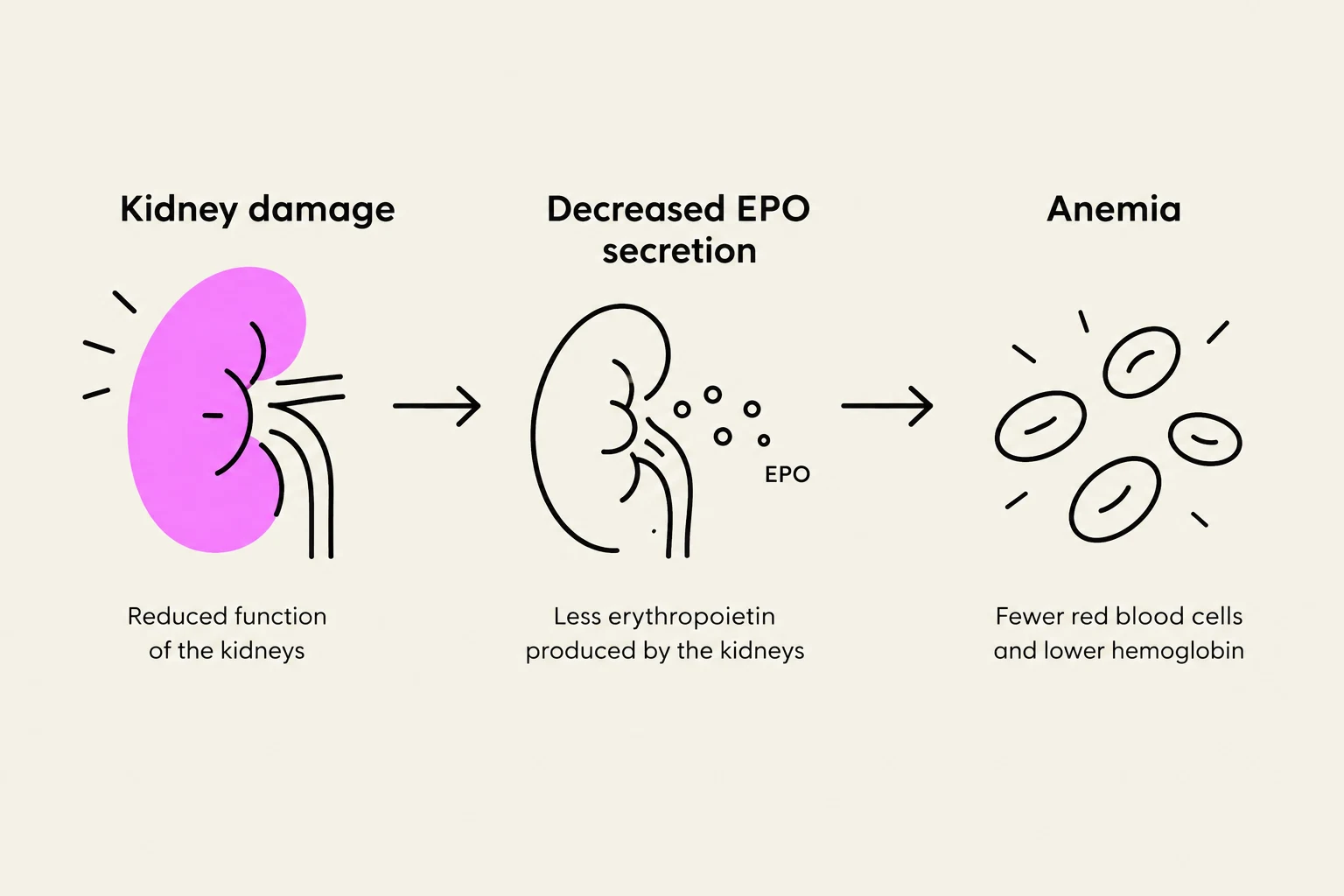
Most critically, the kidneys decrease the secretion of erythropoietin.
Without sufficient EPO, there is decreased stimulation of the bone marrow, leading to a drop in the Red Blood Cell count.
Mechanism of Action
Epoetin alfa (e.g., Eprex) acts directly on the erythroid progenitor cells in the bone marrow to stimulate the production of new red blood cells. This is a preferred treatment for anemia related to CKD when a direct blood transfusion is not safe or indicated.
This diagram illustrates how kidney damage can lead to decreased erythropoietin (EPO) secretion, resulting in anemia due to fewer red blood cells and lower hemoglobin.
Exam Tip: Transfusion Reactions
Always monitor the patient closely during the first 15 minutes of any transfusion. If a patient develops fever, chills, back pain, or hypotension, stop the transfusion immediately and notify the provider, as these may be signs of an acute hemolytic reaction or sepsis.
Summary Table: Quick Reference for Blood Products
Product
Primary Indication
Key Storage/Admin Note
RBCs
Anemia / Bleeding
Complete within 4 hours
FFP
Coagulation / Liver disease
Frozen for 1 year; use within 5 days of thawing
Platelets
Thrombocytopenia
Store at 20–24∘C on an agitator
Albumin
Low COP / Burns / Ascites
Avoid rapid infusion (risk of pulmonary edema)
EPO
Anemia in CKD
Stimulates bone marrow; not a transfusion
Keep reading for free.
Create an account to finish this reading and make it part of your study routine.