An overview of biomedical research, covering the scientific method, peer review, different levels of study (in vitro, in vivo), observational designs (case reports, case-control, cohort), and experimental designs like clinical trials and randomized controlled studies.
Biomedical research is a systematic endeavor to understand how the human body functions at various levels and to develop interventions—such as drugs or medical devices—to treat diseases. This field moves from the microscopic understanding of molecules to the macroscopic observation of whole organisms. To ensure that medical breakthroughs are safe and effective, researchers follow a rigorous hierarchy of study designs, ranging from simple laboratory observations to complex, multi-phase human clinical trials.
This illustration compares in vitro and in vivo research environments, showing the study of isolated cells versus whole, living organisms.
The Foundation: The Scientific Method and Peer Review
Before any data is collected, researchers must follow the scientific method. This begins by identifying a gap in current knowledge and asking a specific question. From this question, scientists perform extensive research to create a hypothesis: a formal prediction of what they expect to see, specifically identifying potential causes and effects.
Once an experiment is conducted and data is analyzed, the results must be communicated. However, in the biomedical field, "communication" is not as simple as publishing a blog post. Research undergoes peer review, a rigorous process where other experts in the field evaluate the study's methodology, validity, and significance before it is accepted for publication in credible databases like PubMed or the Journal of the American Medical Association.
Exam Tip: When evaluating health news, always look for peer-reviewed evidence. Be wary of "sensational language"—exaggerated claims or dramatic headlines that lack support from multiple data sources.
Levels of Biomedical Research
Biomedical research is categorized by the level of biological organization being studied.
1. Molecular and Cellular Levels: In Vitro Studies
The term in vitro is Latin for "in glass," referring to studies conducted in test tubes or petri dishes. These studies involve the isolation of specific cells or microorganisms to observe their behavior in a controlled environment.
Advantages: They are faster, cheaper, and allow for highly detailed study of specific cell types without the interference of a whole body's complex systems.
Limitations: They are not realistic representations of the human body. A drug might successfully kill cancer cells in a dish but fail to work in a human because it cannot reach the cells or is neutralized by the immune system.
2. Organismal Level: In Vivo Studies
In vivo refers to "living experiments" conducted within a whole living organism, such as animal models.
Advantages: Researchers can study how a treatment affects a subject over its entire lifespan and observe complex interactions between different organ systems.
Limitations: Human physiology is significantly different from animal physiology, meaning results in animals do not always translate perfectly to humans.
Observational Study Designs
Before moving to experimental trials, researchers often use observational methods to identify patterns and risk factors in human populations.
Case Reports and Case Series
A case report is a detailed description of a single patient's unique experience or condition. A case series expands this to a group of several patients who share a commonality.
Use Case: These are invaluable for studying rare diseases or noticing new, unexpected side effects.
Limitation: They cannot be generalized; what happens to one or a few patients may not apply to the general population.
Case-Control vs. Cohort Studies
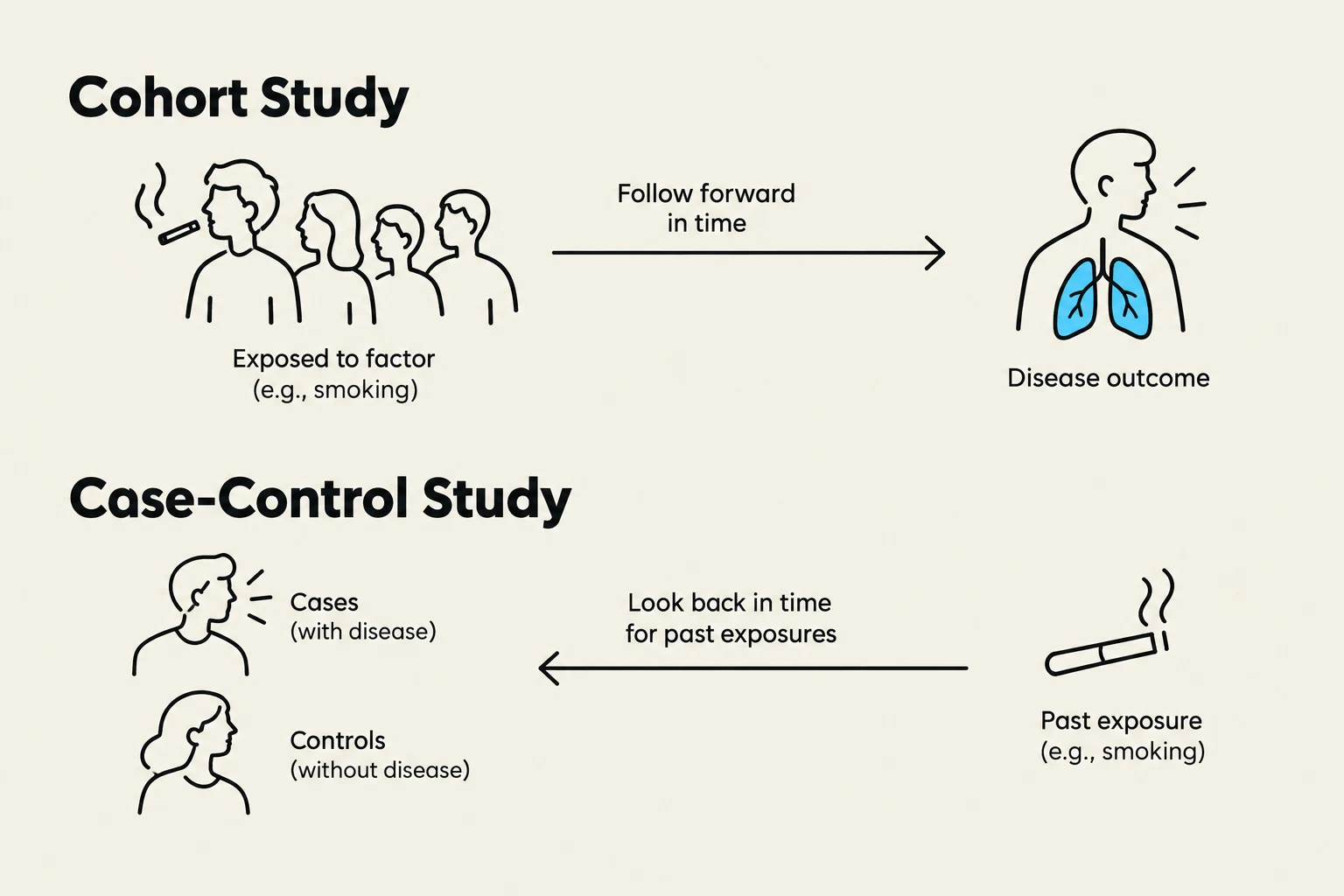
This illustration compares cohort and case-control study designs. A cohort study follows a group exposed to a factor (like smoking) forward in time to observe disease outcomes. A case-control study looks back in time from cases (with disease) and controls (without disease) to identify past exposures.
These two designs are often confused, but they move in opposite directions regarding time and exposure.
Feature
Case-Control Study
Cohort Study
Starting Point
Starts with the outcome (people who already have the disease).
Starts with the exposure (people exposed to a factor, like asbestos).
Direction
Looks backward (retrospective) to see what exposures they had.
Follows subjects forward in time to see if they develop the condition.
Best For
Studying rare diseases.
Studying rare exposures.
Main Limitation
Can show correlation, but not causation.
Other factors (age, lifestyle) can skew results.
Experimental Research: Clinical Trials
When a treatment moves from the lab to humans, it enters the highly regulated world of clinical trials. This process is divided into distinct phases to ensure safety and efficacy.
Pre-clinical: Testing in labs and animals to assess safety, toxicity, and how the drug moves through a biological system (pharmacokinetics/pharmacodynamics).
Phase 1: Small group (20–100 people) to evaluate safety, dosage ranges, and side effects.
Phase 2: Medium group (100–500 people) to further evaluate efficacy and safety.
Phase 3: Large group (300–3,000 people) to confirm effectiveness and monitor adverse reactions in a diverse population.
Phase 4: Post-marketing studies conducted after the drug is available to the public to find long-term risks and optimal uses.
The Gold Standard: Randomized Controlled Studies
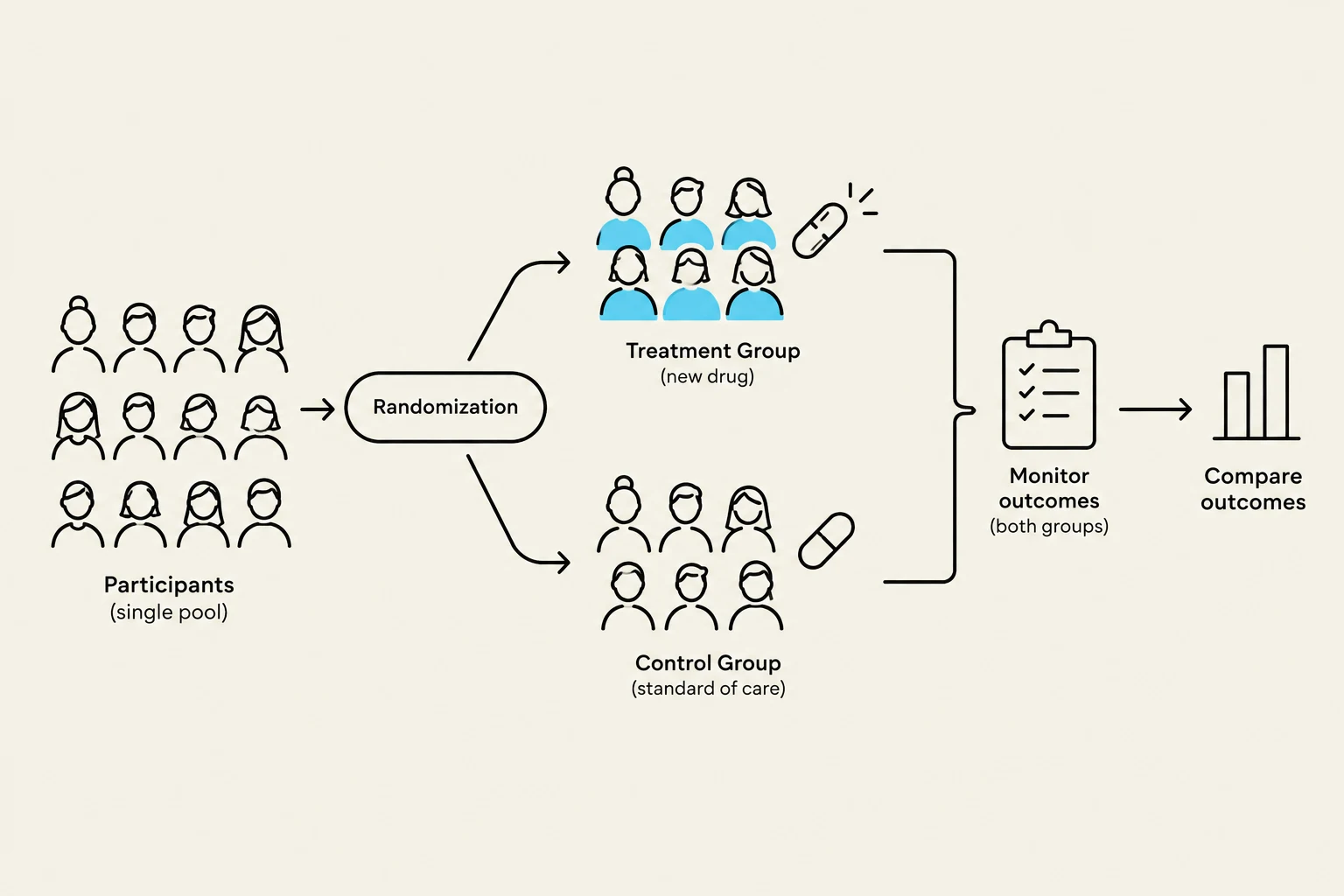
This diagram illustrates the process of a randomized controlled trial, where participants are randomly assigned to either a treatment group receiving a new drug or a control group receiving the standard of care. Outcomes are then monitored and compared between the two groups.
Within these phases (most notably Phase 3), the Randomized Controlled Trial (RCT) is considered the "gold standard" of medical research. In an RCT, participants are randomly assigned to either a treatment group or a control group. The new treatment is typically tested against the current "standard of care" to see if it provides a genuine advantage. This randomization minimizes bias and prevents external factors from skewing the results.
Synthesizing Knowledge: Systematic Reviews and Meta-Analysis
At the very top of the evidence hierarchy are studies that do not look at individual patients, but at all existing research on a topic.
Systematic Reviews: These provide a comprehensive overview of all individual research studies related to a specific question.
Meta-Analysis: This is a statistical technique used within a systematic review. It "pools" the data from many different individual studies to reach a new, more powerful conclusion.
Summary Note: While these methods are powerful and can distinguish between useful and harmful therapies, they are only as good as the studies they include. If the underlying studies are incomplete or skewed, the meta-analysis will be too.
Keep reading for free.
Create an account to finish this reading and make it part of your study routine.