An introduction to the biomechanics of resistance training, covering the musculoskeletal system, planes of motion, lever systems, and the force-velocity relationship.
Understanding how the human body moves under load is the cornerstone of effective strength and conditioning. While anatomy focuses on the memorization of body parts, biomechanics is the study of how those anatomical components interact to produce movement. For the resistance training practitioner, mastering biomechanics means moving beyond simply "lifting weights" to understanding the physics of how force is generated, transferred, and applied to the musculoskeletal system.
The Musculoskeletal System and Muscle Action
Movement is driven by the musculoskeletal system, which consists of bones, joints, muscles, and tendons. A fundamental principle to remember is that muscles and tendons can only exert pulling forces. Even when we describe an exercise as a "pushing" movement (like a bench press), the underlying biological mechanism is the muscle pulling on a bone to create that action.
To describe how muscles function during a specific movement, we categorize them by their roles:
Agonist (Prime Mover): The muscle primarily responsible for initiating the movement.
Antagonist: The muscle that opposes the agonist; it serves to stabilize the joint, stop the motion, or slow it down to prevent injury.
Furthermore, we define muscles by their attachment points. The origin is the proximal attachment (the end closer to the center of the body), while the insertion is the distal attachment (the end further from the center).
Exam Tip: When analyzing a movement, always identify the agonist first. Remember that the muscle's ability to produce force is heavily influenced by its insertion point. A farther tendon insertion can lead to greater force production due to a larger moment arm, though this often comes at the cost of contraction speed.
Planes of Motion and Anatomical Terms
To communicate movement accurately, we divide the body into three primary anatomical planes. Every resistance training exercise occurs within one of these planes:
1. The Sagittal Plane
This plane divides the body into right and left sides. Movements in this plane typically involve forward and backward motions.
This plane divides the body into front (anterior) and back (posterior) sections. Movements here occur side-to-side.
Key Movements: Abduction (moving away from the midline), adduction (moving toward the midline), elevation, depression, and lateral flexion.
Example: A dumbbell lateral raise.
3. The Transverse Plane
This is the rotational plane, dividing the body into top and bottom halves.
Key Movements: Twisting, medial/lateral rotation, pronation/supination, and horizontal abduction/adduction.
Example: A barbell twist.
The Physics of Movement: Levers and Moment Arms
In biomechanics, the body functions as a system of levers. A lever consists of a rigid bar (the bone) that rotates around a fulcrum (the joint/pivot point). The effectiveness of a lever is determined by the moment arm, which is the perpendicular distance from the line of force to the fulcrum.
By manipulating the position of the weight or the angle of the limb, practitioners can change the length of the moment arm, thereby altering the difficulty of an exercise.
The Three Classes of Levers
Levers are classified based on the relative positions of the fulcrum, the force (muscle), and the resistance (weight):
First-Class Lever: The resistance and muscle force are on opposite sides of the fulcrum. A classic example is the articulation between the atlas vertebra and the skull.
Second-Class Lever: The resistance and muscle force are on the same side of the fulcrum, but the muscle acts through a longer lever arm. This provides a mechanical advantage, allowing for greater force production with less effort. An example is the calf raise.
Third-Class Lever: The resistance and muscle force are on the same side, but the muscle acts through a shorter lever arm. This results in a mechanical disadvantage, meaning more force is required to move the load, but it allows for greater speed and range of motion. A dumbbell curl is a prime example.
Key Concept: Most human movement occurs via third-class levers. While this is a "disadvantage" in terms of pure force efficiency, it is an evolutionary advantage for speed and mobility.
Mechanical Advantage vs. Disadvantage
Mechanical advantage is expressed as the ratio of the muscle moment arm (Mm) to the resistance moment arm (Mr):
Ratio=MrMm
If the ratio equals 1.0, the system is in equilibrium.
An advantage (e.g., 1.5) means the muscle has a mechanical edge.
A disadvantage (e.g., 0.5) means the muscle must work harder to overcome the load.
Because joint angles change during a lift (such as in a deadlift or a front raise), the mechanical advantage is not static; it changes throughout the entire range of motion.
Diagrams illustrating muscle attachment points and angles relative to a joint and fixed segment.
Force, Velocity, and Strength
To transition from biomechanics to practical training, we must understand the relationship between force and velocity. Force is defined by Newton's Second Law:
Force=mass⋅acceleration
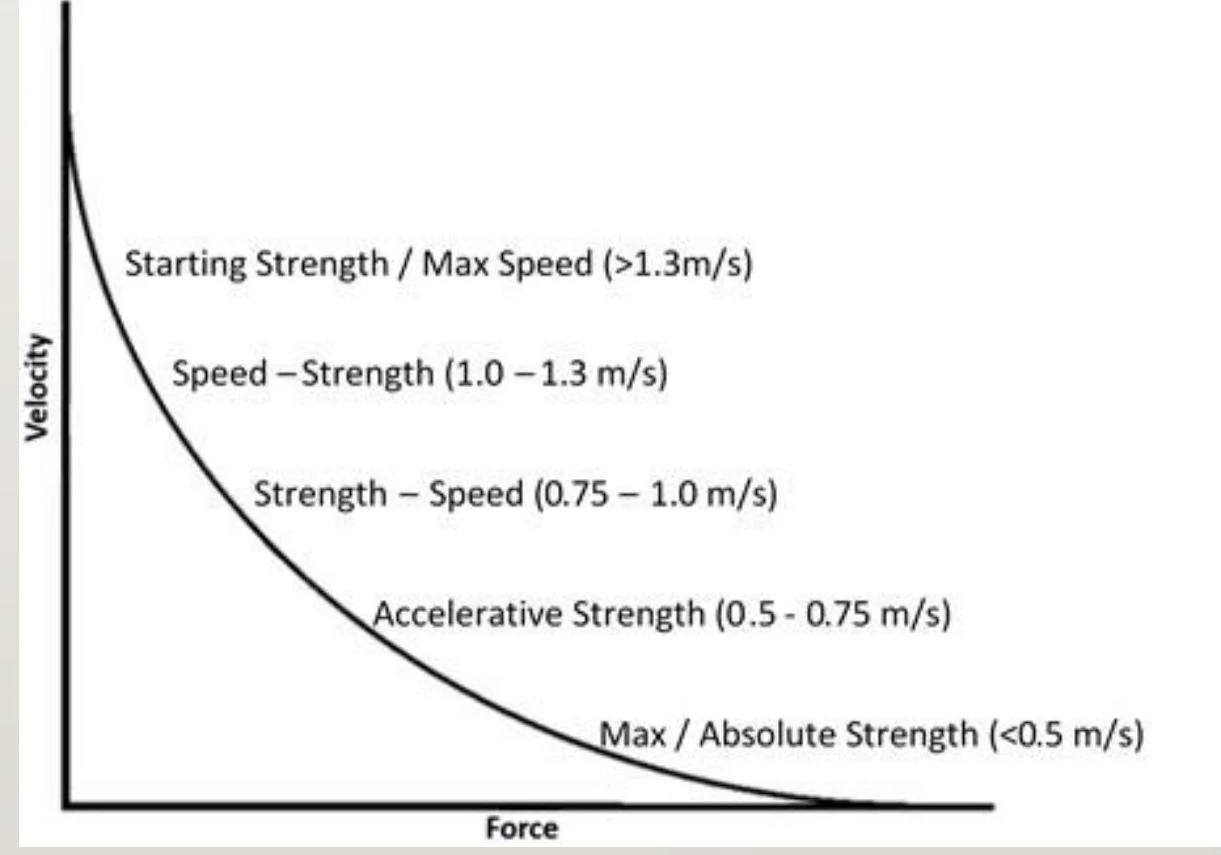
In resistance training, we often look at the relationship between how much weight we can move (force) and how fast we can move it (velocity). This is illustrated by the Force-Velocity Curve:
A graph illustrating the relationship between force and velocity, showing force decreasing as velocity increases from eccentric to concentric movement.
As the load increases, the velocity of the contraction decreases. This is why powerlifters (focusing on maximal force) and Olympic weightlifters (focusing on maximal power/velocity) have different training requirements.
Factors Affecting Strength Production
Several physiological factors determine how much force a muscle can produce:
Neural Factors: The ability to recruit more motor units, use larger motor units, and increase the firing rate (rate coding).
Muscle Cross-Sectional Area (CSA): Generally, a larger muscle produces more force.
Pennation Angle: The angle at which muscle fibers align with the tendon. A larger angle allows for more sarcomeres in parallel (increasing force) but can decrease contraction velocity.
Muscle Length: The "length-tension relationship" dictates that there is an optimal muscle length for peak force production.
A graph illustrating the relationship between force and velocity, categorizing different types of strength based on speed ranges.
By understanding these biomechanical principles, athletes can optimize their training to target specific mechanical advantages, improve their strength-to-mass ratio, and master the various planes and lever systems of the human body.
Keep reading for free.
Create an account to finish this reading and make it part of your study routine.