


The shoulder is one of the most mobile joints in the human body, but this high degree of mobility comes at a cost: stability. To move the arm through a full range of motion, the body does not rely on a single joint, but rather a complex coordination of the glenohumeral joint and the scapulothoracic joint. Understanding how these components work together—specifically through the concepts of scapulohumeral rhythm and rotator cuff force couples—is essential for understanding both normal movement and common pathologies like impingement syndrome.
Scapulohumeral Rhythm
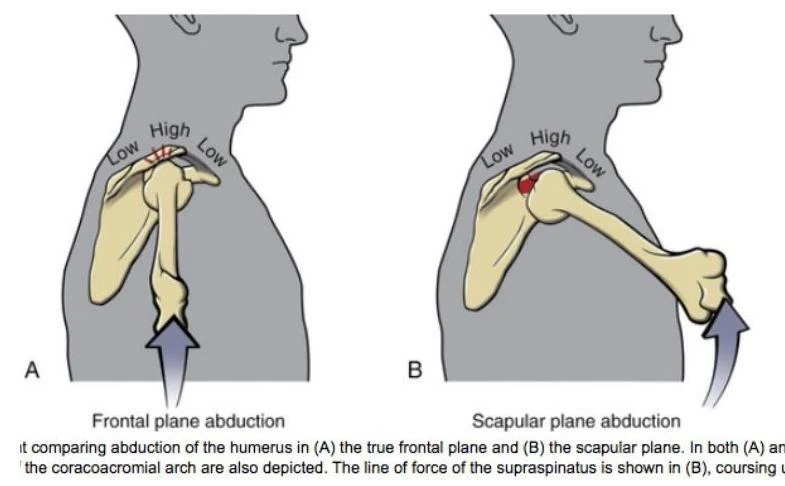
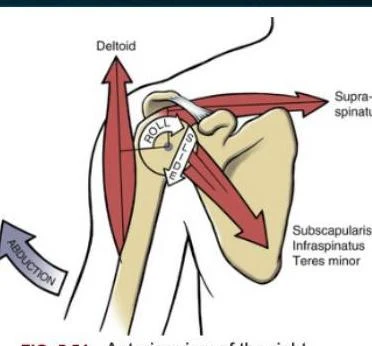
When you lift your arm out to the side (abduction), the movement is not solely occurring at the glenohumeral (GH) joint. Instead, there is a coordinated timing relationship between the GH joint and the scapulothoracic (Sc-T) joint known as scapulohumeral rhythm.
Typically, movement begins at the glenohumeral joint. As the arm continues to rise, the scapulothoracic joint begins to contribute more significantly, reaching its peak movement between 60 and 120 degrees of abduction.
The overall ratio of movement is approximately 2:1:

This rhythm serves two critical purposes:
- Glenoid Fossa Orientation: It rotates the scapula so that the glenoid fossa (the "socket") points toward the direction of the moving humerus, providing a stable base for movement.
- Muscle Length-Tension Relationship: It maintains the optimal length of the middle deltoid. Without upward rotation of the scapula, the deltoid would become excessively shortened during abduction, making it transiently weak or "actively insufficient".
Keep reading for free.
Create an account to finish this reading and make it part of your study routine.
Continue reading freeAlready have an account? Log in
Updated