Biology Review: From Macromolecules to Cell Membrane Dynamics
This review covers the fundamental concepts of biological macromolecules, cellular structure and function, and membrane transport mechanisms, including diffusion, osmosis, and active transport.
Understanding life requires a journey from the microscopic chemical building blocks to the complex, organized structures of the cell. Biological systems are built upon a foundation of specialized macromolecules that dictate structure and function, which are then housed within cellular compartments that manage energy, transport, and waste. This review article explores the essential concepts of biochemistry, cellular anatomy, and membrane transport.
The Chemical Building Blocks: Macromolecules
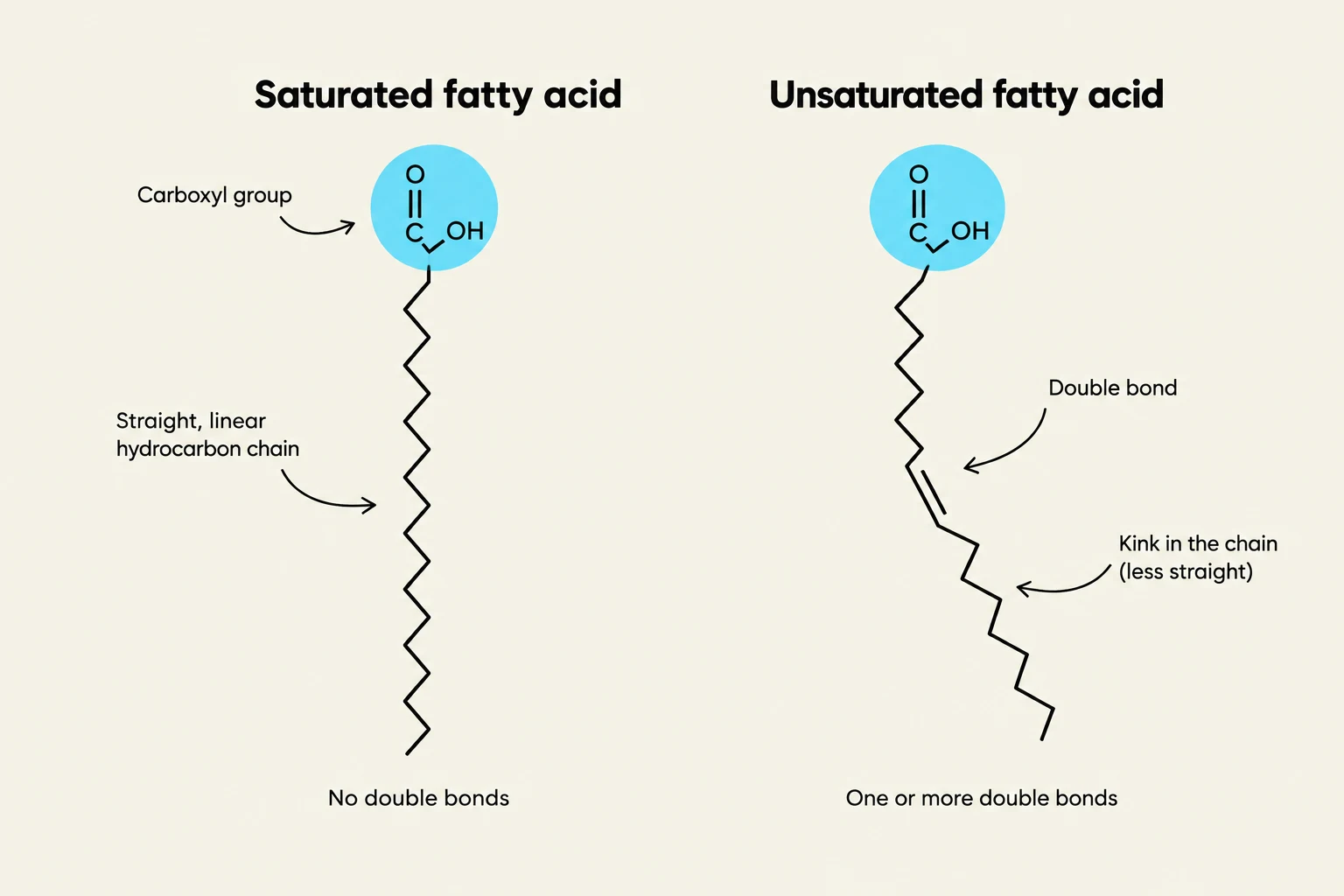
Comparison of saturated and unsaturated fatty acids, highlighting the presence or absence of double bonds in their hydrocarbon chains.
All living organisms are composed of organic molecules known as macromolecules. These are categorized by their unique chemical structures and the specific roles they play in maintaining life.
Proteins and Polypeptides
Proteins are perhaps the most versatile macromolecules. They are constructed from monomers called amino acids. When these amino acids link together, they form a peptide bond through a process known as a dehydration reaction (the removal of a water molecule to join monomers).
It is important to distinguish between a polypeptide and a protein. A polypeptide is simply a long chain of amino acids, whereas a protein is a functional unit that has folded into a specific three-dimensional shape. This folding includes secondary structures, such as the coiled alpha helix and the folded beta pleated sheet.
Lipids and Energy Storage
Lipids are a diverse group of hydrophobic molecules. Fats (triglycerides) serve as long-term energy storage, while phospholipids are the primary structural component of cell membranes. A key distinction in lipid chemistry is the presence of saturated or unsaturated fatty acids. Saturated fats typically have no double bonds between carbon atoms, while unsaturated fats contain one or more double bonds, often creating "kinks" in their structure.
Nucleic Acids
The blueprints of life are found in nucleic acids, such as DNA (deoxyribonucleic acid) and RNA (ribonucleic acid). These polymers are made of monomers called nucleotides. Each nucleotide consists of three essential parts: a sugar molecule, a phosphate group, and a nitrogenous base. DNA is famously characterized by its double-helix structure, which allows it to store genetic information securely.
Exam Tip: If asked to distinguish between a protein and a polypeptide, remember: Polypeptide = the chain; Protein = the functional, folded shape.
Cellular Structure and Function
Cells are the fundamental units of life, categorized into two main types: prokaryotic cells, which lack a nucleus and membrane-bound organelles, and eukaryotic cells, which possess a nucleus and a complex system of internal compartments.
The Endomembrane System
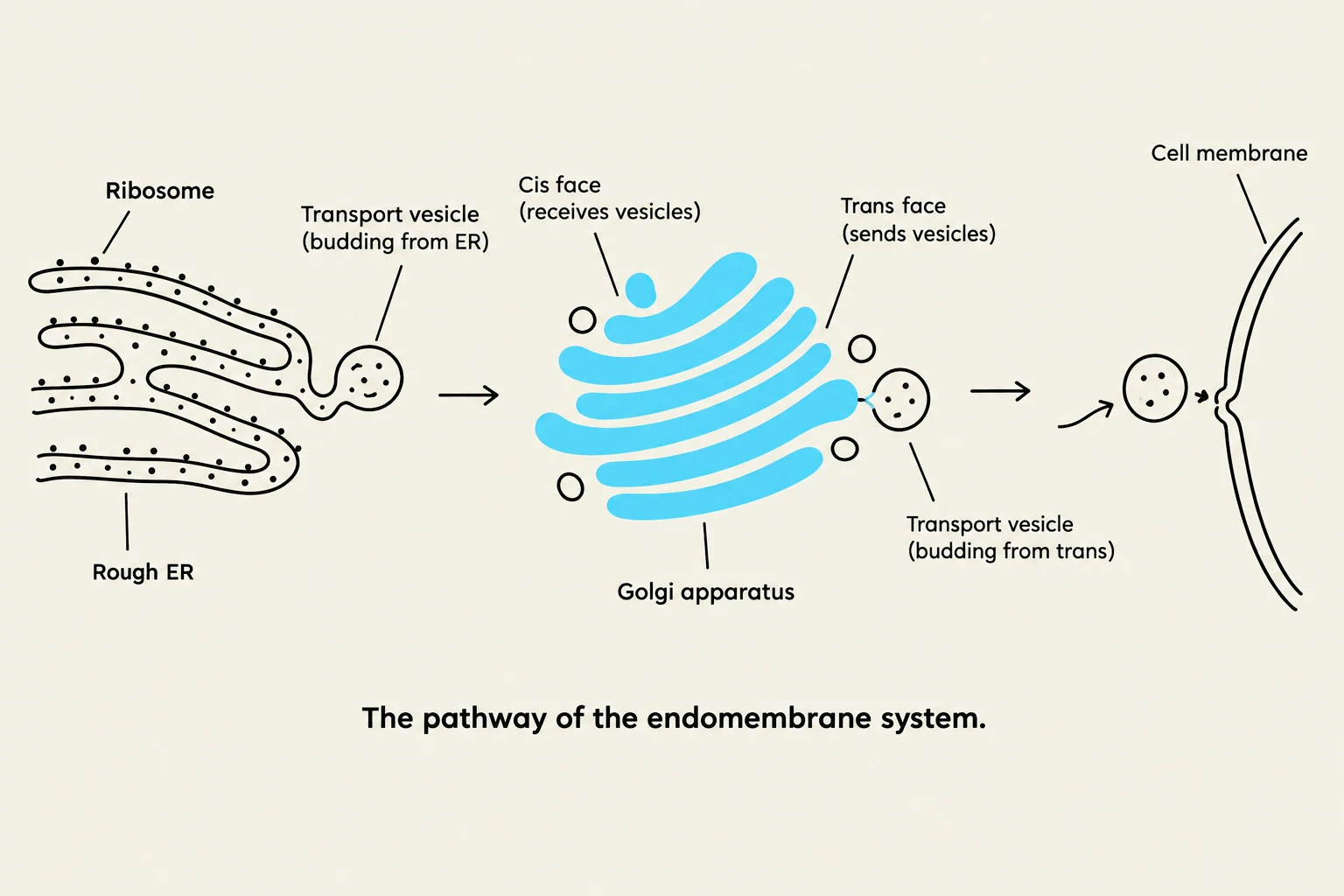
Diagram illustrating the pathway of the endomembrane system, showing the roles of the rough endoplasmic reticulum (Rough ER), ribosomes, Golgi apparatus, transport vesicles, and cell membrane in protein processing and transport.
Eukaryotic cells rely on the endomembrane system to coordinate the synthesis, modification, and transport of molecules. Key components include:
Nuclear Envelope: A double membrane that encloses the nucleus, utilizing pores to regulate the movement of materials in and out.
Ribosomes: The cellular machinery responsible for protein synthesis.
Endoplasmic Reticulum (ER): This organelle comes in two forms. The rough ER is studded with ribosomes and is involved in protein synthesis, while the smooth ER is responsible for lipid synthesis.
Golgi Apparatus: Acting as the cell's "post office," the Golgi modifies, sorts, and packages proteins. It has a distinct polarity, with a cis side that receives vesicles and a trans side that ships them out.
Lysosomes and Vacuoles: Lysosomes are specialized for intracellular digestion, while vacuoles serve various storage functions.
Energy and Support
Beyond the endomembrane system, cells require energy and structural integrity. Mitochondria are the sites of energy conversion, producing the ATP necessary for cellular work. To maintain shape and facilitate movement, cells utilize a cytoskeleton composed of three types of filaments: microtubules, microfilaments, and intermediate filaments. Additionally, structures like cilia and flagella utilize these cytoskeletal elements to facilitate cellular movement.
Membrane Dynamics and Transport
The cell membrane is not a static barrier; it is a dynamic, fluid structure that regulates the cell's internal environment.
Membrane Fluidity and Proteins
Cell membrane fluidity is essential for function. Cholesterol plays a vital role here by acting as a buffer, helping to stabilize the membrane and resist changes in fluidity caused by temperature fluctuations.
The membrane is embedded with various proteins:
Peripheral proteins are located on the surface of the membrane.
Integral proteins are embedded within the lipid bilayer.
Within the integral category, we find channel proteins (which provide a path for specific molecules) and carrier proteins (which bind to substances to move them across).
Mechanisms of Transport
Movement across the membrane is largely determined by the concentration gradient—the difference in the concentration of a substance between two areas.
Diffusion: The spontaneous movement of solutes from an area of high concentration to an area of low concentration.
Facilitated Diffusion: A form of passive transport where substances move down their concentration gradient through specific transport proteins.
Osmosis: The specific diffusion of water across a semipermeable membrane.
Active Transport: The movement of substances against their concentration gradient, a process that requires the expenditure of energy.
Osmotic Solutions
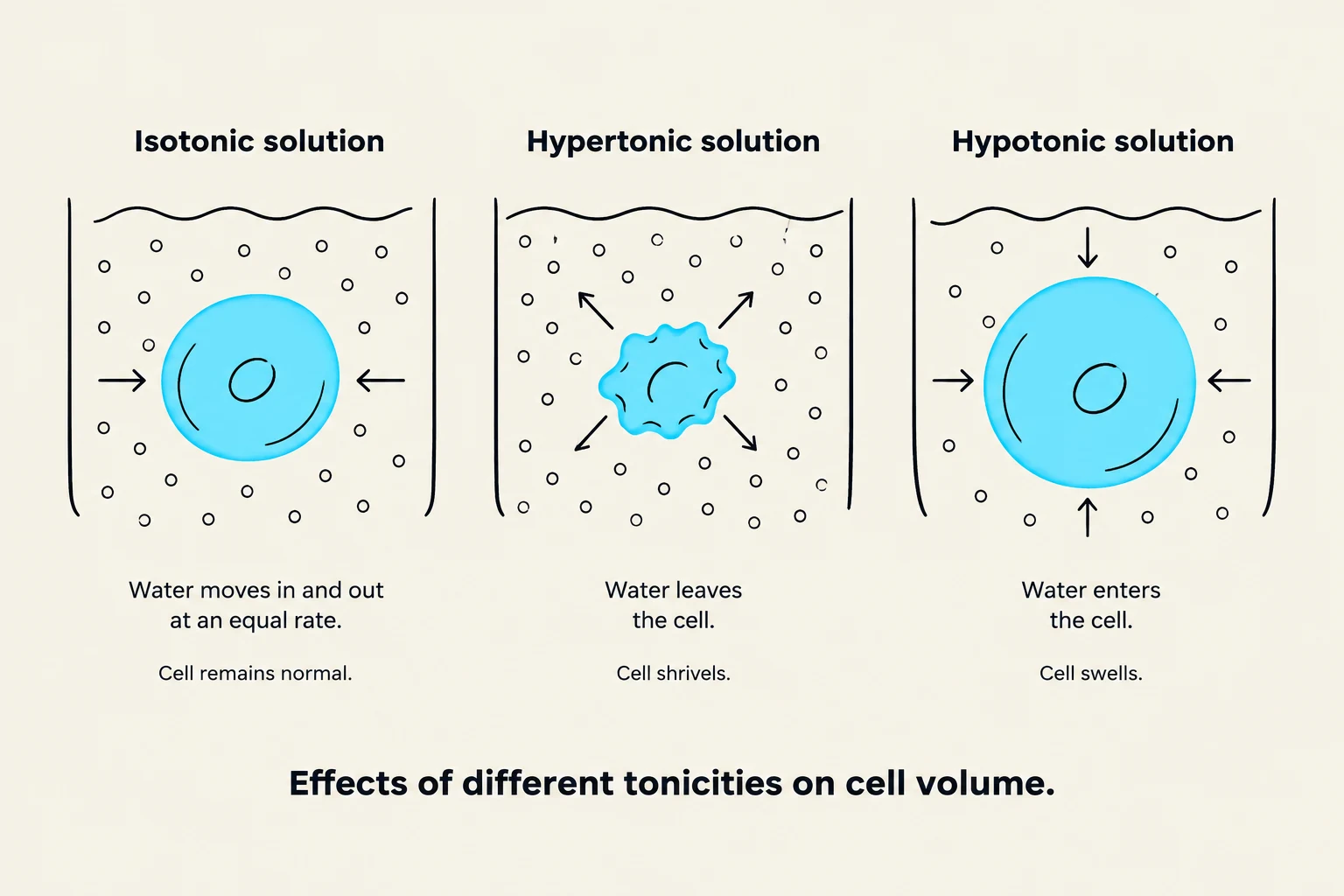
Effects of different tonicities on cell volume.
When studying osmosis, it is critical to understand how a solution affects a cell's volume:
Isotonic: The solute concentration is equal inside and outside the cell; there is no net movement of water.
Hypertonic: The solution has a higher solute concentration than the cell; water will leave the cell, causing it to shrink.
Hypotonic: The solution has a lower solute concentration than the cell; water will enter the cell, causing it to swell.
Study Check: Can you predict the direction of water movement?
Water moves from Hypotonic (low solute) →Hypertonic (high solute).
Keep reading for free.
Create an account to finish this reading and make it part of your study routine.