Explores the two primary internal biological mechanisms governing sleep: the circadian rhythm and sleep-wake homeostasis. Discusses the role of melatonin, sleep stages (NREM and REM), and the importance of sleep quantity and quality for overall health.
Sleep is not merely a period of inactivity; it is a vital biological necessity, as essential to human survival as food and water. While it may be tempting to sacrifice rest for social media or late-night study sessions, sleep serves critical functions ranging from energy conservation and physical repair to cognitive consolidation and immune support. To understand why we feel sleepy at certain times and why we feel an intense urge to sleep after a long day, we must examine the two primary internal biological mechanisms that govern our rest: the circadian rhythm and sleep-wake homeostasis.
The Circadian Rhythm: Your Internal Clock
The circadian rhythm acts as an internal biological clock that operates on a roughly 24-hour cycle. This rhythm is responsible for regulating a wide array of daily physiological functions, including your metabolism, body temperature, and the timing of hormone release. One of the most significant ways the circadian rhythm influences behavior is by signaling when it is time to be awake and when it is time to sleep.
This internal clock does not operate in a vacuum; it synchronizes with environmental cues, most notably light and temperature. For example, the presence of light during the day helps maintain wakefulness, while the absence of light signals the body to prepare for rest.
The Role of Melatonin and the Pineal Gland
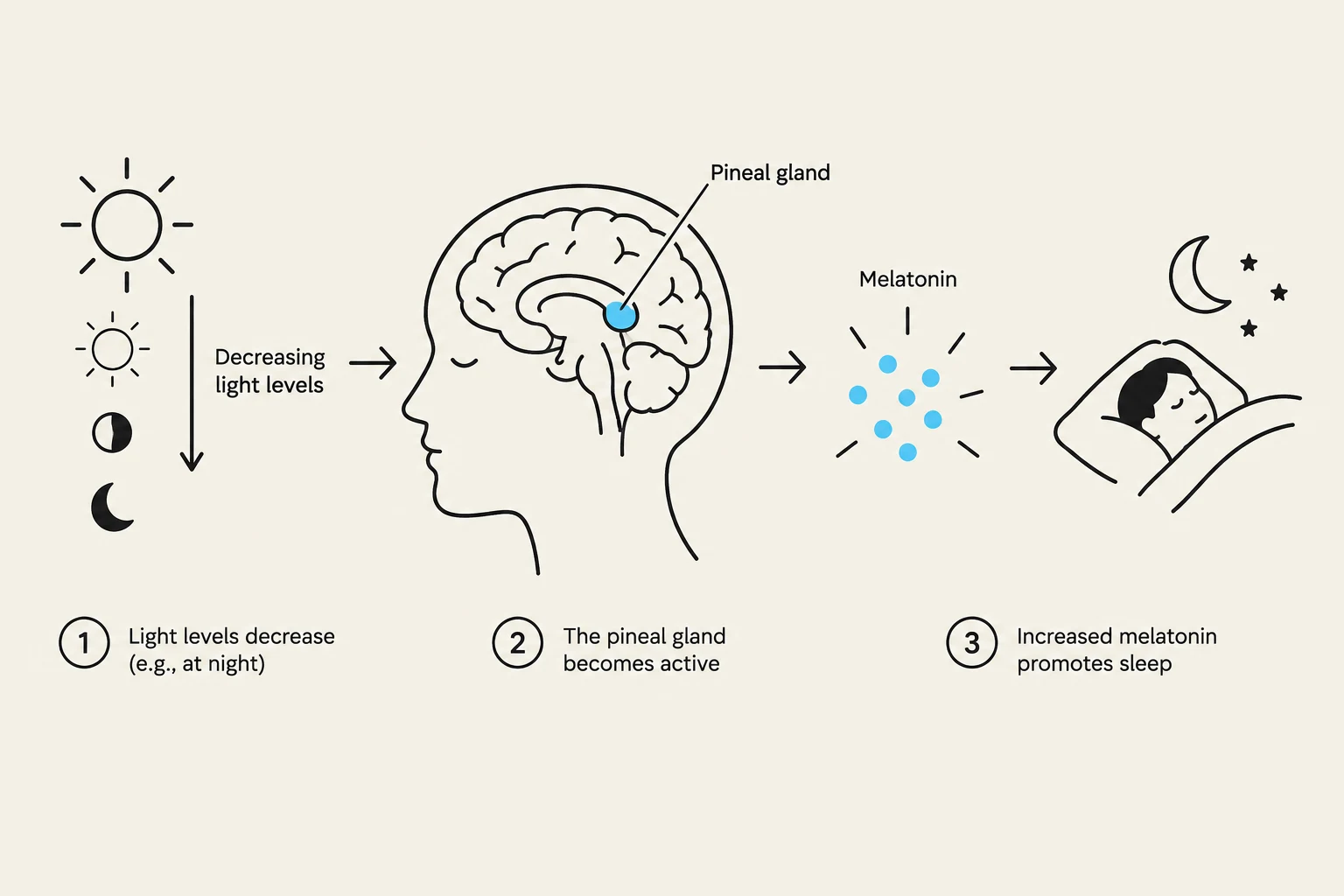
A key player in this synchronization is melatonin, a hormone produced by the pineal gland located in the brain. As light levels decrease in the evening, the pineal gland increases the release of melatonin, which promotes sleepiness and helps align the body's internal state with the external cycle of darkness.
This diagram illustrates the biological process of melatonin production in response to decreasing light levels, which promotes sleep.
When there is a mismatch between these environmental cues and the internal clock—such as when traveling across time zones (jet lag) or working night shifts—the circadian rhythm becomes out of sync. This can make it incredibly difficult to fall asleep when you want to or to stay awake when you need to.
Sleep-Wake Homeostasis: The Pressure to Sleep
While the circadian rhythm manages the timing of sleep, the second mechanism, sleep-wake homeostasis (also known as homeostatic sleep drive), manages the need for sleep.
The homeostatic sleep drive is a physiological pressure that builds up every hour you remain awake. Think of it like a reservoir that slowly fills with "sleep pressure" throughout the day; the longer you stay awake, the higher the pressure becomes, eventually forcing the body to seek rest.
The intensity of this drive is not constant and can be influenced by several factors:
Physical Exertion: High levels of physical activity can increase the need for sleep.
Cognitive Stimulation: Intense mental effort, such as studying for a difficult exam, can increase sleep drive.
Immune Activity: When the body is fighting an infection, the need for sleep increases to support the immune system.
Sleep Deprivation: If you miss sleep one night, the homeostatic drive will be significantly stronger the following night, leading to longer and deeper sleep to compensate.
Exam Tip: Remember the distinction between the two mechanisms. The Circadian Rhythm is about timing (the 24-hour cycle), whereas Sleep-Wake Homeostasis is about intensity/need (the buildup of sleep pressure during wakefulness).
The Architecture of Sleep: Stages and Cycles
Sleep is not a uniform state of unconsciousness. Instead, it is composed of several distinct stages that repeat in cycles throughout the night. A typical person cycles through these stages approximately five to six times per night, with each cycle lasting about 90 minutes.
Non-REM Sleep (N1, N2, and N3)
Non-REM sleep is characterized by a lack of rapid eye movement and is divided into three stages:
N1 (Light Sleep): The transition from wakefulness to sleep. Muscles relax, and heart rate and breathing begin to slow.
N2 (Deeper Sleep): Heart rate and breathing slow further, eye movements stop, and body temperature drops.
N3 (Deep/Restorative Sleep): This is the most critical stage for physical recovery. During N3, the body releases growth hormones to repair tissues and strengthen the immune system, and delta brain waves help process memories.
REM Sleep (N4)
The final stage is REM (Rapid Eye Movement) sleep. During this stage, the brain becomes highly active—almost as active as when you are awake—and your eyes move rapidly under your eyelids. REM sleep is essential for insightful thinking, creativity, and memory consolidation. To prevent you from physically acting out your dreams, your muscles (arms and legs) are temporarily paralyzed during this stage.
Evaluating Sleep: Quantity vs. Quality
To determine if you are getting adequate rest, you must look at two different metrics: how long you sleep and how well you sleep.
Sleep Quantity
This refers to the total amount of time spent sleeping. While individual needs vary based on age, gender, and development, experts generally recommend 7–9 hours of sleep per night for adults.
If you consistently sleep less than your target, you accumulate sleep debt—the total number of hours of missed sleep. For example, if your target is 8 hours but you only sleep 5, you have a sleep debt of 3 hours that night.
Sleep Quality
Quantity alone does not guarantee rest; you must also consider sleep quality, or the efficiency of your sleep period. High-quality sleep is defined by three criteria:
Falling asleep within 30 minutes of going to bed.
Sleeping soundly through the night with no more than one awakening.
If interrupted, being able to return to sleep within 20 minutes.
Disruptions to these biological mechanisms—whether through sleep disorders like insomnia or environmental factors like blue light from phones—can severely impair both the quantity and quality of your rest, ultimately impacting your health and daily performance.
Keep reading for free.
Create an account to finish this reading and make it part of your study routine.