For decades, the debate over why individuals commit crimes was split between "nature" and "nurture." Is a criminal born with a predisposition toward violence, or is crime a product of a broken environment? Modern criminology suggests the answer lies in the middle through biosocial theory. This perspective posits that criminality is a biosocial phenomenon—a complex interaction where genetic inheritability and physiological predispositions meet environmental influences. Under this view, biology does not act as a deterministic "destiny," but rather as a set of predispositions that can be mitigated or exacerbated by social support and life experiences.
The Chemistry of Aggression: Serotonin and MAOA
At the heart of many biological theories is the study of neurotransmitters, the chemical messengers of the brain. One of the most critical players in regulating mood and impulse is serotonin.
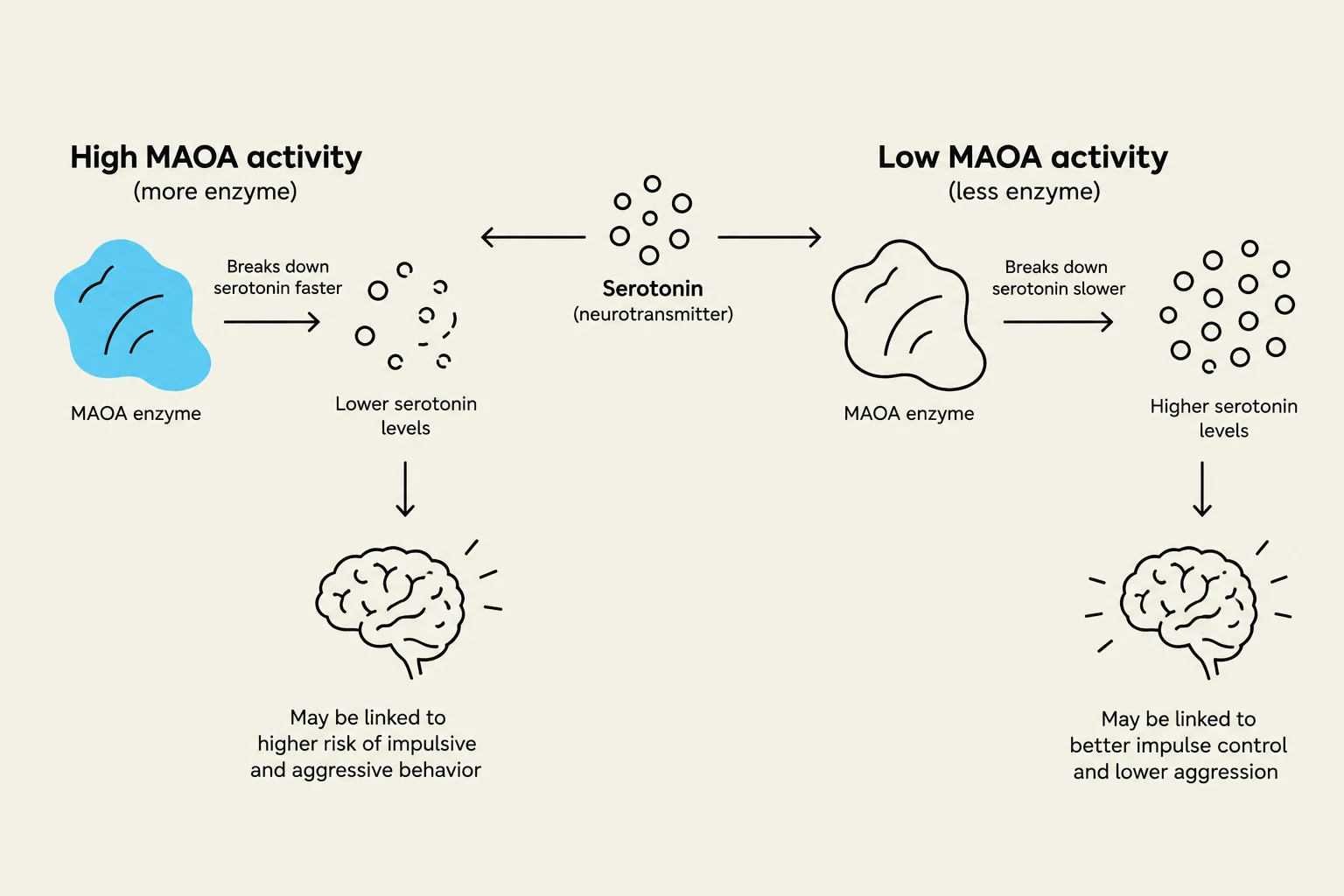
Research indicates that low levels of serotonin are closely linked to increased aggression and impulsivity. To understand how these levels are maintained, we must look at the MAOA enzyme (Monoamine Oxidase A). In the body, MAOA acts as an enzyme that breaks down neurotransmitters like serotonin. If an individual is born with an imbalance—such as producing too much MAOA—the enzyme may "eat" serotonin too quickly, leading to the low levels associated with aggressive behavior.
Interestingly, this biological mechanism is also a target for medical intervention. Many antidepressants are classified as MAOAs inhibitors; they work by blocking the enzyme, thereby increasing the availability of serotonin to help stabilize mood.
This diagram illustrates the relationship between MAOA enzyme activity, serotonin levels, and potential behavioral outcomes. High MAOA activity breaks down serotonin faster, leading to lower serotonin levels and a possible link to higher impulsivity and aggression. Conversely, low MAOA activity breaks down serotonin slower, resulting in higher serotonin levels and a potential link to better impulse control and lower aggression.
Exam Tip: When discussing brain chemistry, remember that biology is rarely about a single "bad gene." Instead, look for the interaction between enzymes (like MAOA) and neurotransmitters (like serotonin).
Brain Structure and Executive Function
While chemistry provides the "fuel" for behavior, brain structure provides the "steering." The prefrontal cortex is the region of the brain responsible for executive functions, which include decision-making, judgment, and, most importantly, impulse control.
When the prefrontal cortex is underdeveloped or damaged, an individual may struggle to weigh the consequences of their actions. This is particularly evident in teenagers, whose prefrontal cortexes are not yet fully matured, explaining why adolescents are often more prone to delinquent or risky behavior.
ADHD and Brain Wave Activity
A related area of study involves Attention Deficit Hyperactivity Disorder (ADHD). Research involving brain wave studies has suggested that children with ADHD may exist in a state of "sleep-like inactivity" during the day. When measuring alpha waves—which are typically active during tasks—researchers found that in some children with ADHD, these waves appear slow and long, similar to those seen during sleep. This physiological state of "tiredness" or lack of focus can lead to impulsivity. Consequently, stimulants like Ritalin are often used to help "wake up" the brain, allowing for better focus and executive control.
Hormones, Arousal, and the Search for Stimulation
Beyond the brain's structure and chemistry, the endocrine system plays a significant role in shaping temperament. One of the most studied relationships is between testosterone and serotonin.
Studies have found a correlation between high testosterone levels and increased criminality, particularly when paired with low serotonin levels. This suggests a "complete system" connection: high testosterone may drive a biological urge toward dominance or aggression, while low serotonin fails to provide the chemical "brake" needed to control those urges.
Physiological Markers of Arousal
Criminologists also look at physiological markers to understand how individuals respond to stimulation:
Resting Heart Rate: Some theories suggest that individuals with low resting heart rates may be "under-aroused" and thus seek out high-stimulation, high-risk, or even criminal environments to compensate for their baseline physiological state.
Electrodermal Response (GSR): This measures skin sweat response, which is a direct indicator of autonomic nervous system arousal.
This diagram illustrates the potential link between hormone and neurochemical imbalances, specifically higher testosterone and lower serotonin levels, and an increased risk of criminal behavior, characterized by higher aggression, lower impulse control, and greater risk-taking.
Emerging Frontiers: The Gut Biome and Neuroplasticity
Modern research is expanding beyond the skull to look at the gut biome. Emerging evidence suggests that the bacteria and parasites living in our digestive systems can influence temperament and brain function. Because the gut and brain are deeply connected, imbalances in bacteria or the presence of certain parasites can potentially alter personality traits or contribute to neurological issues.
Despite these biological complexities, there is a profound reason for optimism: neuroplasticity. The brain possesses the incredible capability to alter its own structure and pathways in response to new experiences, learning, or even injury.
Key Concept: Neuroplasticity means that biological predispositions are not "set in stone." Because the brain can change, environmental support, therapy, and social interventions can help individuals overcome biological disadvantages.
In summary, while factors like low serotonin, high testosterone, or prefrontal cortex dysfunction can increase the risk of criminal behavior, they do not guarantee it. The interplay between our biology and our environment remains the most vital area of study in understanding the human condition.
Keep reading for free.
Create an account to finish this reading and make it part of your study routine.