Explore the fascinating ways our brain interprets 2D retinal images to perceive a 3D world. This guide explains binocular cues (like retinal disparity) and monocular cues (such as interposition, relative size, and motion parallax) that enable depth perception.
Have you ever wondered how your brain transforms a flat, two-dimensional image hitting your retina into a rich, three-dimensional world? While the light entering your eyes creates a 2D projection, your brain is a master of interpretation. It uses a sophisticated set of "depth cues"—specialized pieces of visual information—to estimate distances, recognize the positions of objects, and navigate your environment safely. These cues are broadly categorized into two types: binocular cues, which require both eyes, and monocular cues, which can be perceived using only one eye.
Binocular Cues: The Power of Two Eyes
Binocular cues rely on the fact that our eyes are located in slightly different positions on our faces. Because of this physical separation, each eye receives a slightly different view of the surrounding world.
Retinal Disparity
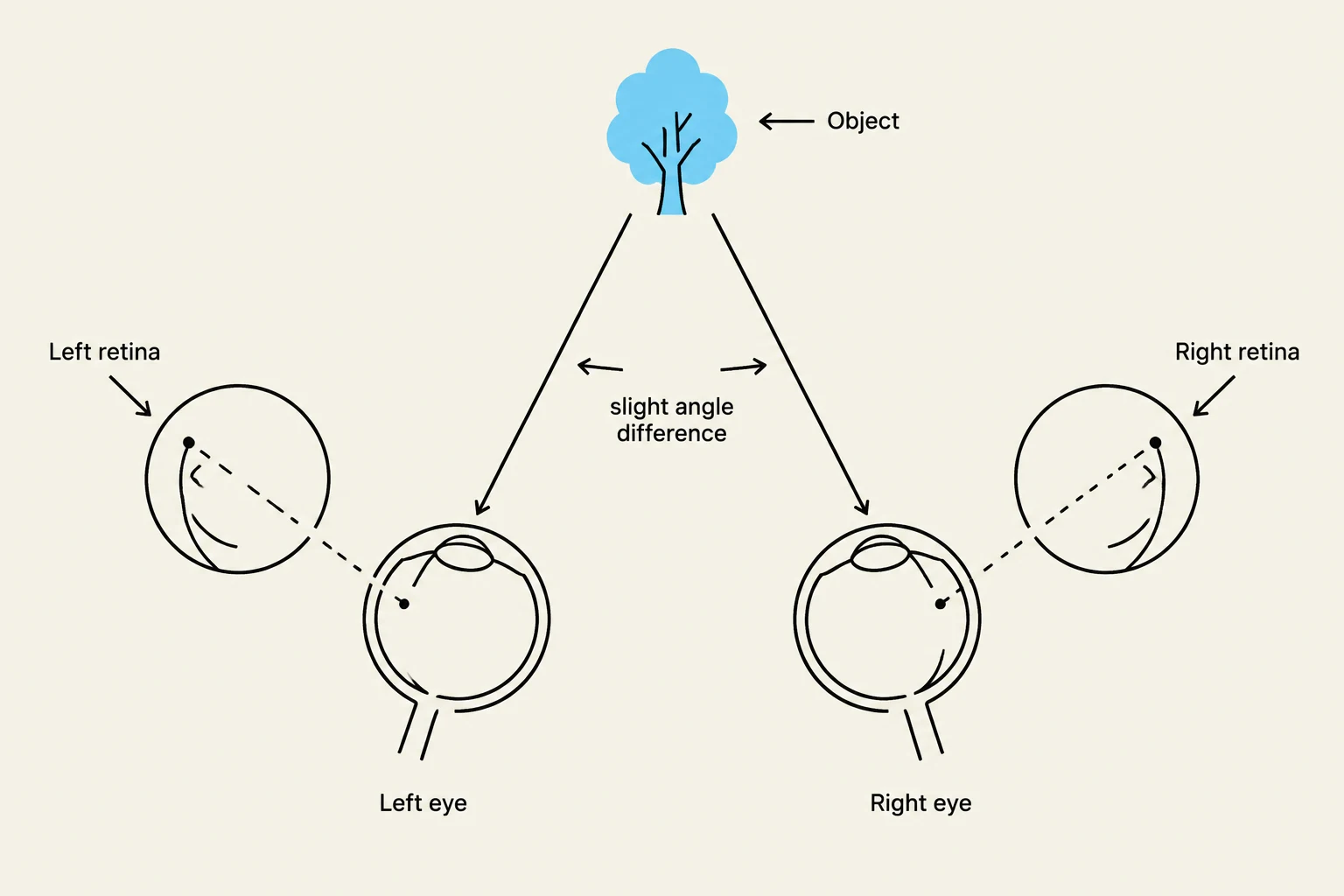
Diagram illustrating how the slight angle difference between the images received by the left and right retinas contributes to depth perception.
The primary binocular cue is retinal disparity (also known as retinal difference). This refers to the difference between the two slightly different images received by the left and right eyes.
The brain calculates the degree of this difference to determine how far away an object is. Generally, the closer an object is to your face, the larger the difference (disparity) between the two images. As an object moves farther away, the disparity decreases.
Try This Experiment: Hold your finger in front of your face. Close your left eye, then switch and close your right eye. You will notice your finger appears to "shift" or jump relative to the background. This shift is the visual manifestation of retinal disparity.
This principle is the foundation of 3D movie technology. 3D systems present slightly different images to each eye through special glasses, allowing the brain to combine them and interpret the differences as depth, creating a convincing three-dimensional experience.
Monocular Cues: Depth with a Single Eye
Even if you close one eye, the world does not suddenly appear completely flat. This is because your brain utilizes monocular cues—visual features that provide depth information even when only one eye is providing input. These cues are often used by artists to create the illusion of depth on a flat canvas.
Interposition (Overlap)
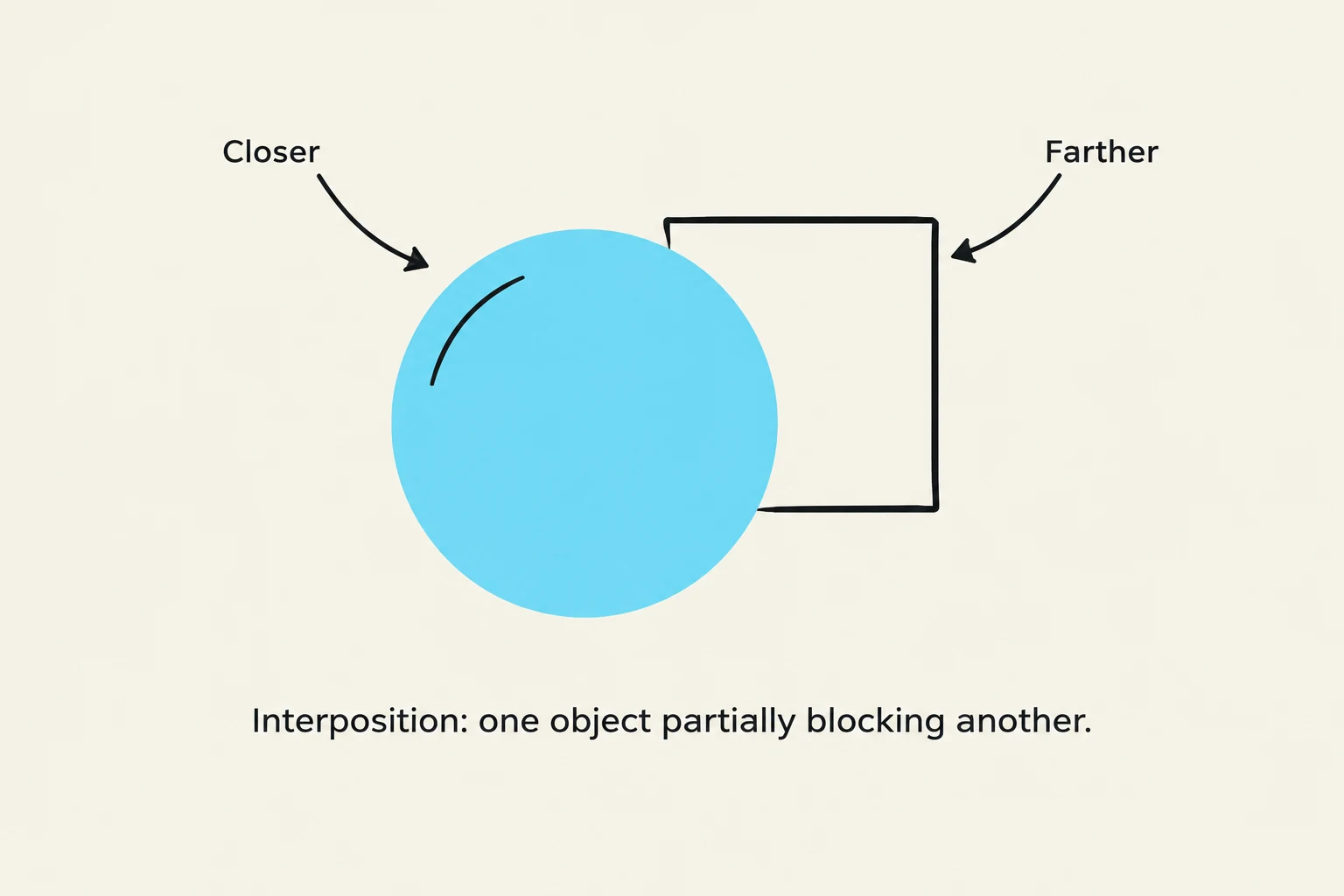
Interposition: one object partially blocking another.
Interposition occurs when one object partially blocks our view of another object. When this happens, the brain follows a simple rule: the object that is doing the blocking is perceived as being closer to the viewer, while the partially hidden object is perceived as being farther away.
Relative Size
This cue is based on our assumption that objects are generally similar in actual size. If we see two objects that we know are the same size (for example, two identical pencils), but one produces a much smaller image on our retina than the other, we perceive the smaller-looking object as being farther away.
Relative Height
Relative height refers to the position of objects within our visual field. Specifically, objects that are positioned higher up in the visual field—especially when viewed along a ground plane like a road—are often perceived as being farther away. For instance, on a long highway, cars near the horizon appear higher in your field of vision than cars right in front of you.
Motion Parallax (Relative Motion)
Motion parallax is a cue that becomes apparent when we are moving. When you move, objects at different distances appear to move at different speeds across your field of vision.
Nearby objects: Appear to rush past very quickly (e.g., trees seen from a moving train).
Distant objects: Appear to move much more slowly (e.g., distant mountains).
Very distant objects: May appear to stay almost stationary.
Linear Perspective
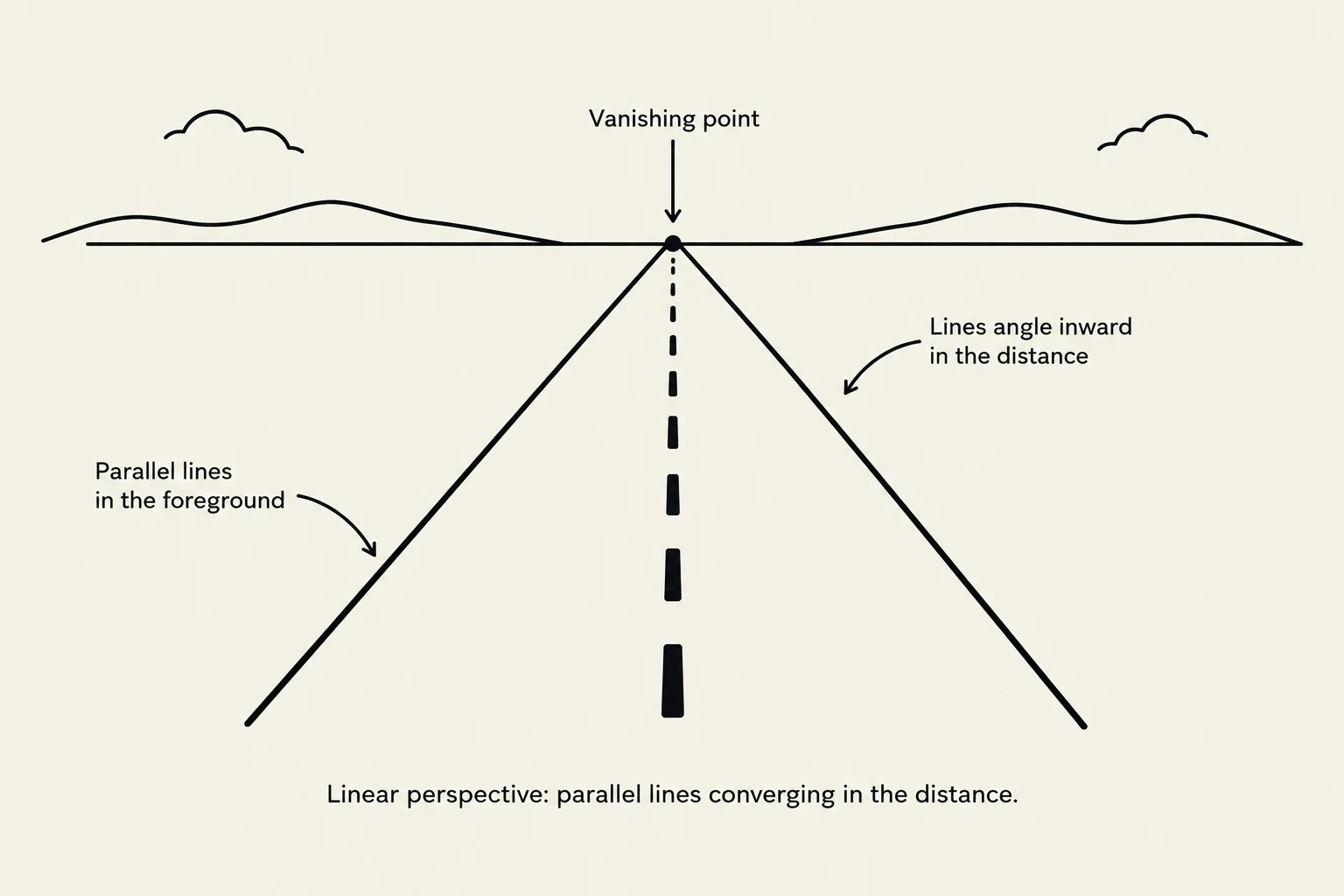
Linear perspective illustration showing parallel lines converging at a vanishing point.
Linear perspective is the phenomenon where parallel lines appear to converge (come together) as they extend into the distance. A classic example is looking down a set of railway tracks; even though the tracks are actually parallel, they appear to meet at a single point on the horizon. The brain interprets this convergence as evidence that the scene extends deep into the distance.
Summary Table of Depth Cues
Cue Type
Name
How it works
Binocular
Retinal Disparity
Uses the difference between images from both eyes.
Monocular
Interposition
One object blocks another; the blocker is closer.
Monocular
Relative Size
Smaller retinal image implies greater distance.
Monocular
Relative Height
Higher objects in the visual field seem farther away.
Monocular
Motion Parallax
Nearby objects move faster than distant ones when you move.
Monocular
Linear Perspective
Parallel lines appear to converge in the distance.
Exam Tip: If a question asks about a cue that requires both eyes, look for "Retinal Disparity." If the question describes a cue that works with one eye (like overlapping objects or converging lines), it is a monocular cue.
Keep reading for free.
Create an account to finish this reading and make it part of your study routine.