


In the study of logic, an argument is considered "good" if it successfully demonstrates that its conclusion is worth accepting. However, not all good arguments work in the same way. Depending on the level of certainty an author intends to convey, arguments are categorized into two primary forms: deductive and inductive. Understanding the distinction between these two is the first step in evaluating whether a claim is logically sound or merely probable.
The Anatomy of an Argument
Before diving into the types of reasoning, we must understand the basic building blocks of any argument. Every argument consists of premises and a conclusion.
- Premises: The statements offered as evidence or reasons to support a claim.
- Conclusion: The main claim that the premises are intended to support.
When analyzing an argument, you must first identify these components. You can often find them by looking for "indicator words." For example, words like "because" or "since" often introduce premises, while words like "therefore" or "so" often introduce conclusions.
Deductive Reasoning: The Quest for Certainty
Deductive arguments are designed to provide logically conclusive support for their conclusions. The goal of a deductive argument is to use rigorous, inescapable logic to prove that if the premises are true, the conclusion must be true.
Validity and Truth-Preservation
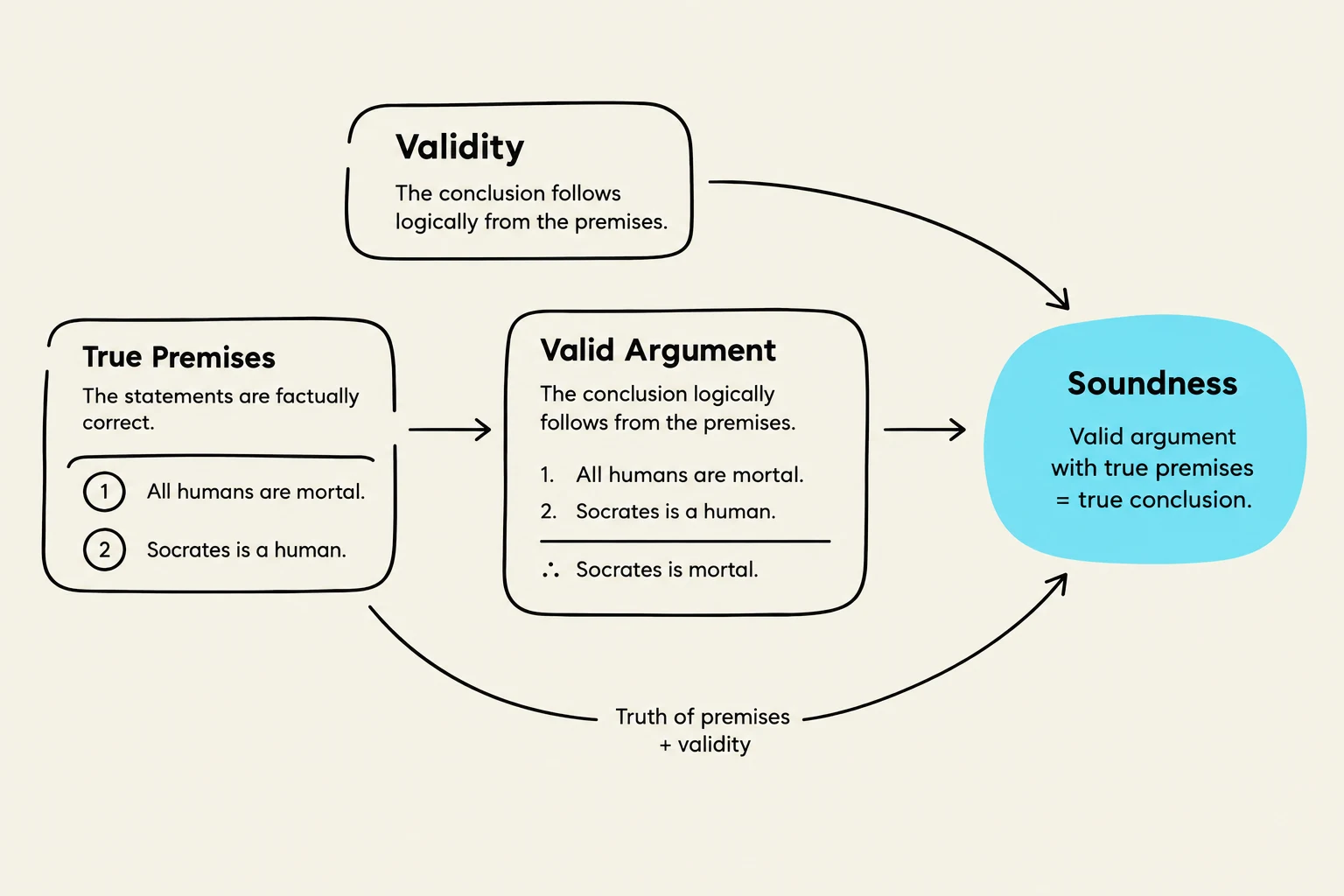
In logic, we use the term validity to describe the structural strength of a deductive argument. A valid argument is "truth-preserving". This means the logical form is so tight that it is impossible for the premises to be true while the conclusion is false.
Keep reading for free.
Create an account to finish this reading and make it part of your study routine.
Continue reading freeAlready have an account? Log in
Updated