


Understanding how the human body moves requires a specialized vocabulary. Movement is not random; it is a series of precise, directional actions that describe how body parts move relative to the body's midline or its anatomical position. Whether you are performing a simple task like grasping a pen or a complex athletic maneuver, your joints are executing specific types of movements categorized by their planes and axes.
Angular Movements: Flexion and Extension
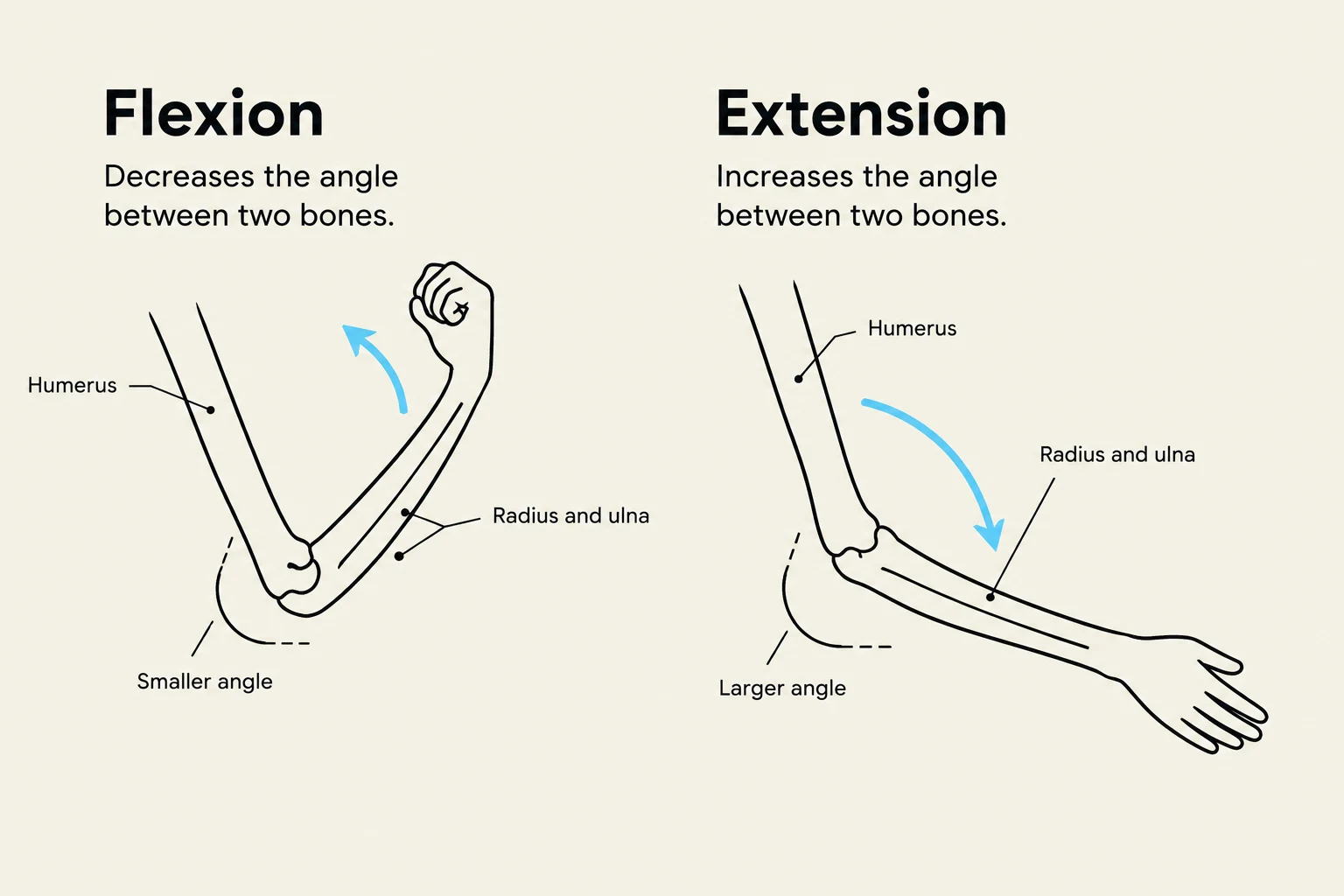
The most fundamental way we describe movement is through the change in the angle between two bones at a joint.
- Flexion: This movement decreases the angle between the bones of a joint. For example, bending your elbow to bring your hand toward your shoulder is a flexion movement.
- Extension: This is the opposite of flexion; it increases the angle between the bones. Straightening your arm back out is an extension.
Exam Tip: Remember that these movements are often paired. If a question asks about the movement that "increases the joint angle," they are looking for the term extension.
Lateral and Medial Movements: Abduction and Adduction
When moving limbs away from or toward the center of the body, we use the terms abduction and adduction. These movements are commonly observed in condyloid, saddle, and ball-and-socket joints.
- Abduction: Moving a limb laterally, away from the body's centerline.
- Adduction: Moving a limb toward the midline of the body.
Keep reading for free.
Create an account to finish this reading and make it part of your study routine.
Continue reading freeAlready have an account? Log in
Updated