


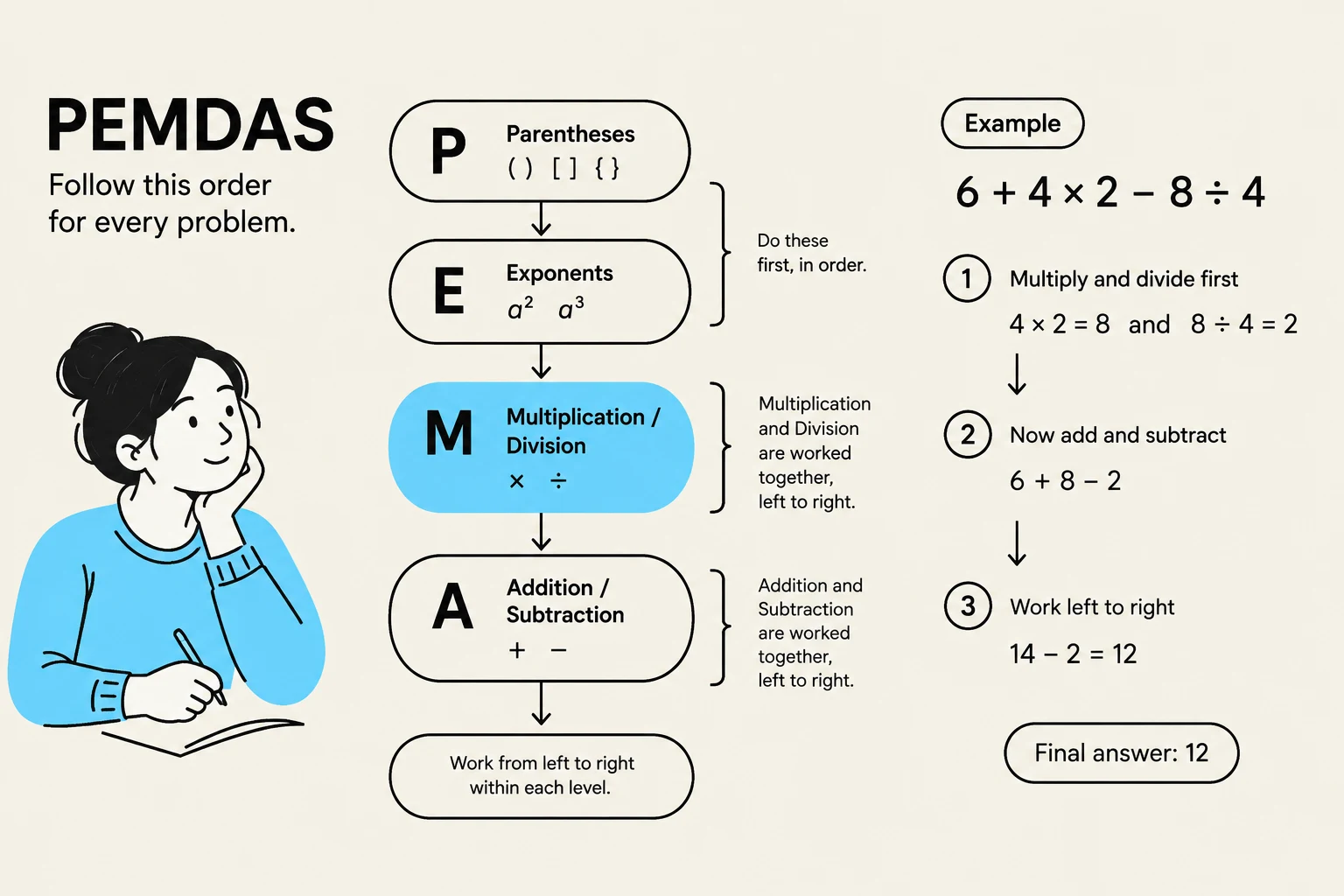
In the healthcare profession, mathematical precision is not just an academic requirement; it is a fundamental component of patient safety. Whether you are calculating medication dosages, monitoring fluid intake, or interpreting lab results, the ability to apply basic arithmetic accurately is essential. Mastering the four primary operations—addition, subtraction, multiplication, and division—alongside the correct order of operations, provides the mathematical foundation necessary for safe and effective clinical practice.
Addition and Subtraction
Addition and subtraction are the most frequent operations used in clinical settings, such as calculating total intake or determining the difference in a patient's weight over time.
Addition
Addition is the process of combining multiple quantities into a single sum. To prevent errors, it is vital to align place values vertically. This means ensuring that ones are under ones, tens under tens, and hundreds under hundreds. When the sum of a specific column exceeds nine, you must "carry" the value over to the next highest place value.
For example, in the calculation :
- Ones: (write , carry )
- Tens: (write , carry )
- Hundreds: The final answer is .
Subtraction
Subtraction determines the difference between two numbers. A common challenge occurs when a digit in the top number (the minuend) is smaller than the digit directly below it. In these instances, you must perform regrouping, also known as "borrowing," from the next highest place value.
Clinical Tip: The Verification Method To ensure your subtraction is accurate, perform the inverse operation. Add your answer to the number you subtracted; if the sum equals your original starting number, your calculation is correct.

Keep reading for free.
Create an account to finish this reading and make it part of your study routine.
Continue reading freeAlready have an account? Log in
Updated