Balancing Chemical Equations: A Step-by-Step Guide
Learn the fundamental principles of balancing chemical equations, including the Law of Conservation of Mass, the anatomy of a chemical equation, and a systematic approach to balancing, with practical examples and common pitfalls to avoid.
Have you ever wondered why a chemist doesn't just throw random amounts of ingredients into a beaker and hope for the best? In chemistry, precision is everything. When a chemical reaction occurs, atoms aren't created out of thin air, nor do they simply vanish into nothingness. They are rearranged to form new substances. To represent this accurately in writing, we use balanced chemical equations. This process ensures that our mathematical models reflect the physical reality of the universe.
The Foundation: The Law of Conservation of Mass
At the heart of balancing equations lies a fundamental principle of physics known as the Law of Conservation of Mass. This law states that in a closed system, mass is neither created nor destroyed during a chemical reaction.
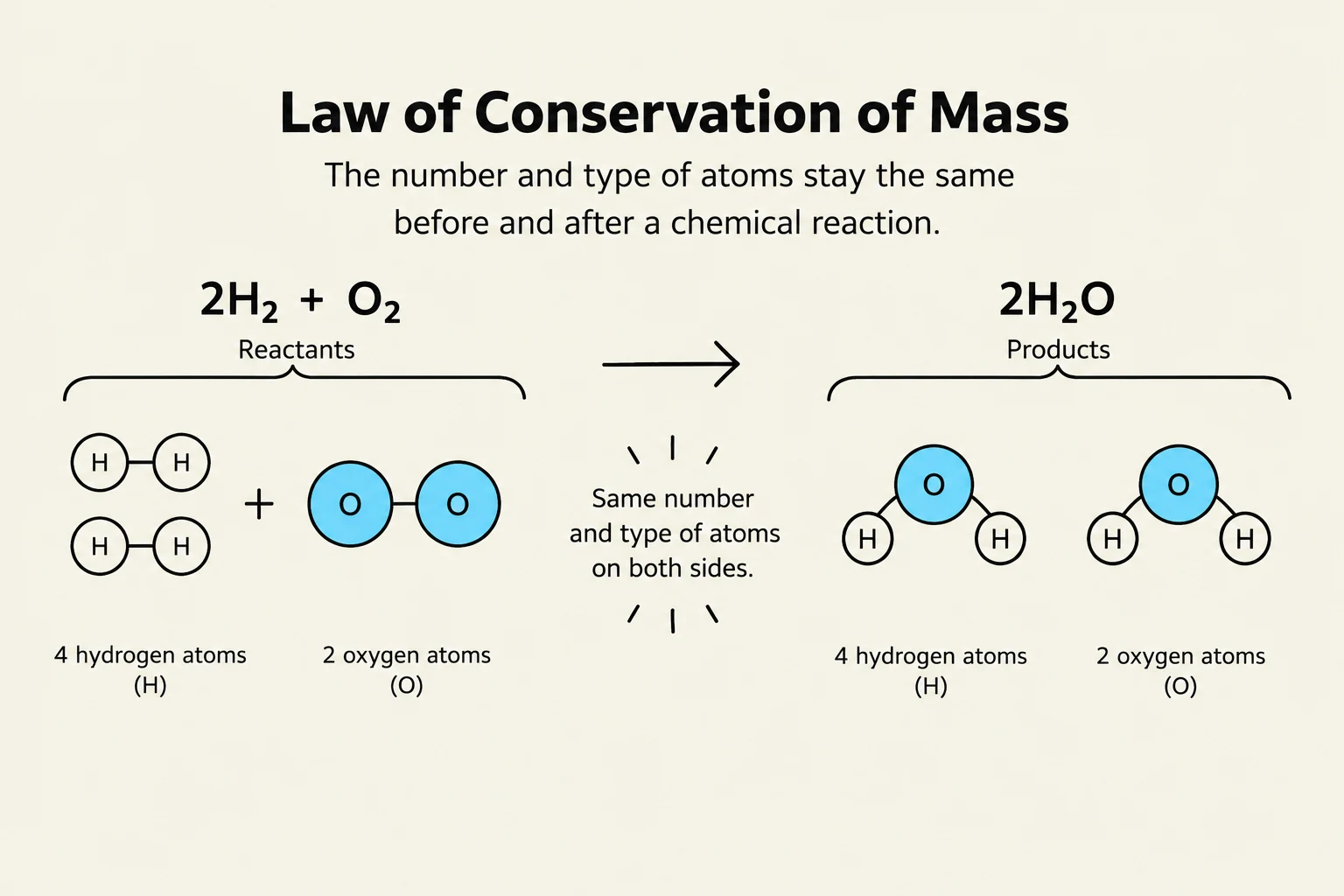
In the context of a chemical equation, this means that the total mass of the reactants (the starting materials) must equal the total mass of the products (the substances formed). More specifically, the number of atoms of each element must be exactly the same on both sides of the equation. If you start with four atoms of hydrogen, you must end with four atoms of hydrogen, even if they are now part of a different molecule.
Key Concept: Think of a chemical equation like a recipe. If you use two eggs to make a cake, you can't suddenly end up with three eggs in the finished product. The "atoms" must balance out!
The law of conservation of mass states that the number and type of atoms remain constant before and after a chemical reaction, as illustrated by the formation of water from hydrogen and oxygen.
Anatomy of a Chemical Equation
Before we can balance an equation, we must understand its components. A standard chemical equation consists of several parts:
Reactants: The substances written on the left side of the arrow.
Products: The substances written on the right side of the arrow.
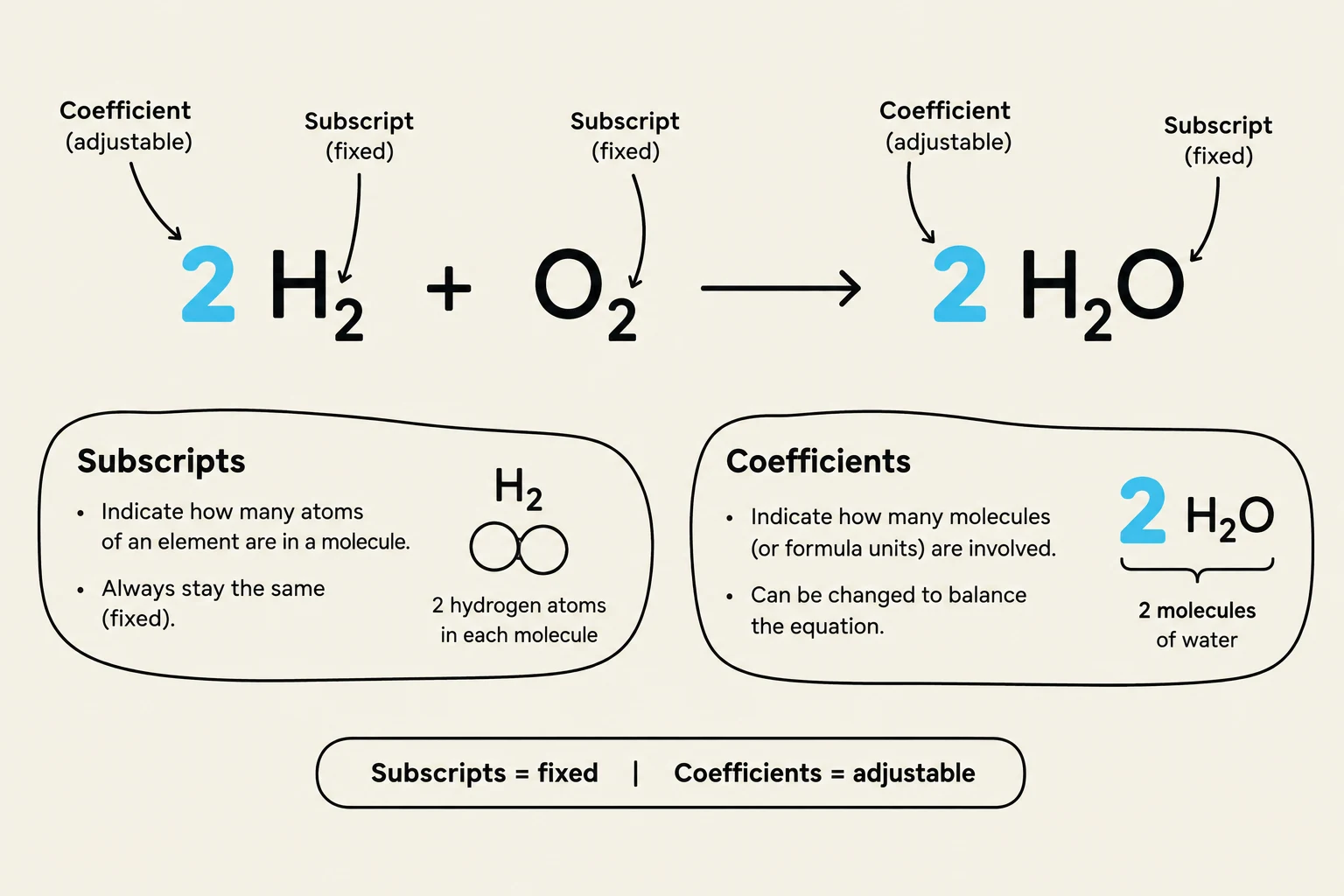
Subscripts: The small numbers written below the line (e.g., the 2 in H2O). These indicate how many atoms of an element are in a single molecule. Crucially, you cannot change these when balancing!
Coefficients: The large numbers placed in front of chemical formulas (e.g., the 2 in 2H2O). These are the only numbers you are allowed to change to balance the equation.
Let's look at an unbalanced equation for the formation of water:
H2+O2→H2O
In this unbalanced state, we have 2 hydrogen atoms and 2 oxygen atoms on the left, but only 2 hydrogen atoms and 1 oxygen atom on the right. This violates the Law of Conservation of Mass.
This illustration explains the difference between coefficients and subscripts in a chemical equation, using the reaction of hydrogen and oxygen to form water as an example. Coefficients, shown in blue, indicate the number of molecules involved and can be adjusted to balance the equation. Subscripts, shown in black, indicate the number of atoms of an element within a molecule and are fixed.
Step-by-Step: How to Balance Equations
Balancing is a trial-and-error process, but following a systematic approach makes it much easier. Here is a reliable strategy:
1. Take an Inventory
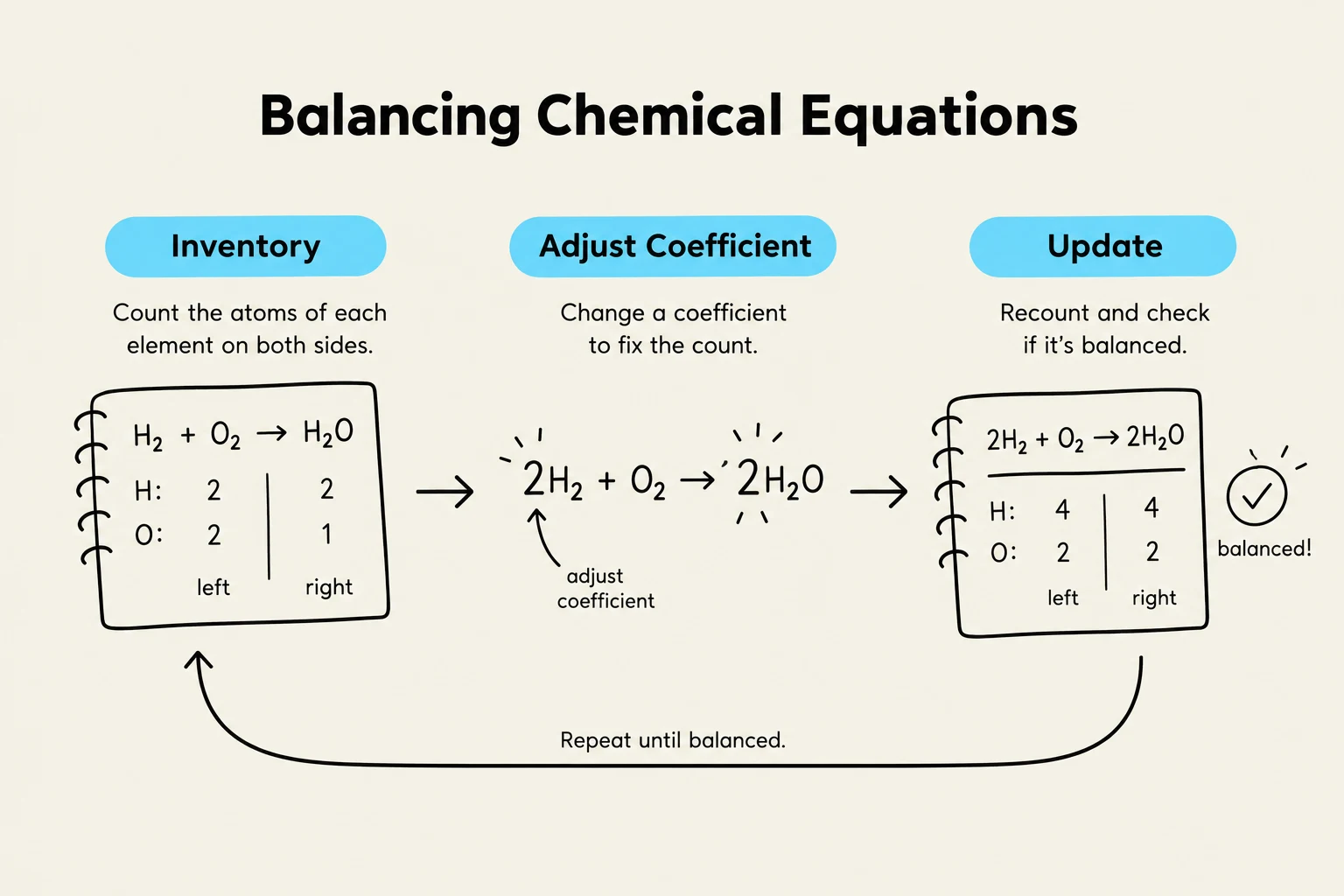
Start by counting how many atoms of each element are present on both the reactant side and the product side.
2. Balance Elements One by One
A good rule of thumb is to balance elements that appear in only one reactant and one product first. Leave elements like Oxygen or Hydrogen for last, as they often appear in multiple compounds and might balance themselves out as you work on others.
3. Use Coefficients to Adjust
If you have 2 oxygens on the left and 1 on the right, place a coefficient of 2 in front of the product containing oxygen.
4. Re-evaluate and Repeat
Every time you add a coefficient, it changes the count for every element in that molecule. You must go back to your inventory and update your numbers.
Exam Tip: Always check your final answer! Once you think you are finished, do a final count of every single atom on both sides to ensure they match perfectly.
Worked Example: The Combustion of Methane
Let's apply these steps to the combustion of methane (CH4). The unbalanced equation is:
CH4+O2→CO2+H2O
Step 1: Initial Inventory
Reactants: $C = 1, H = 4, O = 2$
Products: $C = 1, H = 2, O = 3$ (2 from $CO_2$and 1 from$H_2O$)
Step 2: Balance Carbon
Carbon is already balanced (1 on each side).
Step 3: Balance Hydrogen
We have 4 hydrogens on the left and 2 on the right. To fix this, we place a coefficient of 2 in front of H2O:
CH4+O2→CO2+2H2O
Step 4: Update Inventory
Reactants: $C = 1, H = 4, O = 2$
Products: $C = 1, H = 4, O = 4$ (2 from $CO_2$and 2 from$2H_2O$)
Step 5: Balance Oxygen
Now we have 2 oxygens on the left and 4 on the right. We need to place a coefficient of 2 in front of O2 on the reactant side:
CH4+2O2→CO2+2H2O
Final Check:
Left side: $C=1, H=4, O=4$
Right side: $C=1, H=4, O=4$
The equation is now balanced!
This diagram illustrates the process of balancing chemical equations, involving inventorying atoms, adjusting coefficients, and updating counts until the equation is balanced.
Common Pitfalls to Avoid
Changing Subscripts: This is the most common mistake. If you change H2O to H2O2 to balance oxygen, you have changed the substance from water to hydrogen peroxide. You have changed the chemistry, not just the amount!
Forgetting to Multiply: When you add a coefficient, it multiplies everything in that molecule. For example, $2Ca(OH)_2$ means you have 2 Calcium atoms, 4 Oxygen atoms, and 4 Hydrogen atoms.
Ignoring Polyatomic Ions: If a polyatomic ion (like SO42−) appears unchanged on both sides of the equation, treat it as a single unit to simplify your counting.
By mastering these steps, you ensure that your chemical equations are not just mathematical exercises, but accurate representations of the physical world.
Keep reading for free.
Create an account to finish this reading and make it part of your study routine.