Bacterial Genetics: Genomes, Plasmids, and DNA Replication
Explore the fundamental aspects of bacterial genetics, including the structure and organization of bacterial genomes, the role of plasmids in evolution and biotechnology, and the intricate regulation of DNA replication.
In the study of microbiology, understanding how genetic information is stored, organized, and passed on is fundamental. While all living organisms rely on DNA, the way bacteria manage their genetic material is strikingly different from that of eukaryotes. By examining the bacterial genome, the role of extrachromosomal elements like plasmids, and the precise regulation of DNA replication, we can uncover how these organisms thrive in diverse and often hostile environments.
The Bacterial Genome
The genome is defined as the complete DNA sequence of a cell, representing the sum total of all its genes. While the concept of a genome is universal, its scale and organization vary significantly between domains of life.
Bacterial genomes are typically circular, whereas eukaryotic genomes are linear. One of the most striking differences is the size and density of the genetic information. A bacterial genome generally ranges from 0.6 to 9.4 million base pairs (Mb). To put this in perspective, the human genome is approximately 3 billion base pairs—roughly $1,000$ times larger than that of E. coli.
Furthermore, bacterial genomes are highly efficient. In bacteria and archaea, only about $15%$ of the genome consists of non-coding DNA. This contrasts sharply with eukaryotes, where over $90%$ of the genome can be non-coding. In bacteria, the vast majority of the DNA is dedicated to active genetic instructions, with non-coding regions primarily serving regulatory roles, such as promoters.
Exam Tip: If asked to compare bacterial and eukaryotic genomes, remember two key distinctions: bacteria have circular DNA and much higher gene density (less non-coding DNA) compared to eukaryotes.
Plasmids: The Evolutionary "Bonus" Pack
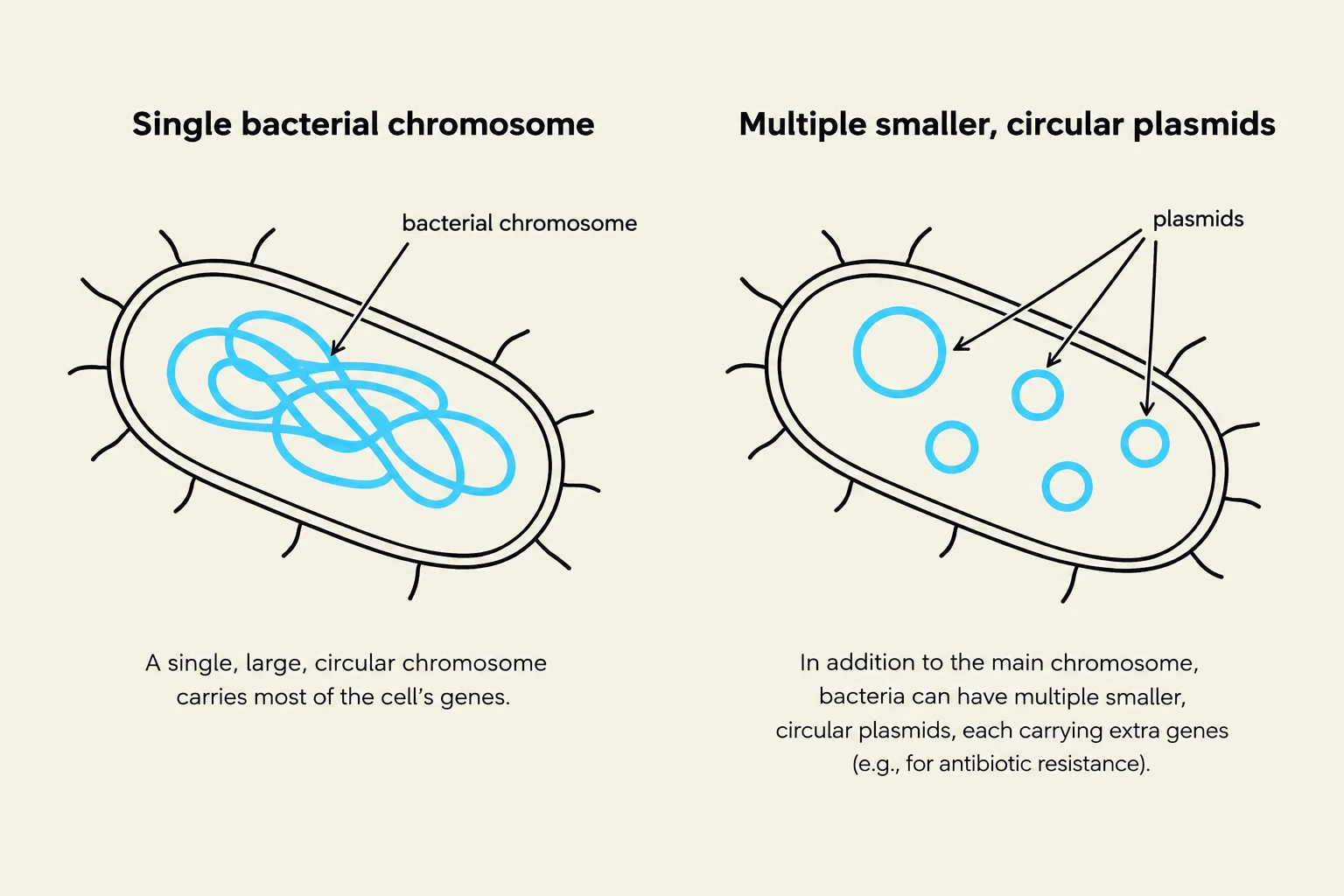
While the chromosome contains the essential genes for life, many bacteria possess additional, smaller pieces of extrachromosomal DNA known as plasmids. Plasmids are not required for basic survival under standard conditions, but they provide significant evolutionary advantages in specific environments.
Plasmids can carry genes that confer:
Antibiotic resistance: Allowing survival in the presence of drugs.
Metal resistance: Protection against toxic heavy metals.
Metabolic capabilities: The ability to utilize rare or unusual food sources.
Virulence: Factors that allow the bacteria to cause disease (pathogenesis).
Symbiosis: Genes that help the bacteria live in partnership with a host.
In biotechnology, scientists exploit these properties to use plasmids for DNA amplification, complementation, and the over-expression of specific proteins.
Plasmid Copy Number
Plasmids are categorized based on how many copies exist within a single cell:
Low-copy-number plasmids: These exist in only one or two copies per cell and segregate to daughter cells in a manner similar to the main chromosome.
High-copy-number plasmids: These can reach up to 50 copies per cell (and even >100 in laboratory settings). Because they are so numerous, they divide continuously and segregate randomly to daughter cells during division.
Diagrams illustrating a single bacterial chromosome and multiple smaller, circular plasmids within bacteria.
DNA Supercoiling
Because the bacterial chromosome is a large circular molecule, it must be tightly packed to fit inside the small confines of the bacterial cell. To achieve this compaction, the DNA undergoes a process called DNA supercoiling. Think of this like twisting a rubber band; as you add twists, the band coils upon itself, occupying much less space.
Bacterial DNA Replication and Regulation
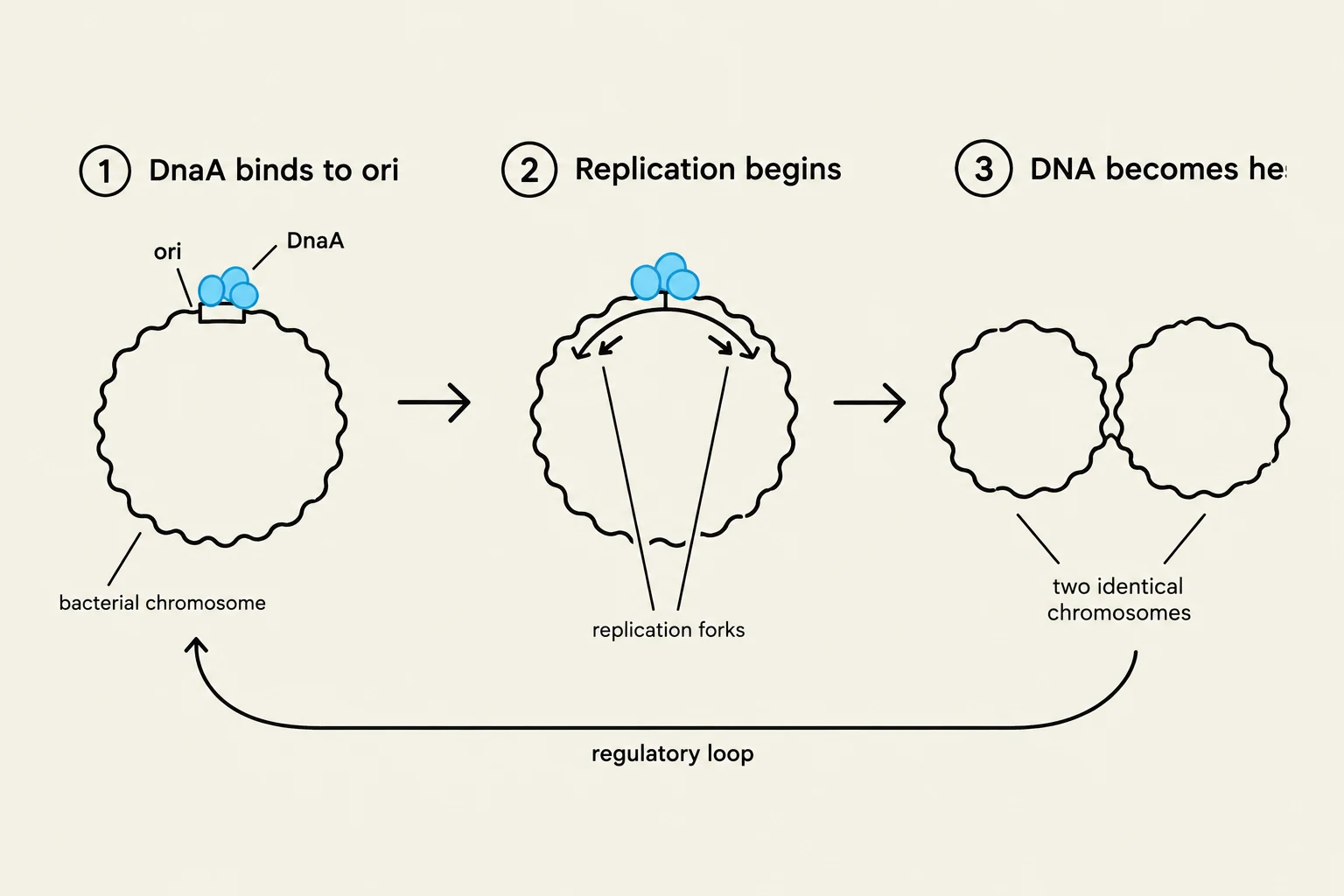
DNA replication is the mechanism by which a cell duplicates its genetic material. This process results in two double helices, each consisting of one original (parental) strand and one newly synthesized strand.
For a cell to divide successfully, replication must be perfectly timed. The cell must ensure it has grown sufficiently and has enough resources before it commits to duplicating its entire genome. This timing is regulated at a specific site called the origin of replication (ori).
The Players: DnaA and SeqA
The initiation and inhibition of replication are controlled by the interaction of specific proteins:
DnaA: This protein acts as the "activator." When DnaA binds to the ori, it provides the necessary access for the replication machinery to begin copying the DNA.
SeqA: This protein acts as the "inhibitor." Its job is to prevent "ill-timed" initiation, ensuring the cell doesn't start a new round of replication before it is ready.
The Role of DNA Methylation
The "switch" that allows SeqA to inhibit replication is a chemical modification called DNA methylation.
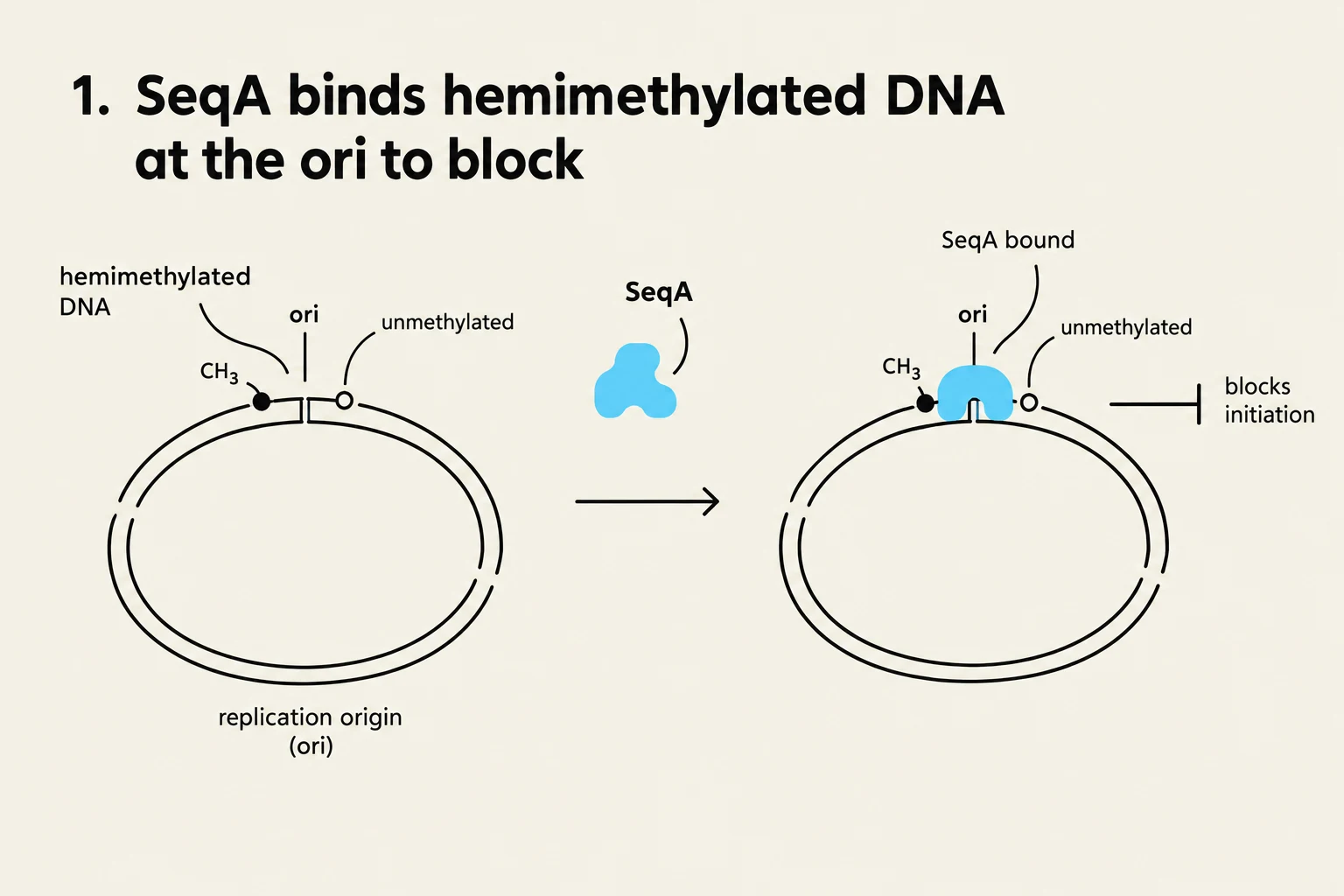
In bacteria, DNA is methylated (the addition of a −CH3 group) to mark it as "mature." Immediately after the replication machinery passes through the ori, the newly synthesized strand is not yet methylated. This creates a state known as hemimethylation, where only the parental strand has the methyl groups.
SeqA specifically recognizes this hemimethylated state. It binds to the ori, physically blocking DnaA from binding and starting another round of replication. Only after the cell has had sufficient time to methylate the new strand will SeqA dissociate, leaving the ori open for DnaA to initiate the next cycle when the cell is ready to divide.
Diagram illustrating how SeqA protein binds to hemimethylated DNA at the replication origin (ori) to block initiation.
Summary Table: Replication Regulation
Protein
Function
Interaction with DNA
DnaA
Activates replication
Binds to ori to start the process
SeqA
Inhibits replication
Binds to hemimethylated ori to block DnaA
Diagram illustrating the process of bacterial DNA replication, showing DnaA binding to the origin of replication, the initiation of replication forks, and the formation of two identical chromosomes.
Keep reading for free.
Create an account to finish this reading and make it part of your study routine.